


In September, OpenAI announced that some 10,000 AI agents partially 'solved' the Navier–Stokes problem, one of the most prestigious open challenges in mathematics. University of Vienna mathematicians Nathanaël Berestycki and Vera Fischer agree that the field will never be the same, but argue that maths is far more than producing proofs at speed.
Mathematicians are grappling with the possibility that AI might eclipse them
I talked to 20 mathematicians about rapid AI progress in their field.
AI Has Solved One of Math’s $1 Million Millennium Prize Problems | Quanta Magazine
Mathematicians at OpenAI showed that the Navier-Stokes equations, which describe how fluids flow, can sometimes “blow up.” But the massive result is not without controversy.

Is AI the End of Math As We Know It? | Quanta Magazine
Mathematicians are facing the sudden shift with grief, anger, and a desperate search for fresh ideas: “If we don’t adapt, there’s just no more math in 50 years.”
MATHEMATICS + AI
An open letter on human–AI collaboration in mathematics The recent progress of artificial intelligence in mathematics opens up new possibilities for discovery, proof, and understanding. We are optimistic that AI systems will expand the human understanding of mathematics, and we encourage
Mathematics in the age of AI
An essay, based on a public lecture delivered at the 2026 International Congress of Mathematicians, on how the mathematical community might respond to the arrival of artificial intelligence tools that are capable of performing research-level mathematical tasks. Rather than debating the capabilities of such tools, we condition on the hypothesis that these capabilities will arrive, and examine instead a question that is orthogonal to it: what the goals and values of mathematical research actually are. The problem-solving component of mathematics is used as a case study.

AI Just Cracked the Hardest Problem in Mathematics. It Will Change Everything
The Riemann Hypothesis has fallen
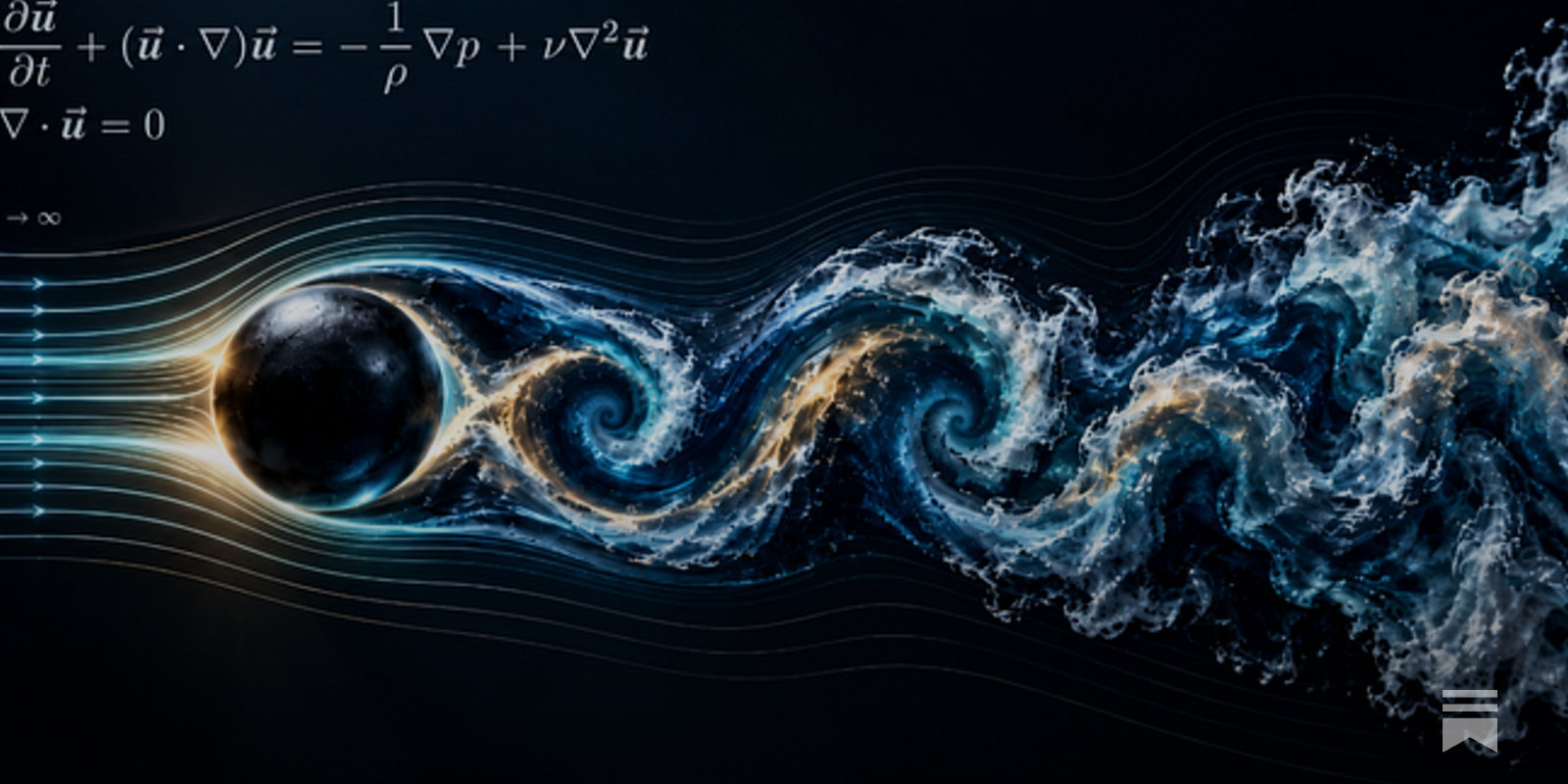
No, AI hasn’t officially solved Navier–Stokes. Yet
PropAIganda, now with a Millennium Prize Problem
No. 020: Astra solves ten open math problems, AI agents fail at open-ended research, peer review under strain - The Hallway Track
The Hallway Track No. 020 - How AI is affecting the practice of science
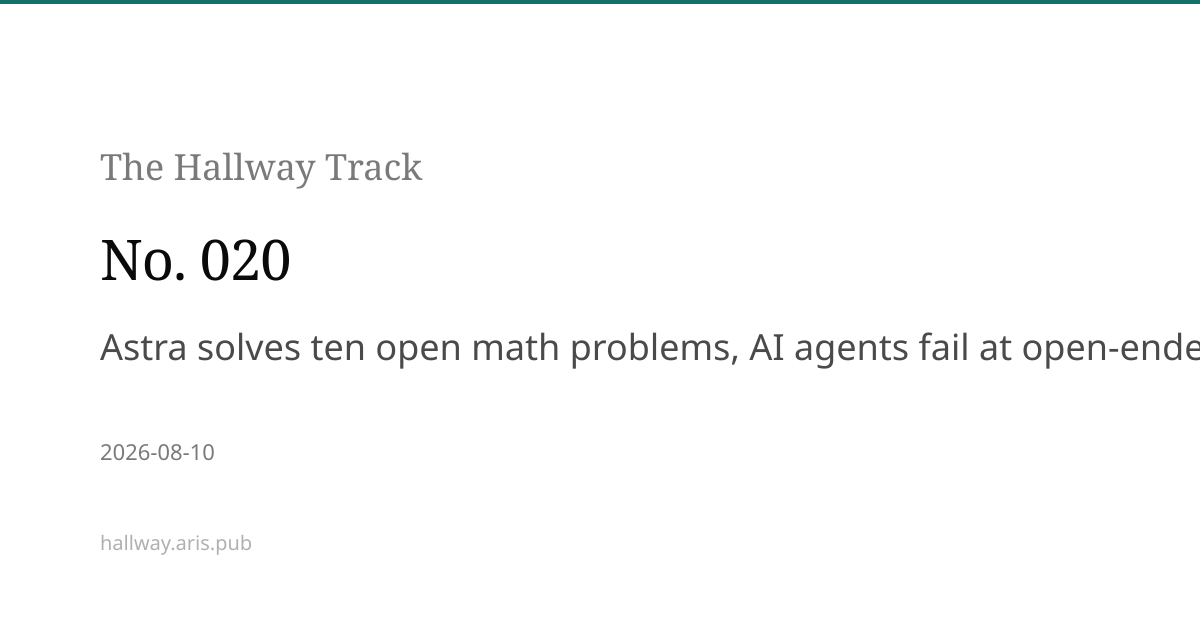
The fall of the theorem economy
How AI could destroy mathematics and barely touch it
The fall of the theorem economy
How AI could destroy mathematics and barely touch it
AI co-mathematician: Accelerating mathematicians with agentic AI
We introduce the AI co-mathematician, a workbench for mathematicians to interactively leverage AI agents to pursue open-ended research. The AI co-mathematician is optimized to provide holistic support for the exploratory and iterative reality of mathematical workflows, including ideation, literature search, computational exploration, theorem proving and theory building. By providing an asynchronous, stateful workspace that manages uncertainty, refines user intent, tracks failed hypotheses, and outputs native mathematical artifacts, the system mirrors human collaborative workflows. In early tests, the AI co-mathematician helped researchers solve open problems, identify new research directions, and uncover overlooked literature references. Besides demonstrating a highly interactive paradigm for AI-assisted mathematical discovery, the AI co-mathematician also achieves state of the art results on hard problem-solving benchmarks, including scoring 48% on FrontierMath Tier 4, a new high score among all AI systems evaluated.
Ale×ey on Twitter / X
Funniest possible outcome of new ai math proofs publications would be that explosive progress cannot be delivered through individual genius and singular products but only through contextualized human understanding and embedding of knowledge.— Ale×ey (@EqualParallel) October 7, 2026
I’ll write romance novels if AI solves all maths, Chinese Fields winner jokes
As AI models prove they can push the boundaries, mathematicians are grappling with the threat that they could become obsolete.

The AI Revolution in Math Has Arrived | Quanta Magazine
AI is being used to prove new results at a rapid pace. Mathematicians think this is just the beginning.
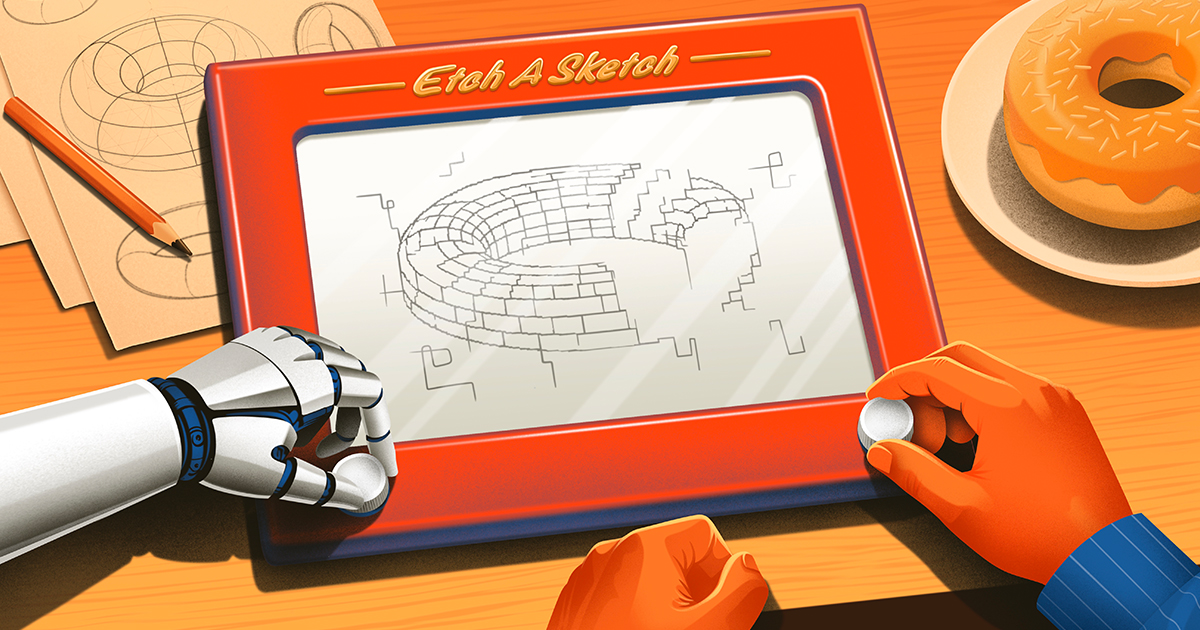
OpenAI’s math breakthrough played to AI’s strengths
I tried to explain OpenAI’s solution more clearly than OpenAI did.
OpenAI solves Navier–Stokes, but research misconduct concerns remain | Olga Holtz posted on the topic | LinkedIn
OpenAI says its AI has solved a Millennium Prize Problem: Navier–Stokes. A human mathematician asks whether OpenAI committed research misconduct. As a mathematician working at the intersection of mathematics and AI, I find this truly messy while also potentially historic. Three things deserve attention. 1. The fine print IS the mathematics. The claimed construction starts with a three-dimensional incompressible fluid at rest. Under a smooth external force, its velocity becomes unbounded in finite time, even while its kinetic energy stays bounded. Crucially, the force itself remains smooth through the singularity. Forcing is explicitly permitted in Clay’s official breakdown alternatives C and D. Its presence does not disqualify the result. But this construction does not establish blow-up for unforced Navier–Stokes. That distinction matters. 2. This was a research system, not one clever prompt. OpenAI reports roughly 10,000 concurrent agents in the successful group and a result after about 88 hours. The Navier–Stokes effort used approximately 130 billion output tokens; Lean formalization and verification took another 17 hours. Human researchers redirected the effort and used tools to consolidate intermediate insights. The salient part here, as I already wrote earlier, is a new organization of mathematical discovery using an enormous amount of compute, not a faster chatbot. The published Lean formalization is important: there is something concrete for others to check. Let‘s see independent scrutiny of both the proof and whether the formal statement matches the intended theorem. 3. Proof verification is not provenance verification. The result follows the line of attack designed by Spanish mathematicians Diego Córdoba and Luis Martínez Zoroa, who appeared to be close to solving the problem themselves. Tristan Buckmaster has raised concerns about research priority and possible use of private Codex material (his statement is linked to the comment by Guillermo Núñez Ponasso below). Those concerns are not automatic proof of misconduct, yet: OpenAI recognizes Buckmaster and Levent Alpöge’s priority on forced Euler, a related but different problem. It denies accessing their unpublished work. But it also cannot rule out de-identified data from their OpenAI product usage helping improve its models, though it calls that unlikely. Is it though? That ‚leakage’ is quite possible, in my view. If correct, this is an extraordinary result. Let’s get independent verification. And let’s protect unpublished research — but exactly how to protect it from an AI lab if using its tools for this research? Recall that a verified theorem can settle a mathematical question. It cannot, by itself, settle scientific credit or establish that the discovery process was fair. Are you comfortable using an AI lab’s tools when that lab could also become your research competitor? https://lnkd.in/g4HzzUNp #AI #Mathematics #AIforScience #MillenniumProblems #NavierStokes | 54 comments on LinkedIn
