


Sharing out the best meta-thinking tools I’ve learned this year
Tools for better thinking
Collection of thinking tools and frameworks to help you solve problems, make decisions and understand systems.
Stop learning frameworks
We are developers. We need to stay up to date with technology. Every day, we learn programming languages, frameworks, and libraries. The more modern tools we know — the better. Keeping up to date with Angular, React, Vue, Riot, Ember, Knockout is fun. But we are wasting our time.

Ink & Switch
An independent research lab exploring the future of tools for thought.

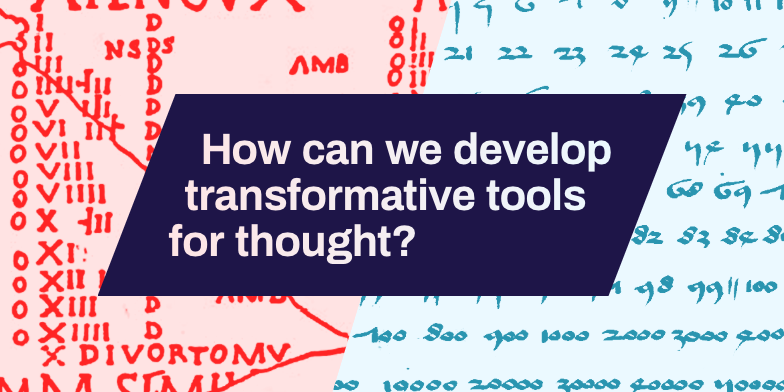
Thinking with Sand: A Talk Series Exploring New Software Tools for Creative Exploration and Augmented Thinking At the MIT Media Lab
progression.fyi
A collection of open source frameworks for helping designers and engineers to grow at work
How to Research Tools for Thought
Early Tools for Thought, Mark Bernstein @ Tools For Thought Rocks
Do Frameworks Matter Anymore?
I'm not trying to be facetious. I want to really want consider whether or not, in 2026, in the age of vibe coding, agentic programming, loop or graph or whatever diagrammatic metaphor-based engineering is most popular, does it matters what web framework you use? More importantly (to me and my particular interests), and at the risk of Betteridge-ing myself: should we make new frameworks?
What is a framework? Understanding their purpose, value, development and use
Many frameworks exist across the sciences and science-policy interface, but it is not always clear how they are developed or can be applied. It is also often vague how new or existing frameworks are positioned in a theory of science to advance a specific theory or paradigm. This article examines these questions and positions the role of frameworks as integral but often vague scientific tools, highlighting benefits and critiques. While frameworks can be useful for synthesizing and communicating core concepts in a field, they often lack transparency in how they were developed and how they can be applied. Positioning frameworks within a theory of science can aid in knowing the purpose and value of framework use. This article provides a meta-framework for visualizing and engaging the four mediating processes for framework development and application: (1) empirical generalization, (2) theoretical fitting, (3) application, and (4) hypothesizing. Guiding points for scholars and policymakers using or developing frameworks in their research are provided in closing.

The Mind-Expanding Ideas of Andy Clark
The tools we use to help us think—from language to smartphones—may be part of thought itself.

Sebastian Raschka on Twitter / X
Pretty cool. I think 2025-2026 will be a stronger focus on these in open source tooling.I.e. having LLMs delegate knowledge-based queries to search, which in turn frees up model capacity to improve reasoning capabilities and tool use. https://t.co/wNTg283mb2— Sebastian Raschka (@rasbt) August 12, 2025
Intrigued by @semble.so as a potential research tool for creatives as well as encouraging deeper thinking, making connections between ideas. For me, I can see using it alongside @obsidian.md (which I use similarly, but for my private use). Also love how responsive the developers are to questions.
⚡ Metaventory: building better science ⚡ Had many discussions about the need for mapping out all that's meta-science: people, tools, events, jobs, simulations, etc. in one place. Metaventory aims to help connect those interested in meta-science & improving science. metaventory.vercel.app

