


How AI is destroying the life of the mind.
The Age of Wonders and Terrors
Twenty years ago, when the idea of AI taking over the world in our lifetimes still struck most of us as the unconstrained fantasy of those who knew too much science fiction and too little science, …

AI overuse could spark "brain fry," new research finds
The mental strain associated with AI carries "significant costs," researchers find.

233. "The Illusion of Thinking" — Thoughts on This Important Paper
This is a fantastic paper. I just love it. tl;dr AI is not human. Anthropomorphization has been bad for AI, LLMs, and Chat. Clippy walked so today's AI could run.
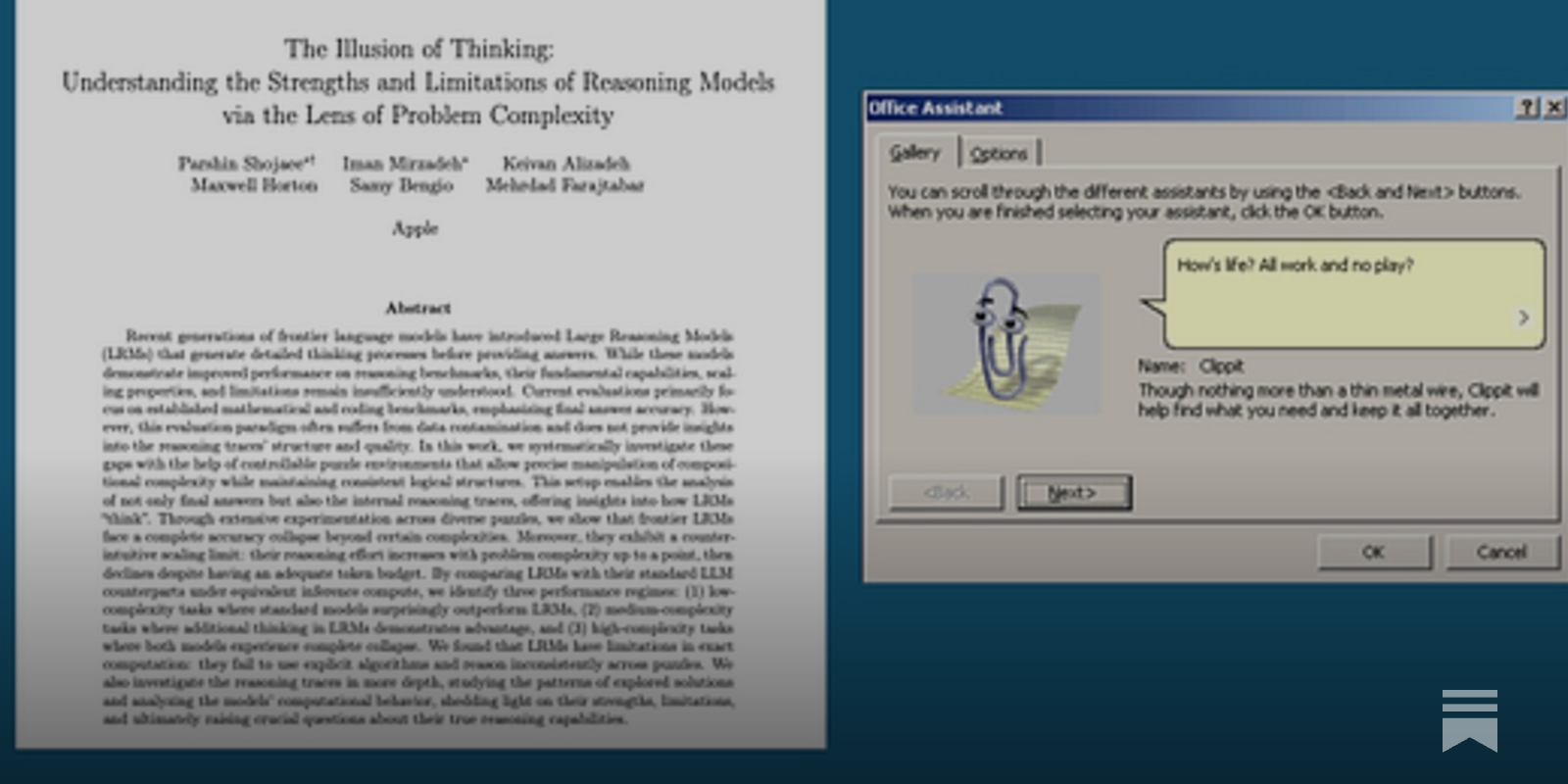
AI is not superhuman
What metaphor should drive the field of AI research?

What the Studies Say About How AI Affects Your Brain: A (Very Big) Compilation
The entire literature clearly points to a single surprising finding
My Thoughts on AI, Part 1: Fears, Opinions, and Mental Journey
My own personal thoughts and opinions on AI effects and usage, and how those have evolved over time

why I am AI sober
on walking away from AI and how you can mirror similar boundaries with big tech.
why I am AI sober
on walking away from AI and how you can mirror similar boundaries with big tech.

Is there something it is like to be an AI?
Posted on Wednesday 2 Jul 2025. 1,593 words, 6 links. By Matt Webb.

To grow, we must forget… but now AI remembers everything
AI’s infinite memory could endanger how we think, grow, and imagine. And we can do something about it.

What is AI poisoning? A computer scientist explains
Despite the hype surrounding AI, the technology is far more fragile than it might appear.

What is AI poisoning? A computer scientist explains
Despite the hype surrounding AI, the technology is far more fragile than it might appear.
How AI is changing your mind
And here are six ways to protect yourself from a world view determined by AI.

AI Use Appears to Have a "Boiling Frog" Effect on Human Cognition, New Study Warns
A new study claims to offer the first causal link between AI dependency and cognitive erosion. Researchers warn of long-term implications.
The Impact of Artificial Intelligence on Human Thought
This research paper examines, from a multidimensional perspective (cognitive, social, ethical, and philosophical), how AI is transforming human thought. It highlights a cognitive offloading effect: the externalization of mental functions to AI can reduce intellectual engagement and weaken critical thinking. On the social level, algorithmic personalization creates filter bubbles that limit the diversity of opinions and can lead to the homogenization of thought and polarization. This research also describes the mechanisms of algorithmic manipulation (exploitation of cognitive biases, automated disinformation, etc.) that amplify AI's power of influence. Finally, the question of potential artificial consciousness is discussed, along with its ethical implications. The report as a whole underscores the risks that AI poses to human intellectual autonomy and creativity, while proposing avenues (education, transparency, governance) to align AI development with the interests of humanity.
