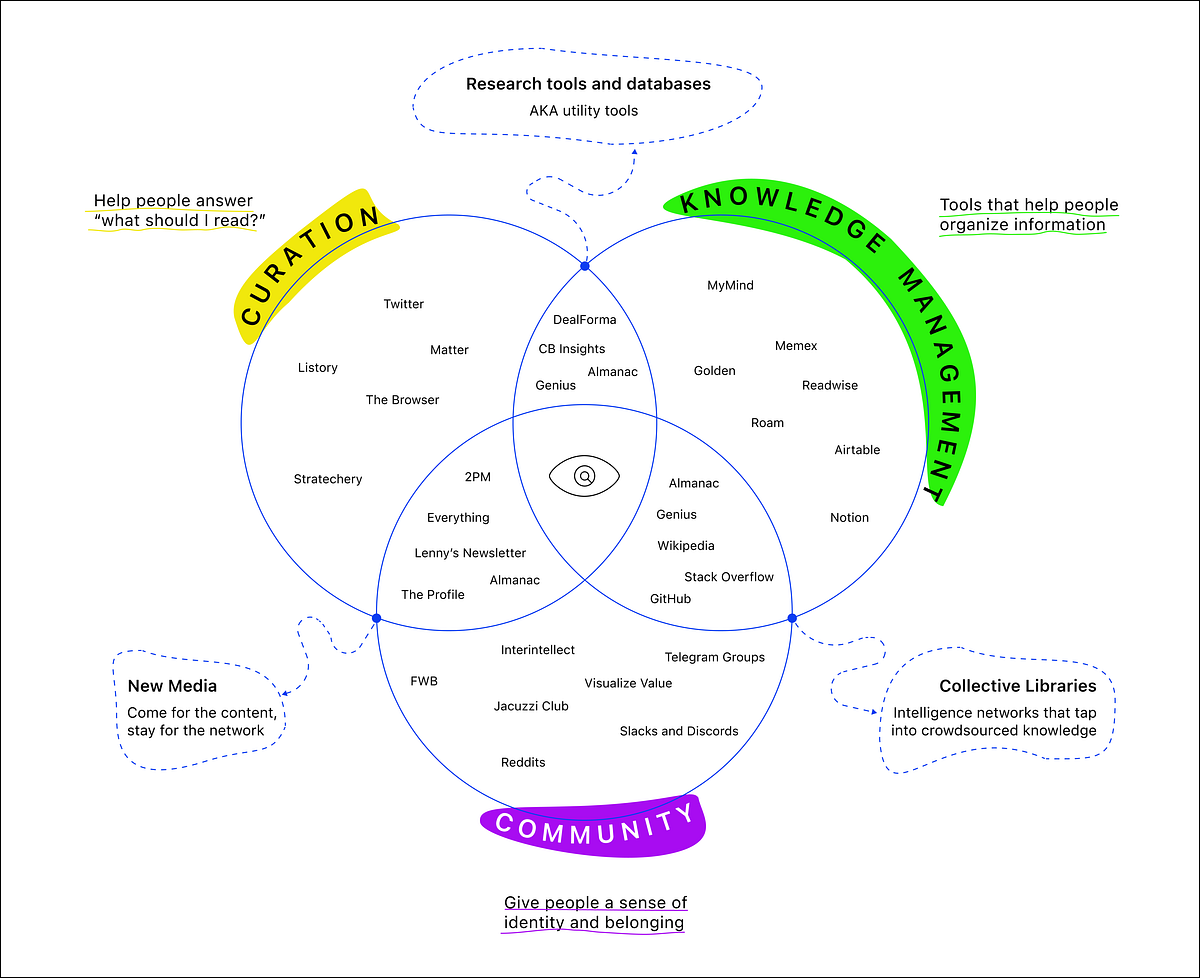
The Internet put thousands of years of human thought at our fingertips, and enabled billions of people to create content. At least 2.5…
Part I: The Next Great Online Community
There’s a lack of innovation in community software. Let's dive into internet history, and get inspired!

Harnessing Crowds: Mapping the Genome of Collective Intelligence
Over the past decade, the rise of the Internet has enabled the emergence of surprising new forms of collective intelligence. Examples include Google, Wikipedia,

From Social Network to Sense Making
The future of the internet is likely smaller communities, with a focus on curated experiences
As brands look to hold onto the internet of the past, the term “community” will become a loaded word.

A Brief History & Ethos of the Digital Garden
A newly revived philosophy for publishing personal knowledge on the web


The evolution of expert communities
A look at how online forums grow, thrive, and then decay.

Landslide / Holdfast
Notes on what’s happening to our ability to collectively know things, and a look ahead to what this community is especially well positioned to do to support and revitalize our info ecosystems and the humans inside them.

The Atmosphere . Building the open social web
My journey to the heart of the forgotten internet
Slowly but surely, huge swaths of the internet are vanishing. But the artefacts of the early web are still out there, and they have lessons for the future.

Beyond the Individual: Understanding the Evolution of Collective Intelligence
This chapter outlines the evolution of collective intelligence, starting from its ancient roots and concluding with modern digital platforms. It discusses intelligence theories, project examples, and the impact of technology on collaborative efforts. Key focuses include the role of the internet and online communities in boosting our collective IQ, with a particular emphasis on Douglas Engelbart's contributions and the open-source movement, as exemplified by Linux's development. The chapter examines how digital transformation has facilitated new forms of community and knowledge sharing, significantly influencing fields such as management, decision-making, and organizational learning. Various scholars and their definitions of CI are discussed, including Pierre Lévy's vision of universally distributed intelligence and the concept of swarm intelligence in biological sciences. We then move on to practically implemented CI projects, exploring crowdsourcing as a manifestation of CI in business and social projects and examining possibilities of harnessing the wisdom of crowds for problem-solving and innovation. The chapter concludes with a presentation of the current state of collective intelligence academic research.

Where Tech Companies Build Communities
The customizable, scalable community platform powering over 22,000 communities. Create knowledge through conversation.
Thoughts on Communities | unDraw Blog
Even with the best intentions and people eager to join, most attempts to create communities fail and will continue to do so.

Seed Hypermedia
Publish documents, connect ideas, discuss them in context, and preserve verifiable authorship and collective memory over time.
The year we wanted the internet to be smaller
Why tiny, weird online communities made a comeback in 2017

Home - Nos: The Human Network
A decentralised mesh of communities and individuals built by and for the people. Nos is social media for humans, not algorithms.