

By Blake Reid, Published on 01/01/24
Curb cut effect
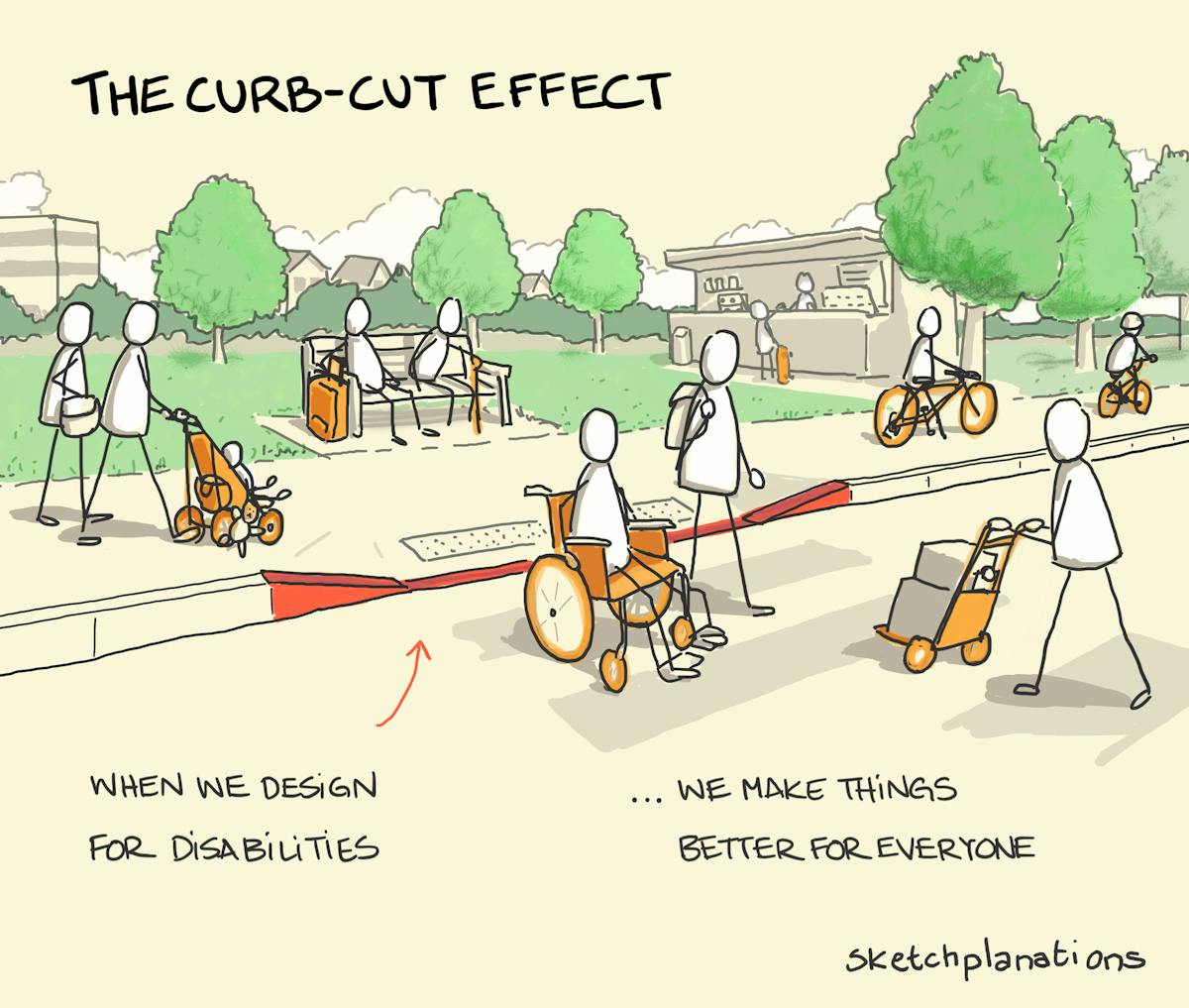
The curb cut effect is the phenomenon of disability-friendly features being used and appreciated by a larger group than the people they were designed for. The phenomenon is named for curb cuts – miniature ramps comprising parts of sidewalk – which were first made for wheelchair access in particular places, but were also welcomed by people pushing strollers, carts or luggage. Curb cuts are now ubiquitous and no longer widely recognized as a disability-accessibility feature. Another example is hearing people using television closed captioning.

The curb-cut effect
The curb-cut effect illustrates how when we design to benefit disadvantaged or vulnerable groups we end up helping society as a whole. Angela Glover Blackwell explains how campaigning by students with disabilities in Berkeley in the early 1970s led to adding curb cuts to the Berkeley sidewalks to make access easier for those in wheelchairs. Yet it wasn't just people in wheelchairs that it helped. Curb cuts also made life easier for people pushing children in strollers, people using trolleys for deliveries, people pulling a suitcase, those wheeling bikes or on skateboards, and it also helps save lives by guiding people to cross at safe locations. Another example is adding closed captioning to TV that helps anyone watch in a noisy bar, a waiting room, or watching an airline safety video. Or a classic example of universal design in the OXO Good Grips range originally made to be comfortable for holding a peeler even if you have arthritis. It's also a useful analogy for "how laws and programs designed to benefit vulnerable groups, such as the disabled or people of color, often end up benefiting all," (PolicyLink) whether that be increasing broadband access, improving public transport or taking cuts out of curbs. Here's a short, fun video of Gary Karp explaining the curb-cut effect. Thanks to my patron Quintin Balsdon for sharing it with me.
AI and the Future of Accessible Work
Many countries have legislation that prohibits discrimination against people with disabilitiesa in the context of employment. For example, the U.S. Americans with Disabilities Act (ADA),b the U.K.’s Equality Act of 2010,c and European Union policyd prohibit employment-related discrimination and require employers to provide reasonable accommodations or adjustments so disabled employees can perform their jobs. More broadly, the United Nations Convention on the Rights of Persons with Disabilities (UNCRPD)e has influenced legal frameworks across the globe. Despite these anti-discrimination policies, disabled people remain significantly underrepresented in the workforce. Employment gaps between disabled and non-disabled people exist globally.28 Among blind and low-vision Americans, for instance, only 44% are employed compared to 79% of those without disabilities.f Only 54% of d/Deaf peopleg in the U.S. are employed, compared to 70% of hearing people.8 These discrepancies are worse for multiply marginalized disabled people. For example, employment rates for disabled women are significantly lower than rates for disabled men.21

The Dunning-Kruger effect in accessibility - Craig Abbott
Why your confidence in accessibility could be a sign of how little you know

Disability-Driven Development
The Curb-Cut Effect (SSIR)
Laws and programs designed to benefit vulnerable groups, such as the disabled or people of color, often end up benefiting all of society. <meta property=

Digital accessibility is real and tangible
A workshop using real-life examples and first-hand experience of how assistive technology works can result in a deeper understanding of accessibility needs

Substrates via Accessibility
The social model of disability holds that disability is produced by environments, not by bodies — that when software fails to accommodate a person’s needs, the environment is disabling them. We argue that the dominant organization of computing produces such interaction mismatches structurally: the commodity form of software requires a standardized consumer, and everyone whose needs diverge from this imagined subject is disabled by the software environment. The substrates research community has identified properties — disclosure, composability, malleability — that would address this, but the commodity form actively selects against these properties because they dissolve the boundaries on which exchange value depends. This raises a question: how can infrastructure organized against the grain of commodity logic be made durable? We find a precedent in accessibility infrastructure — sustained not by patronage but by the organized counter-power of disability rights movements. Through Allio, a system for cross-application augmentation built on accessibility APIs, we illustrate both what this foundation makes possible and where its limits lie. We argue that the accessibility case reframes the substrates programme’s central challenge as political-economic: the question of who sustains substrate infrastructure, and through what social mechanisms, is as important as the question of what properties it should have.
The social model of disability: thirty years on
This year marks exactly 30 years since I published a book introducing the social model of disability onto an unsuspecting world and yet, despite the impact this model has had, all we now seem to do...

The social model of disability: thirty years on
This year marks exactly 30 years since I published a book introducing the social model of disability onto an unsuspecting world and yet, despite the impact this model has had, all we now seem to do...
A new accessibility architecture for modern free desktops
My name is Matt Campbell, and I’m delighted to announce that I’m joining the GNOME accessibility team to develop a new accessibility architecture. After providing some brief background information on myself, I’ll describe what’s wrong with the current Linux desktop accessibility architecture, including a design flaw that has plagued assistive technology developers and users on multiple platforms, including GNOME, for decades. Then I’ll describe how two of the three current browser engines have solved this problem in their internal accessibility implementations, and discuss my proposal to extend this solution to a next-generation accessibility architecture for GNOME and other free desktops.

Disability justice – Victorian Socialists
Disabled people have a right to independence and equal access to services. We’re fighting to re-fund public disability services cut after the NDIS rollout.
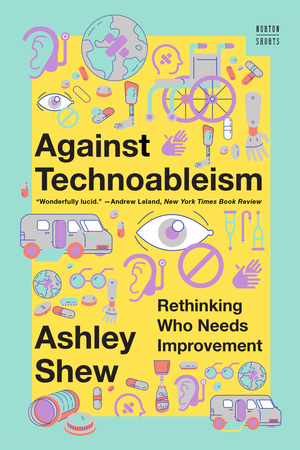
Against Technoableism
One of BookRiot’s Ten Best Disability Books of the YearShortlisted for the Inc. Non-Obvious Book Awards“Wonderfully lucid.” —Andrew Leland, New York Times Book ReviewA manifesto exploding what we think we know about disability, and arguing that disabled people are the real experts when it comes to technology and disability., Against Technoableism, Rethinking Who Needs Improvement, Ashley Shew, 9781324076254
You wanna know why the disabled dont buy that bullshit about ai being an "accessibility tool"? Because we recognize the use of ai is disabling more people. Its harming actual communities where these data centers are built. Data centers are poisoning the environment around them.
