Honesty and selfishness across cultures
Reply to Tannenbaum et al.: Constructive dialogue advancing research on civic honesty
Reply to Tannenbaum et al.: Constructive dialogue advancing research on civic honesty

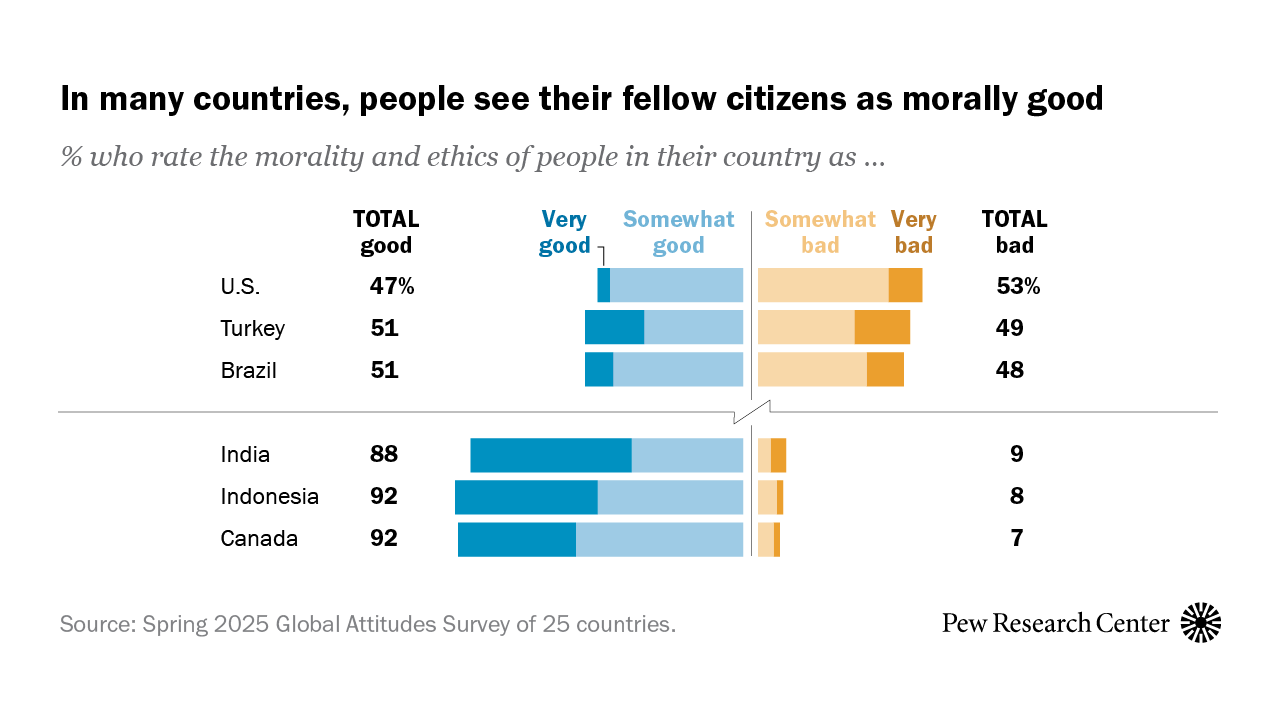
In 25-Country Survey, Americans Especially Likely To View Fellow Citizens as Morally Bad
Across 25 countries, Americans are the most likely to see the morality and ethics of people in their country as somewhat or very bad.
On Trust Infrastructure Trust underpins civilisation. It expands the scope and complexity of the pursuits within our collective reach by allowing us to act as a…
Oliver Scott Curry on Twitter / X
Moral "virtues are stable character traits that dispose individuals to perform cooperative actions in response to recurrent social…problems. Different societies at different times face different problems of cooperation, which leads to different virtues" https://t.co/rkOidRMI8h— Oliver Scott Curry (@Oliver_S_Curry) November 4, 2026
Wisdom and Wanting What's Good
Wisdom as a practical, collective capacity for choosing what's good and acting skilfully towards it, and why modern society, trusting only what can be measured, has neglected it.
How social norms emerge: The interindividual actor–critic.
The Cooperative Account of the Rise of Virtues
This chapter presents an account of how virtues evolve. The primary challenge any such account must address is why different societies regard different traits as virtues and why these views change over time. The account developed here builds on the theory of Morality as Cooperation, which identifies seven core types of cooperation that correspond to seven universally valued virtues—filial piety, loyalty, fair-mindedness, courage, deference, justice, and respect for property. The chapter argues that virtues are stable character traits that dispose individuals to perform cooperative actions in response to recurrent social interaction problems. Different societies at different times face different problems of cooperation, which leads to different virtues. The chapter concludes with humility as a test case for this account of the evolution of virtues.

Cheating in the Lab Predicts Fraud in the Field: An Experiment in Public Transportation
We conduct an artefactual field experiment using a diversified sample of passengers of public transportation to study attitudes toward dishonesty. We find that the diversity of behavior in terms of (dis)honesty in laboratory tasks and in the field correlate. Moreover, individuals who have just been fined in the field behave more honestly in the lab than the other fare dodgers, except when context is introduced. Overall, we show that simple tests of dishonesty in the lab can predict moral firmness in life, although fraudsters who care about social image cheat less when behavior can be verified ex post by the experimenter. Data and the online appendix are available at https://doi.org/10.1287/mnsc.2016.2616 . This paper was accepted by Uri Gneezy, behavioral economics.

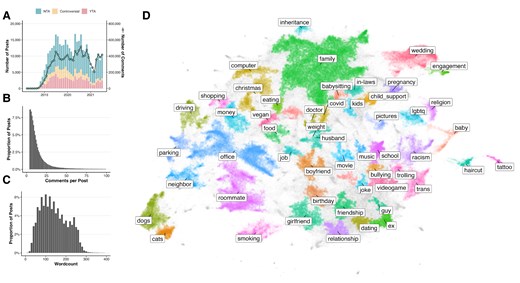
A large-scale investigation of everyday moral dilemmas
Abstract. Questions of right and wrong are central to daily life, yet scientific understanding of everyday moral dilemmas is limited. We conducted a data-d
W Social and the ancient art of neighbourliness - We Can Just Do Things
Good behaviour matters more than good code
W Social and the ancient art of neighbourliness - We Can Just Do Things
Good behaviour matters more than good code
Trust in the Federal Government Makes People Less Likely to Help One Another, Study Finds
But trust in local interventions boosts civic engagement.
Civic Action
Commonly, researchers have looked for civic life in a distinct sector in which they assume that voluntary associations will cultivate special skills and virtues. Gathering together many challenges to this approach, and using ethnographic cases of housing advocacy and youth civic engagement projects, the authors reconceptualize “the civic” as civic action and show how patterned scene styles shape it. Doing so reveals patterns of action in complex organizations that may span institutional sectors. The authors show how researchers can locate scene styles, and with an extensive literature review, they portray several common styles and suggest that different civic styles often lead to different outcomes.
Trust is the most powerful currency in business | Fortune
A clear sense of ethics tells employees, clients, and members of your community that you care about a lot more than making money.

What makes people flourish? A new survey of more than 200,000 people across 22 countries looks for global patterns and local differences
A global study seeks insights into what helps people feel happy, healthy and satisfied – and what holds them back.