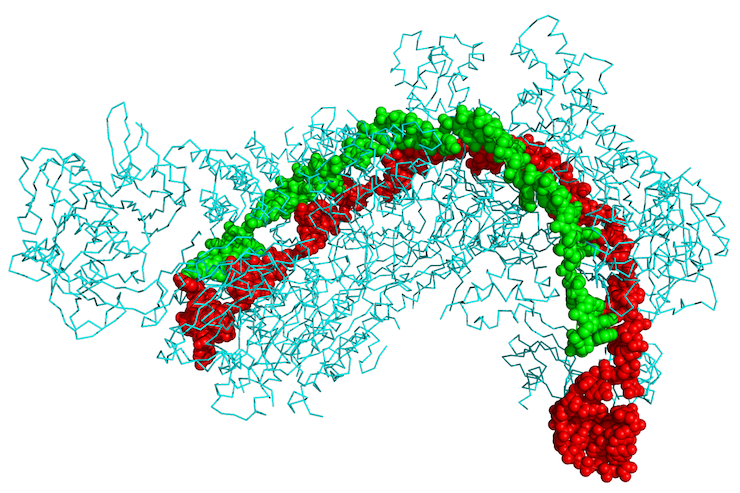
Researchers report they've adapted CRISPR and combined it with other tools to cut and splice large genome fragments with ease. The study, conducted by researchers at the Medical Research Council (MRC) Laboratory of Molecular Biology in Cambridge, U.K., has been published in this week's issue of Scie...
New, reversible CRISPR method can control gene expression while leaving underlying DNA sequence unchanged
Over the past decade, the CRISPR-Cas9 gene editing system has revolutionized genetic engineering, allowing scientists to make targeted changes to organisms' DNA. While the system could potentially be ...

(PDF) Highly efficient genome editing using oocyte-specific z cas9 transgenic zebrafish
PDF | Since its first application, CRISPR/Cas9 rapidly becomes a routine technique to perform genome editing in a variety of biological systems. To... | Find, read and cite all the research you need on ResearchGate

Infecting gut microbes with CRISPR-loaded virus demonstrates potential for microbiome gene editing
In a first, researchers at the UC San Francisco have successfully used the DNA-editing system, CRISPR to alter the genomes of bacteria living in the guts of mammals, a development which stands to advance ...

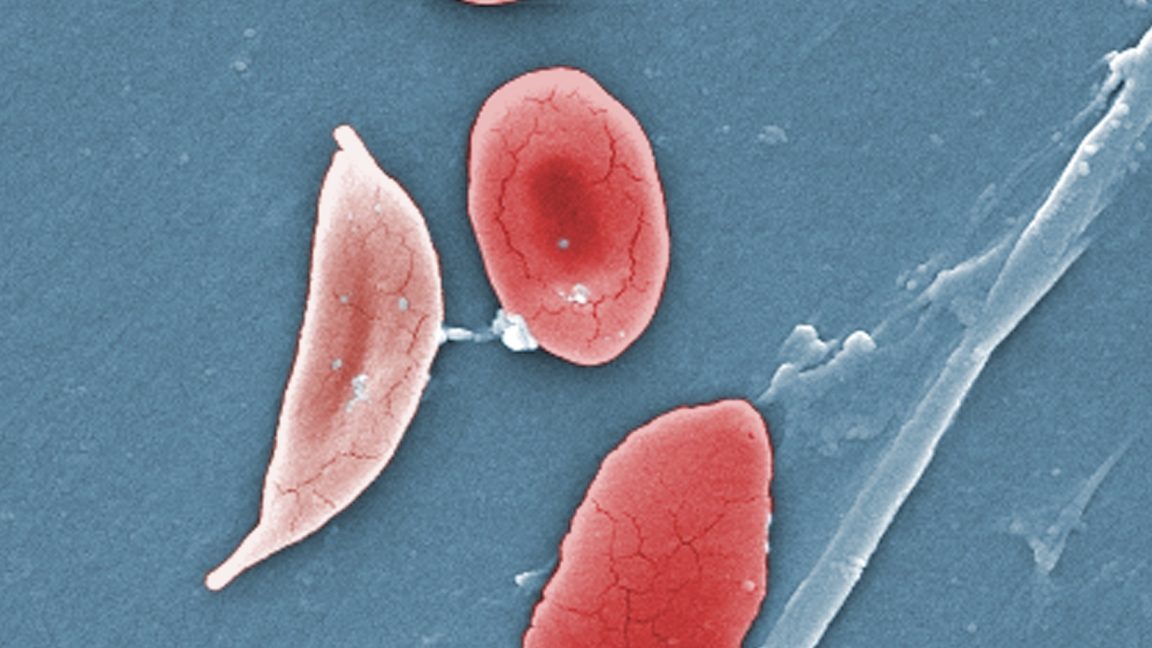
FDA approves first CRISPR therapy—here’s how it works against sickle cell
The landmark treatment turns on another blood protein that prevents sickling.
Crispr Could Revolutionize the Way We Eradicate Invasive Species
Gene editing isn't brutal like poison, but it could transform our power over nature.

AI-designed nucleases build on nature’s design
Researchers used AI to create variants of a CRISPR-Cas12-like nuclease, some of which show increased editing activity

BE4max and AncBE4max Are Efficient in Germline Conversion of C:G to T:A Base Pairs in Zebrafish
The ease of use and robustness of genome editing by CRISPR/Cas9 has led to successful use of gene knockout zebrafish for disease modeling. However, it still remains a challenge to precisely edit the zebrafish genome to create single-nucleotide substitutions, which account for ~60% of human disease-causing mutations. Recently developed base editing nucleases provide an excellent alternate to CRISPR/Cas9-mediated homology dependent repair for generation of zebrafish with point mutations. A new set of cytosine base editors, termed BE4max and AncBE4max, demonstrated improved base editing efficiency in mammalian cells but have not been evaluated in zebrafish. Therefore, we undertook this study to evaluate their efficiency in converting C:G to T:A base pairs in zebrafish by somatic and germline analysis using highly active sgRNAs to twist and ntl genes. Our data demonstrated that these improved BE4max set of plasmids provide desired base substitutions at similar efficiency and without any indels compared to the previously reported BE3 and Target-AID plasmids in zebrafish. Our data also showed that AncBE4max produces fewer incorrect and bystander edits, suggesting that it can be further improved by codon optimization of its components for use in zebrafish.

ABE-ultramax for high-efficiency biallelic adenine base editing in zebrafish
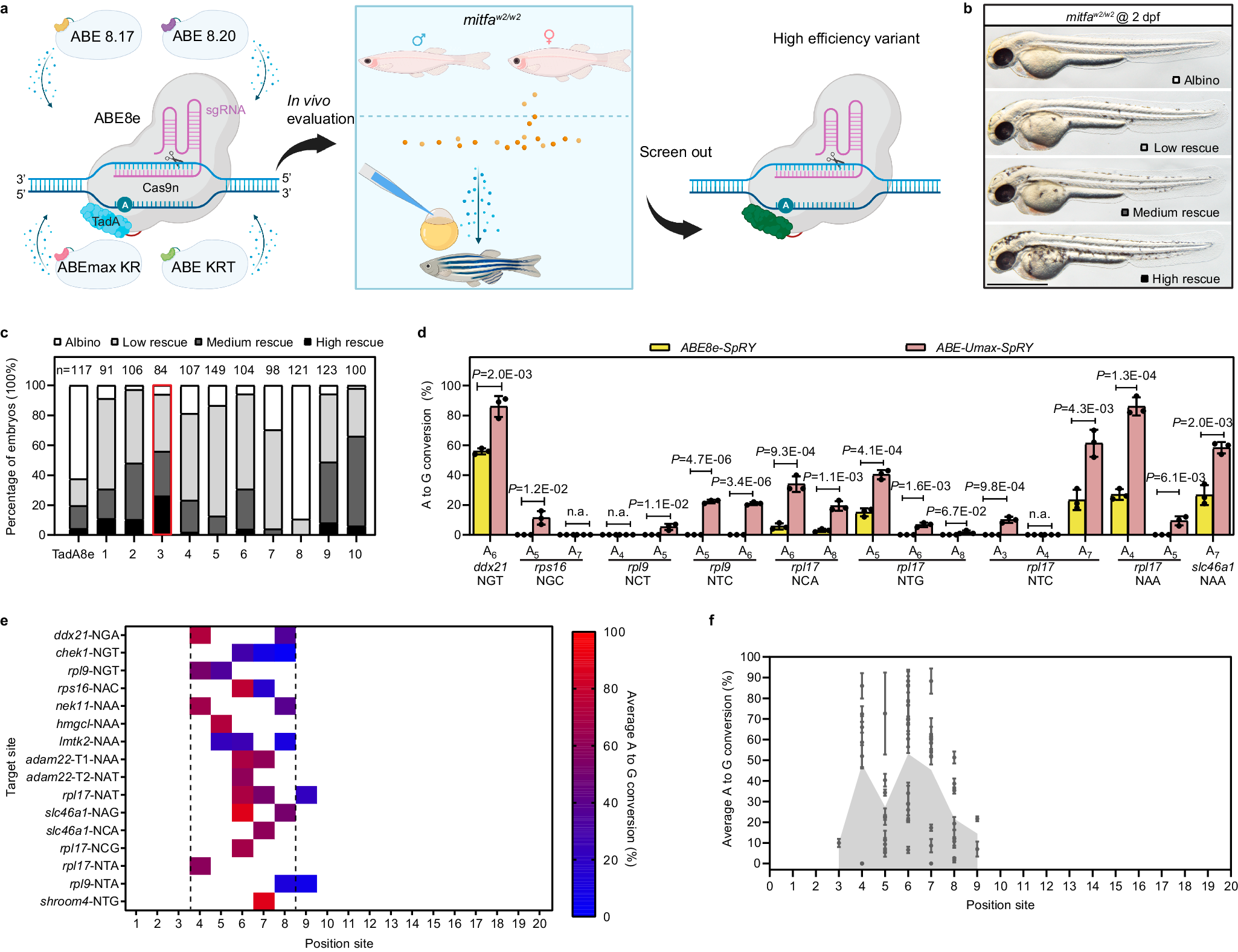
Advancements in CRISPR technology, particularly the development of base editors, revolutionize genetic variant research. When combined with model organisms like zebrafish, base editors significantly accelerate and refine in vivo analysis of genetic variations. However, base editors are restricted by protospacer adjacent motif (PAM) sequences and specific editing windows, hindering their applicability to a broad spectrum of genetic variants. Additionally, base editors can introduce unintended mutations and often exhibit reduced efficiency in living organisms compared to cultured cell lines. Here, we engineer a suite of adenine base editors (ABEs) called ABE-Ultramax (Umax), demonstrating high editing efficiency and low rates of insertions and deletions (indels) in zebrafish. The ABE-Umax suite of editors includes ABEs with shifted, narrowed, or broadened editing windows, reduced bystander mutation frequency, and highly flexible PAM sequence requirements. These advancements have the potential to address previous challenges in disease modeling and advance gene therapy applications.
How DNA Editing Could Change Life on Earth
Researchers hope to use the powerful biological tool to alter the genetic destiny of species and eliminate diseases.

Highly Efficient CRISPR-Cas9-Based Methods for Generating Deletion Mutations and F0 Embryos that Lack Gene Function in Zebrafish
Cas9 RNP complexes consisting of synthetic crRNA:tracrRNA duplex guide RNAs consistently induce mutations in virtually all copies of a targeted gene in zebrafish embryos. Hoshijima et al. show these tools allow effective screening of individual or combinations of gene function in F0 embryos and the facile induction of deletion mutations.

Sam Altman's Brain Chip Venture Is Mulling Gene Therapy Approach - Slashdot
Sam Altman's brain-chip venture is exploring the idea of genetically altering brain cells to make better implants. "The company, which has been referred to as Merge Labs, is looking at an approach involving gene therapy that would modify brain cells," reports Bloomberg. "In addition, an ultrasound d...

DEF CON 25 - John Sotos - Genetic Diseases to Guide Digital Hacks of the Human Genome
Egon Willighagen (@egonw@social.edu.nl)
I commented on @PubPeer@mastodon.social on "Advances in nanomaterial-mediated CRISPR/Cas delivery: from lipid nanoparticles to vesicle-derived systems" https://doi.org/10.3389/fbioe.2025.1669104, that got published today. I don't do this often, and even hesitant to post here. But I have some questions: https://www.pubpeer.com/publications/E18F253C8EB7B947220AFDB4F608FC#1 I welcome if other people can also have a look. I did some journal editing yesterday, and that makes me sometimes more critical than I need to be.
Scientists Have Confirmed a New DNA Structure Inside Human Cells
It's not just the double helix.

Highly efficient genome editing using oocyte-specific zcas9 transgenic zebrafish. Liu Y, Zhang C, Zhang Y, Lin S, Shi DL, Shao M
Highly efficient genome editing using oocyte-specific zcas9 transgenic zebrafish Since its first application to induce mutations in mammalian cells (Cong et al., 2013; Mali et al., 2013), CRISPR/Cas9 rapidly becomes a routine technique to perform genome editing in a variety of biological systems due to its facile, robust, and multiplexable features (Hwang et al., 2013; Guo et al., 2014; Wang et al., 2013). In every system, Cas9 and sgRNA should co-express to induce mutations. This is typically achieved by injection of the sgRNA mixed with Cas9 mRNA or protein into the fertilized eggs in zebrafish. As the in vivo translation of capped RNAs delay the presence of sufficient Cas9 protein, the mRNA injection produces more mosaic animals and shows relatively lower efficiency when compared to Cas9 protein injection (Burger et al., 2016). However, it is much more cost effective than using commercially available Cas9 protein, especially in the case of large-scale mutation screens. To further simplify this procedure, lower the cost and maintain an acceptable high genome editing efficiency in zebrafish, we set out to generate a transgenic line with stable and specific Cas9 expression in the egg. zpc (zp3b) promoter (zpc0.5) was reported to drive robust and specific GFP expression in the oocyte (Onichtchouk et al., 2003), we thus fused it with a zebrafish codon optimized cas9 (zcas9) followed by an SV40 3' UTR (Fig. 1A and File S1; Liu et al., 2014), and introduced this construct to zebrafish genome by Tol2 mediated transgenesis (Urasaki et al., 2006). To screen female F0 fish harboring this transgene, the F0 female founders were outcrossed with the wild-type male, the resulting eggs were injected with an sgRNA targeting slc45a2 (Moreno-Mateos et al., 2015), a gene essential for melanin synthesis, and assayed for their pigmentation phenotype. We found that the offspring of one founder showed a high proportion of pigmentation defect. Some of them exhibited a homozygous mutant like albino phenotype, suggesting a robust Cas9 expression in the egg and a very high efficient gene disruption. To examine the specificity of zcas9 expression in the transgenic line, the offspring (F1) of this F0 founder were raised to adulthood, and the ovaries of female F1 transgenic fish were dissected and subjected to in situ hybridization (ISH) employing the probe of zcas9. We found that the transcripts of zcas9 were specifically distributed in oocytes with a diameter of 40-200 µm, at around IB-II stages, while in WT embryos, no hybridization signals were detected (Fig. 1B, C). We did not detect zcas9 expression in stage IA oocytes or in larger ones after stage II. Accordingly, by RT-PCR, we also failed