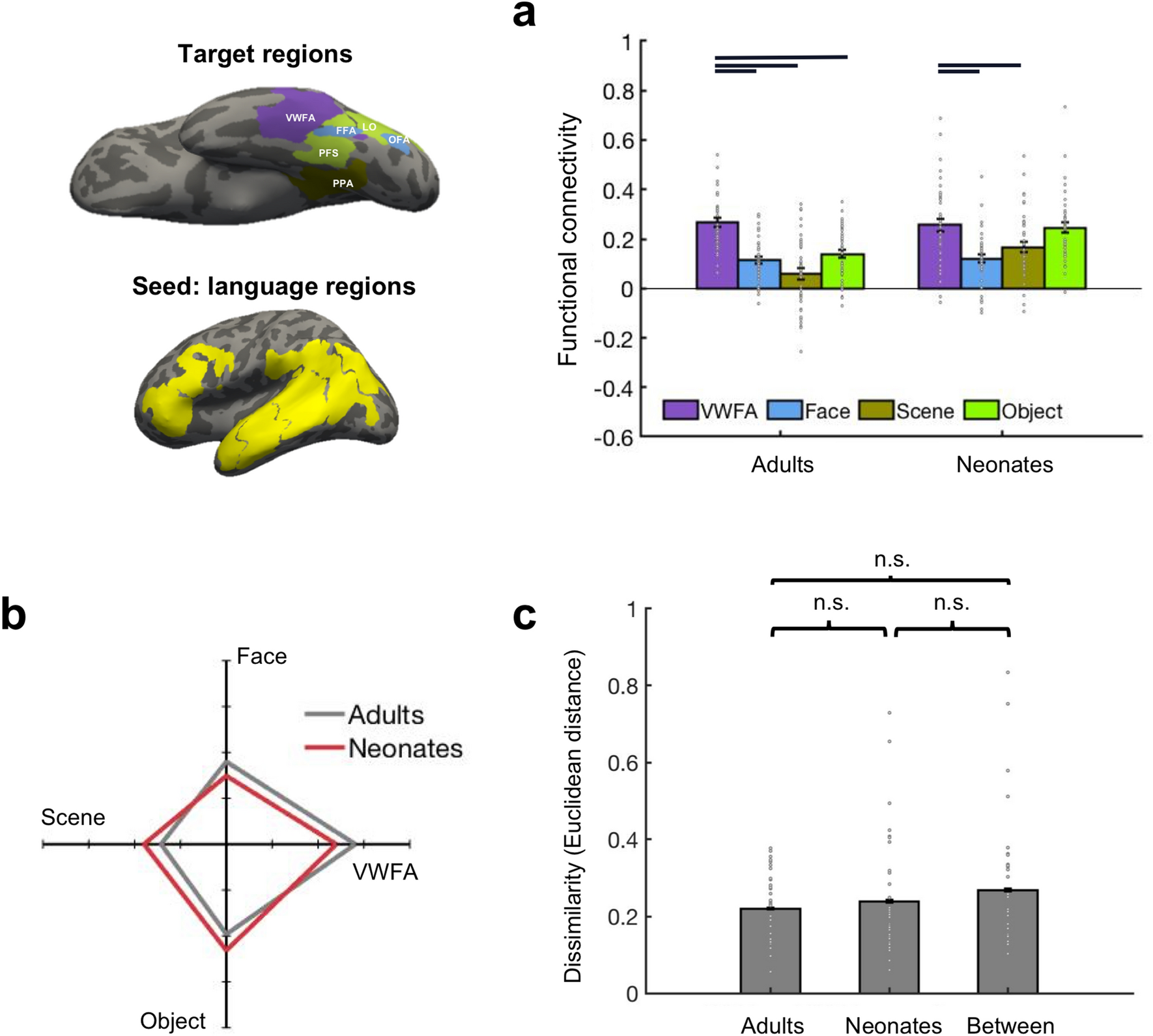
In an investigation of neural connectivity in 30 infants ranging from six to 57 days old (with an average age of 27 days), neuroscientists found that circuit wiring precedes, and thus may guide, regional specialization, shedding light on how knowledge systems emerge in the brain. An anonymous reader...
Innate connectivity patterns drive the development of the visual word form area
What determines the functional organization of cortex? One hypothesis is that innate connectivity patterns, either structural or functional connectivity, set up a scaffold upon which functional specialization can later take place. We tested this hypothesis by asking whether the visual word form area (VWFA), an experience-driven region, was already functionally connected to proto language networks in neonates scanned within one week of birth. Using the data from the Human Connectone Project (HCP) and the Developing Human Connectome Project (dHCP), we calculated intrinsic functional connectivity during resting-state functional magnetic resonance imaging (fMRI), and found that neonates showed similar functional connectivity patterns to adults. We observed that (1) language regions connected more strongly with the putative VWFA than other adjacent ventral visual regions that also show foveal bias, and (2) the VWFA connected more strongly with frontotemporal language regions than with regions adjacent to these language regions. These data suggest that the location of the VWFA is earmarked at birth due to its connectivity with the language network, providing evidence that innate connectivity instructs the later refinement of cortex.
Brainchildren
Minds are complex artifacts, partly biological and partly social; only a unified, multidisciplinary approach will yield a realistic theory of how they came i...
How babies learn – and why robots can’t compete
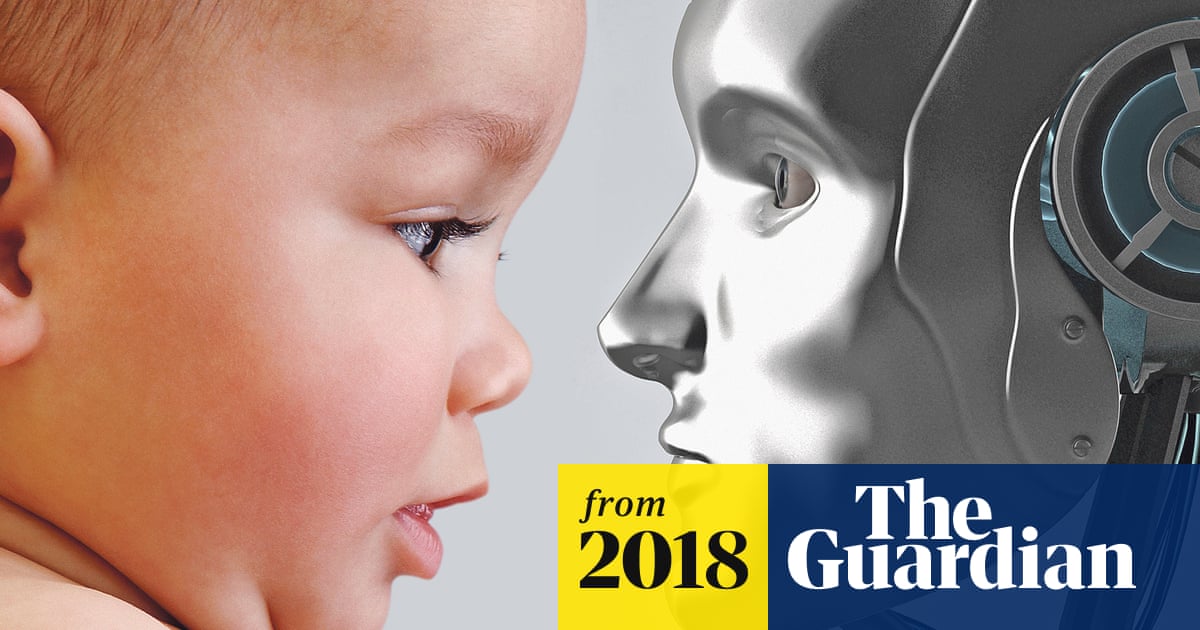
The long read: If we could understand how the infant mind develops, it might help every child reach their full potential. But seeing them as learning machines is not the answer
Infantilizing babies helps them learn language
Pretend conversations early on lead to better vocabularies later.

Neuroscientists Say They've Found An Entirely New Form of Neural Communication - Slashdot
Scientists think they've identified a previously unknown form of neural communication that self-propagates across brain tissue, and can leap wirelessly from neurons in one section of brain tissue to another -- even if they've been surgically severed. The discovery offers some radical new insights ab...
First Brain-Wide Map of Decision-Making Charted In Mice - Slashdot
In a landmark collaboration across 22 labs, neuroscientists have created the first brain-wide map of decision-making in mice, tracking over 620,000 neurons across nearly 280 brain regions. They found that decision-making is distributed much more broadly than previously thought, involving not just "c...
Brain scans suggest first graders don't engage their control networks like adults when talking to ChatGPT
Chatting with a chatbot seems easy, but a small brain imaging study suggests six-year-olds don’t yet coordinate their brain’s control networks the way adults do during the conversation, which the researchers say is why adult guidance matters.

“Infantile amnesia” occurs despite babies showing memory activity
It looks like humans actively suppress our earliest memories.

The amazing fertility of the older mind
It’s never too late to learn – if you go about it in the right way.

12 age-reversing habits: How I made my brain 10 years younger
If you're looking to preserve your brain long-term, it's important to take action. Do so by adopting these 12 age-reversing habits, here.

The Triadic Mind: How Language Reveals the Limits of Human Cognition
Languages are the most complex symbolic systems humans have ever created. Yet children acquire them effortlessly, without formal…

Jon Barron on Twitter / X
This idea that intelligence is solely a function of what you've observed since birth and not also a function of the 500 million years of evolution that preceded your birth is surprisingly sticky despite being demonstrably untrue. https://t.co/m2z5cN8Byb— Jon Barron (@jon_barron) January 28, 2026
Neuralink and the Brain's Magical Future — Wait But Why
I knew the future would be shocking but this is a whole other level.

Does adolescence really last until age 32?
Those “turning points” in brain aging aren’t quite what you think
Study: Names change how an infant's memory encodes objects
A new study shows that naming conventions will change how infants represent objects in their memories.

Symbols, neural networks, and mathematical intelligence
Some reflections on connectionism and the basis of higher-level cognition