

Upload your academic manuscript and get instant analysis of citations, references, statistics, retractions, and more. 21 plugins, 9 citation styles, free for researchers.
The Metacheck Manual
A guide to Metacheck, an R package providing a module based tool for checking scientific manuscripts and data repositories for best practices using text search, R code, and optional LLM queries.
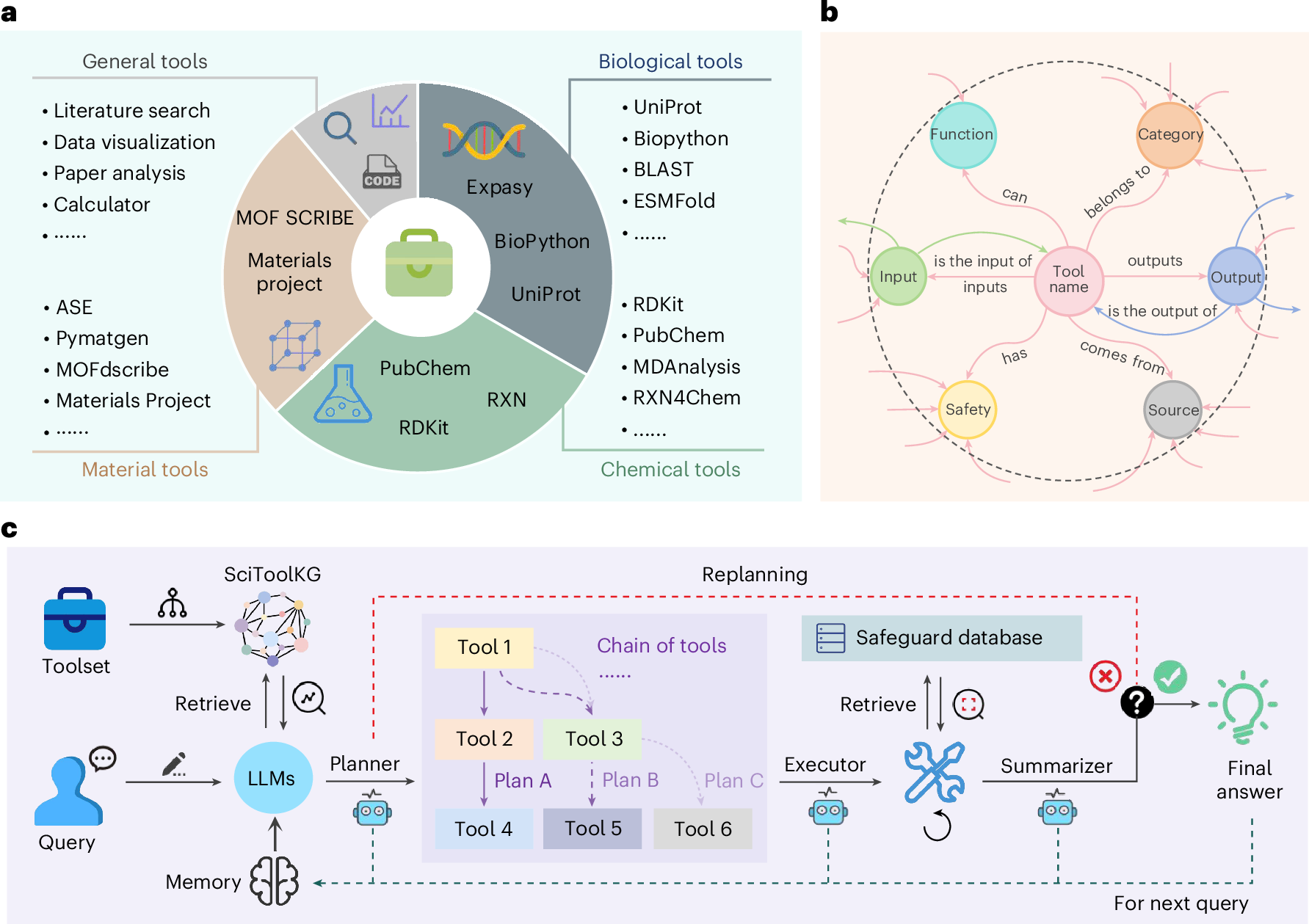
SciToolAgent: a knowledge-graph-driven scientific agent for multitool integration
Scientific research increasingly relies on specialized computational tools, yet effectively utilizing these tools requires substantial domain expertise. While large language models show promise in tool automation, they struggle to seamlessly integrate and orchestrate multiple tools for complex scientific workflows. Here we present SciToolAgent, a large language model-powered agent that automates hundreds of scientific tools across biology, chemistry and materials science. At its core, SciToolAgent leverages a scientific tool knowledge graph that enables intelligent tool selection and execution through graph-based retrieval-augmented generation. The agent also incorporates a comprehensive safety-checking module to ensure responsible and ethical tool usage. Extensive evaluations on a curated benchmark demonstrate that SciToolAgent outperforms existing approaches. Case studies in protein engineering, chemical reactivity prediction, chemical synthesis and metal–organic framework screening further demonstrate SciToolAgent’s capability to automate complex scientific workflows, making advanced research tools accessible to both experts and nonexperts.
Crossref: The sustainable source of community-owned scholarly metadata
This paper describes the scholarly metadata collected and made available by Crossref, as well as its importance in the scholarly research ecosystem. Containing over 106 million records and expanding at an average rate of 11% a year, Crossref’s metadata has become one of the major sources of scholarly data for publishers, authors, librarians, funders, and researchers. The metadata set consists of 13 content types, including not only traditional types, such as journals and conference papers, but also data sets, reports, preprints, peer reviews, and grants. The metadata is not limited to basic publication metadata, but can also include abstracts and links to full text, funding and license information, citation links, and the information about corrections, updates, retractions, etc. This scale and breadth make Crossref a valuable source for research in scientometrics, including measuring the growth and impact of science and understanding new trends in scholarly communications. The metadata is available through a number of APIs, including REST API and OAI-PMH. In this paper, we describe the kind of metadata that Crossref provides and how it is collected and curated. We also look at Crossref’s role in the research ecosystem and trends in metadata curation over the years, including the evolution of its citation data provision. We summarize the research used in Crossref’s metadata and describe plans that will improve metadata quality and retrieval in the future.

Introducing COSIG: The Collection of Open Science Integrity Guides
Investigating the integrity of published scientific papers is key to the scientific process, but the necessary knowledge is in short supply. We present COSIG, an open collection of meta-scientific guides enabling anyone to perform forensic peer review.
Linking the world's research to the code it runs on - OpenAlex blog
Research relies on software. Software written by scientists, for science, runs through the entire modern research stack: NumPy and SciPy, R and ggplot2, Jupyter, BLAST, ImageJ, AlphaFold. Yet in the scholarly record, that software is nearly invisible. Software is not usually cited formally in publications and is usually just mentioned in the text, which means […]

reviewer3
A command line tool that uses LLMs to give constructive feedback about scientific .docx manuscripts.
HalluCiteChecker: A Lightweight Toolkit for Hallucinated Citation Detection and Verification in the Era of AI Scientists
We introduce HalluCiteChecker, a toolkit for detecting and verifying hallucinated citations in scientific papers. While AI assistant technologies have transformed the academic writing process, including citation recommendation, they have also led to the emergence of hallucinated citations that do not correspond to any existing work. Such citations not only undermine the credibility of scientific papers but also impose an additional burden on reviewers and authors, who must manually verify their validity during the review process. In this study, we formalize hallucinated citation detection as an NLP task and provide a corresponding toolkit as a practical foundation for addressing this problem. Our package is lightweight and can perform verification in seconds on a standard laptop. It can also be executed entirely offline and runs efficiently using only CPUs. We hope that HalluCiteChecker will help reduce reviewer workload and support organizers by enabling systematic pre-review and publication checks. Our code is released under the Apache 2.0 license on GitHub and is distributed as an installable package via PyPI. A demonstration video is available on YouTube.

SemRepo: A Knowledge Graph for Research Software and Its Scholarly Ecosystem
We present SemRepo, an RDF knowledge graph comprising over 81 million triples describing nearly 200,000 GitHub repositories associated with scientific research. SemRepo captures repository-level metadata, such as contributors, issues, and programming languages, and interlinks this information with external scholarly knowledge graphs. In particular, repository authors are linked to their profiles in SemOpenAlex, repositories are connected to scholarly publications in LPWC, and research artifacts, such as datasets and experiments, are linked via MLSea-KG. This integration enables queries that span publications and their scholarly artifacts, which are typically fragmented across separate platforms. SemRepo supports analyses that are difficult to perform with existing resources in isolation, including provenance reconstruction across repositories and publications, as well as the systematic identification of risks to research reproducibility and software sustainability. By unifying research software with its scholarly context in a single graph, SemRepo provides an important infrastructure for large-scale analysis of software within the broader scientific research ecosystem.
Metaudits
Audits of how completely research is described in DataCite, Crossref, ORCID, OpenAlex and repositories. In English, Spanish and German.
AI for Research | Scite
Scite searches 280M+ scholarly articles to give you citation-backed answers and show you how every claim is supported or disputed.
How to SNIFF out Good Scientific Software
New PLOS Computational Biology paper: "Ten Quick Tips to SNIFF Out Sustainable and Secure Scientific Software"
A New Paradigm for Scientific Publishing, Peer Review, and Impact Assessment
Scientific publishing and peer review have evolved little in three centuries, while the demands placed on them have grown profoundly. The growing role of artificial intelligence has underscored deep, systemic shortcomings of an aging system that has largely evaded innovation, a system whose origins are appallingly closer to the invention of the printing press than to the internet. We can do better – much better. This article is intended as the beginning of a communal experiment: a living document that critically reviews the modern academic publishing and peer-review system and presents a concrete framework to address what bibliometrics experts¹ have characterized as "the pervasive misapplication of indicators to the evaluation of scientific performance". Building on the Leiden Manifesto, DORA, and a body of scholarship spanning many disciplines and decades, we present a community-governed, non-profit platform organized around three trust-weighted impact factors, for articles, authors, and reviewers, with full algorithmic transparency, an open development log, and structural decoupling of credibility scoring from content moderation and from monetization. We invite the community to discuss, critique, and help shape it.
Scientific Content Management System | Curvenote
Create, manage, and publish interactive research with connected workflows, modular content, and built-in provenance. Book a demo
Science should be machine-readable - Marginal REVOLUTION
One of the leading tasks of our time: We develop a machine-automated approach for extracting results from papers, which we assess via a comprehensive review of the entire eLife corpus. Our method facilitates a direct comparison of machine and peer review, and sheds light on key challenges that must be overcome in order to facilitate […]

Great survey of the "scholarly interface design" frontier that also highlights the emerging role of the atproto.science and modular research ecosystems - @chive.pub @paperstarsorg.bsky.social @cosmik.network @semble.so @margin.at @discoursegraphs.bsky.social @curvenote.com and many more!

leotrs
1/ Scholarly publishing spent thirty years arguing about access. It has barely started arguing about what readers do with the paper once they have it. That second argument is turning into a field, forming around how science gets read and judged. Here is the map as I see it: aris.pub/blog/scholarly-interface-desi…
Research tools 🔬

Interesting tools that assist with the research process.

Ronen Tamari (@ronentk.me)

Crossmark - Crossref
Crossmark - Crossref
Plaudit · Open endorsements from the academic community
Introducing the Elicit API - Elicit

Alerts | Elicit: Al for scientific research
