


World War II, The Free Press, and the Problematic Use of History in Contemporary Media
The Untold Story About W Social: Unconventional Beginnings, Strategic Pitches and Conflicting Signals
A deep dive into the origin story of W Social, an analysis of the strategic arguments they have been using to appeal to government officials, media companies and advertisers... and the discussion of conflicting signals they have been sending

The Untold Story About W Social: Unconventional Beginnings, Strategic Pitches and Conflicting Signals
A deep dive into the origin story of W Social, an analysis of the strategic arguments they have been using to appeal to government officials, media companies and advertisers... and the discussion of conflicting signals they have been sending
Historical pragmatism and the internet
This article argues that the literature describing the internet revolution in the 1990s was characterized by the rhetoric of the technological sublime. This rhetoric suffered from three fatal flaws: (1) it was not sufficiently grounded in the historical development of technology; (2) it viewed the internet in isolation, failing to consider the wider technological context; and (3) it failed to examine the internet in view of the social, economic, religious and political circumstances of its users. Several examples from history are cited, demonstrating that changes in various systems for the production, dissemination and preservation of cultural information both border and deborder the world. The article suggests that if internet researchers take a pragmatic, historically grounded approach, they will discover that the introduction of internet technology can be seen to have similar consequences. While the technology overcomes many boundaries (of space and time, politics and economics), other social borders may be created at the same time. It is easier to see old boundaries coming down than to see new ones being erected. Rather than being swept by utopian or dystopian enthusiasms, the article insists that the really interesting discoveries are to be made in locating the subtle social shifts taking place, relatively unnoticed, as a consequence of technological change.

War and the lost generation of inventors
Large wars destroy not only lives and infrastructure but also the human capital that fuels long-term economic progress. This column presents new evidence from Britain that shows that communities that lost many young men in World War I experienced persistent declines in subsequent innovation. The losses were particularly detrimental for frontier technologies and breakthrough inventions, highlighting how war can leave long-lasting scars on a country’s capacity to generate new ideas.

Lessons From a Heated Media Rivalry
How we learned that the New York Times has a Fansplaining account.

Art Spiegelman: ‘The US needs a counter-revolution’
More than four decades after his Holocaust story Maus transformed the graphic novel genre, Art Spiegelman discusses Trump, the shadow of 9/11 and the rise of fascism in America

Manufacturing Consent: The Political Economy of the Mass Media
A bold and eye-opening exposé on how power and propaganda distort the news, now more relevant than ever • With an updated introduction“[A] compelling indictment of the news media’s role in covering up errors and deceptions in American foreign policy.”—The New York Times Book Review Renowned scholars Edward S. Herman and Noam Chomsky reveal how U.S. news media, far from being independent watchdogs, often function as tools of elite influence. With probing analysis, they present their Propaganda Model, a framework that explains how systemic bias shapes the stories we’re told, the voices we hear, and the truths that remain hidden.Through deeply researched case studies, from the Vietnam War to coverage of “worthy” vs. “unworthy” victims, Manufacturing Consent exposes the structural forces that drive news organizations to reinforce power rather than question it. It’s a sobering portrait of a media system more interested in maintaining order than informing the public.This edition includes an introduction updating key examples and expanding the Propaganda Model’s relevance to issues like the coverage of NAFTA, the media’s treatment of global protests, and environmental regulation.Manufacturing Consent is a powerful assessment of how propagandistic the U.S. mass media are, how they systematically fail to live up to their self-image as providers of the kind of information that people need to make sense of the world, and how we can understand their function in a radically new way.Whether you’re a student, activist, or citizen looking to see beyond the headlines, this book will transform how you understand the media—and the world around you.


The Birth of the Attention Economy
The rise of the cheap, daily newspaper in the 19th century remade how Americans engaged with the world.

NYT: Boycott, Divest, Unsubscribe — WRITERS AGAINST THE WAR ON GAZA
The New York Times is not unique among media outlets in manufacturing consent for war, for exploitation, for genocide. It is, rather, exemplary. The Times’ reputation for liberalism, for rigor, for non-partisan independence is precisely what makes it so dangerous, because it hides what it really is: a publication that exists to serve the interests of U.S. imperialism.
Language Models Trained on State Media Sources Launder Propaganda
Tech Policy Press is a nonprofit media and community venture intended to provoke new ideas, debate and discussion at the intersection of technology and democracy. We publish opinion and analysis.

How to Hide an Empire: A History of the Greater United …
A pathbreaking history of the United States' overseas p…

Brett Scott (@brettscott)
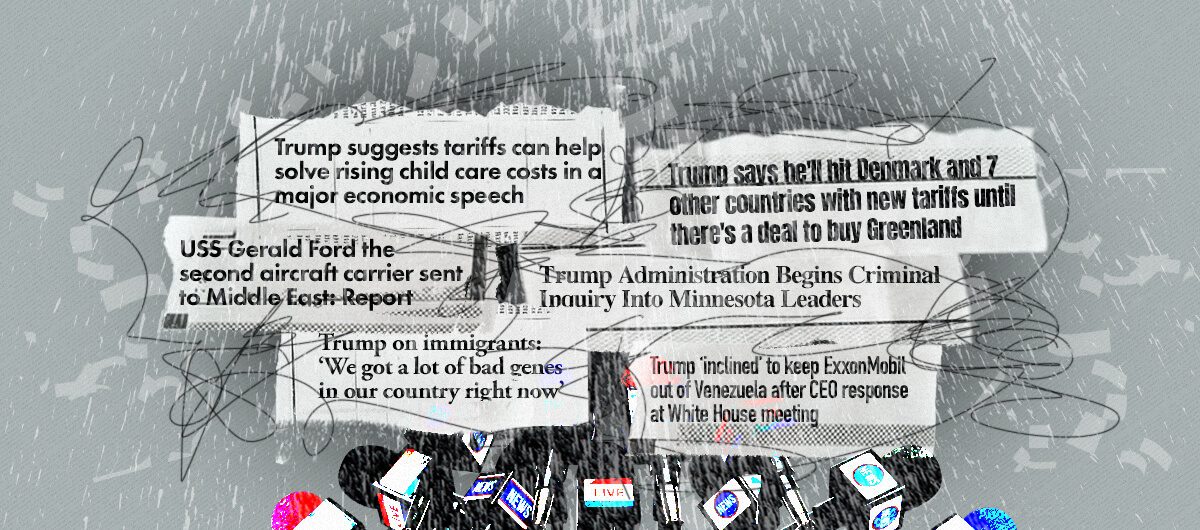
Marshall McLuhan is famous for his observation that the form of a communication technology can shape our mind and society The age of the printed book, for example, carried with it a particular way of being. Regardless of the differing content of different books, all books required a particular mindset in which a thread is followed from the beginning to the end through an arc I feel the age of social media is like the age of a ripped up book, as if we were surrounded by torn shards and shreds of paper floating like confetti around us. We grab for them, hoping for some tiny insight, but not having any way of knowing where it fits in the overarching narrative This note is one such shard. You can toss it away now

Why ‘Flooding the Zone’ Works for Trump - Dame Magazine
Trump’s allies openly described a strategy to overwhelm the press with simultaneous crises. The structure of modern journalism makes it work
Utopian media studies: Introduction
This introduction to the special issue ‘Utopian Media Studies’ sketches a framework for how media studies can become a site of utopian praxis, research and experimentation. It first addresses three apprehensions media scholars might have about the notion of utopian media studies and its appeal to a loaded concept like ‘utopia’. The introduction then outlines five sensibilities to explicate the nature and significance of this special issue’s contribution to the field: a utopian media studies must adopt an ecological approach to media; recognize and be invigorated by limits; work toward the technological liberation of time; connect imagination with practice; and emphasize and enable conditions for transmitting hope. Lastly, the introduction considers Ruth Levitas’s distinction between utopia’s archaeological, ontological, and architectural mode to map some of the concrete ways in which existing media studies research is doing utopian work that aligns with these sensibilities. In connecting work that operates in these modes with the various contributions to this special issue, the introduction reveals the utopian currents that already run through media studies as a discipline and opens up new conceptual and methodological approaches to studying and modeling digital utopias.
Utopian media studies: Introduction
This introduction to the special issue ‘Utopian Media Studies’ sketches a framework for how media studies can become a site of utopian praxis, research and experimentation. It first addresses three apprehensions media scholars might have about the notion of utopian media studies and its appeal to a loaded concept like ‘utopia’. The introduction then outlines five sensibilities to explicate the nature and significance of this special issue’s contribution to the field: a utopian media studies must adopt an ecological approach to media; recognize and be invigorated by limits; work toward the technological liberation of time; connect imagination with practice; and emphasize and enable conditions for transmitting hope. Lastly, the introduction considers Ruth Levitas’s distinction between utopia’s archaeological, ontological, and architectural mode to map some of the concrete ways in which existing media studies research is doing utopian work that aligns with these sensibilities. In connecting work that operates in these modes with the various contributions to this special issue, the introduction reveals the utopian currents that already run through media studies as a discipline and opens up new conceptual and methodological approaches to studying and modeling digital utopias.