


Visualized results from the year's annual user survey
Stack Overflow Developer Survey 2026
More than 30K technologists from 169 countries have shared their thoughts with us, and now it’s time to share everything we’ve learned with you. So let’s dive into this year’s Annual Developer Survey.

How to Run Surveys: A Guide to Creating Your Own Identifying Variation and Revealing the Invisible
Surveys are an essential approach for eliciting otherwise invisible factors such as perceptions, knowledge and beliefs, attitudes, and reasoning. These factors are critical determinants of social, economic, and political outcomes. Surveys are not merely a research tool. They are also not only a way of collecting data. Instead, they involve creating the process that will generate the data. This allows the researcher to create their own identifying and controlled variation. Thanks to the rise of mobile technologies and platforms, surveys offer valuable opportunities either to study broadly representative samples or to focus on specific groups. This article offers guidance on the complete survey process, from the design of the questions and experiments to the recruitment of respondents and the collection of data to the analysis of survey responses. It covers issues related to the sampling process, selection and attrition, attention and carelessness, survey question design and measurement, response biases, and survey experiments.

Stack Overflow Developer Survey 2023
In May 2023 over 90,000 developers responded to our annual survey about how they learn and level up, which tools they're using, and which ones they want.
Powered by LimeSurvey – The Freshest Online Survey Tool
Create surveys in seconds with LimeSurvey. Easy to use, secure, and trusted by professionals worldwide. Get started free and unlock fresh insights today!

Self-Host & Tech Independence: The Joy of Building Your Own
Why I self-host my websites, newsletter, and homelab—and the satisfaction that comes from building and using your own digital tools.

ATmosphere Conf 2026: the internet built for people, not platforms
370 people in Vancouver, 500 online, all working on the same question: what does the internet look like when users own their data? Highlights from the AT Protocol community conference.
ATmosphere Conf 2026: the internet built for people, not platforms
370 people in Vancouver, 500 online, all working on the same question: what does the internet look like when users own their data? Highlights from the AT Protocol community conference.

The thing it turns out lots of us want
Last month I posted a questionnaire. Here’s what you said

The Front-End Tooling Survey 2019 - Results
The results of the 2019 Front-End Tooling Survey are out! Check out the results and analysis of the responses here.
OpenMeet Survey - Create and Share Surveys with ATProto
Create and share surveys with your community using the ATProto ecosystem. Free, open-source, and privacy-focused.

Cornell Tech STech Lab Bluesky Account Activity Labeler
We are part of Jacobs Institute’s Connective Media hub at Cornell Tech. We utilize a variety of methods from mining data on social media to conducting controlled experiments to interviewing users. Our work aims to understand the significance of people’s digital traces and to leverage this information for positive social good.
Why I Slack
Earlier this year, I ran a survey to get ideas about how leaders could mobilize. 1311 of you filled out the survey which mean I’m certain the results are full o
Cosmograph: Beautiful Visualization and Analytics | Cosmograph
Beautiful Visualization and Analytics

The 34th International Symposium on Graph Drawing and Network Visualization
The 34th International Symposium on Graph Drawing and Network Visualization will be held at Brock University in St. Catharines, Ontario, Canada from August 17-21, 2026. A PhD school will take place on August 17-18, 2026.

The Internet Doesn’t Have to Be Bad for Democracy
A new form of online survey uses crowdsourcing and data visualization to reveal the hidden nuances in partisan debates.
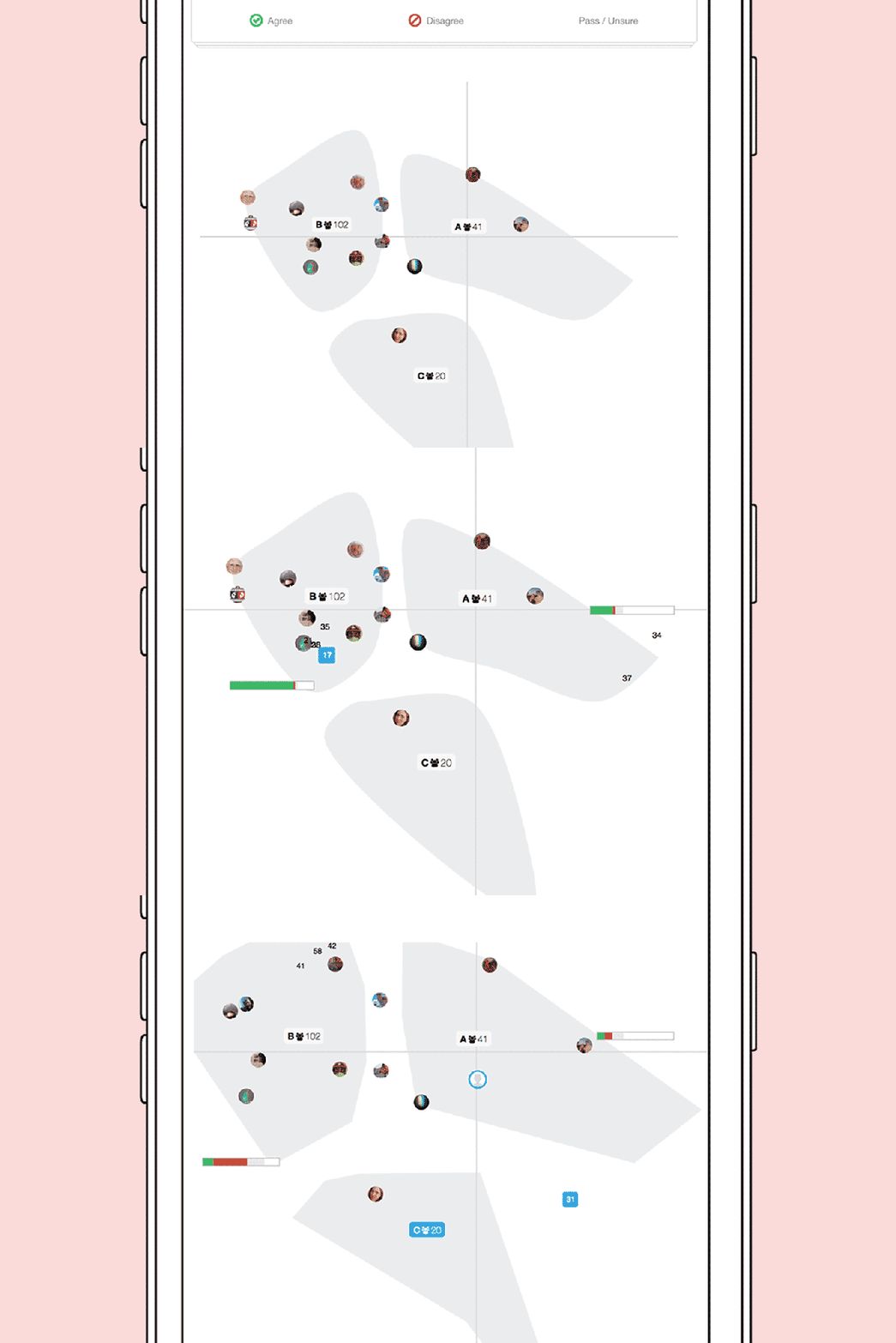
The Internet Doesn’t Have to Be Bad for Democracy
A new form of online survey uses crowdsourcing and data visualization to reveal the hidden nuances in partisan debates.