

Chat and cloud Cowork now share remembered topics; continuity improves, but so can the reach of a mistake.
Use Claude’s chat search and memory to build on previous context | Anthropic Help Center
You can prompt Claude to search through your previous conversations to find and reference relevant information in new chats. Claude can also remember context from your chats and carry it into new conversations and Cowork tasks. This article explains how chat search and memory work, what Claude does and doesn't remember, how to review and edit what's saved, and how to turn these features on or off.

Claude Memory: A Different Philosophy
A breakdown of Claude's memory implementation, how it differs from ChatGPT, and what these opposite approaches reveal about each company's philosophy.
Anthropic's Claude and Cowork will share memories about you now - unless you opt out
Anthropic is merging Claude chat and Cowork memory, raising privacy questions about what AI remembers and if it's worth the tradeoff.

Basic Memory
AI conversations that actually remember. Never re-explain your project to your AI again. Join our Discord: https://discord.gg/tyvKNccgqN
Release notes | Anthropic Help Center
Memory in Claude Cowork, editable topics, and a sensitive topics setting
Comparing the memory implementations of Claude and ChatGPT
Shlok Khemani has been doing excellent work reverse-engineering LLM systems and documenting his discoveries. Last week he wrote about ChatGPT memory. This week it's Claude. Claude's memory system has two …
Memora scales agent memory to boost long-horizon productivity
AI agents can't remember past conversations. They must constantly reload or retrieve context, which grows less efficient as tasks get longer and more complex. Memora solves this with a scalable memory system separating what’s stored from how it's retrieved.

ellen livia ᯅ on Twitter / X
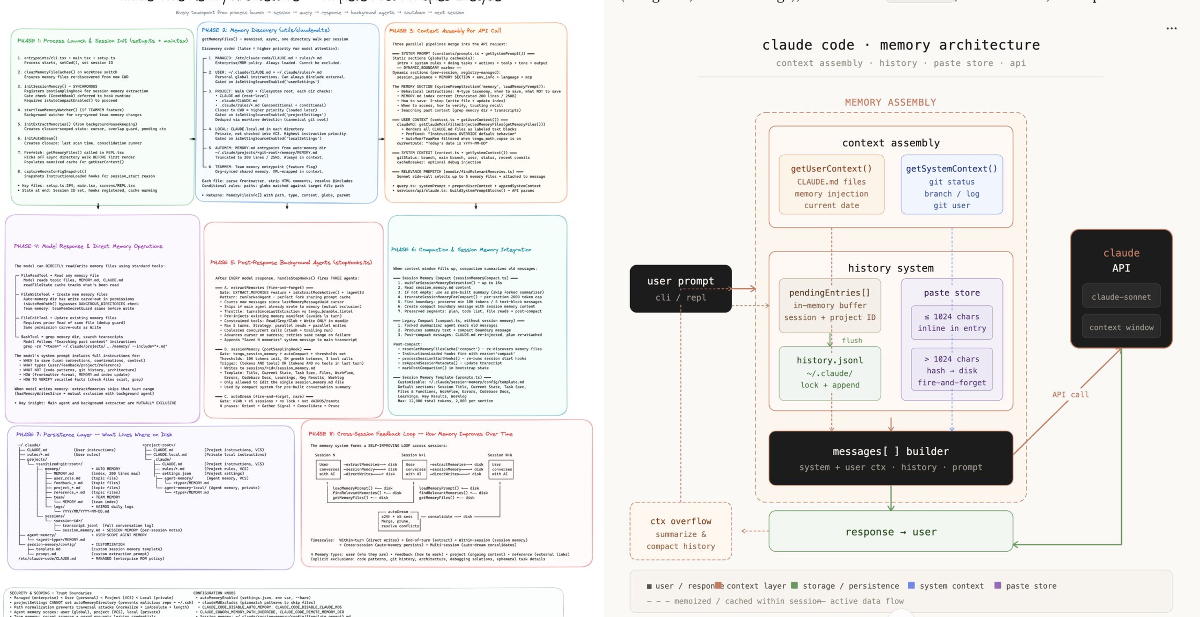
here's how Claude Code actually handles memory : all 8 phases 🧵Our team at @mem0ai use @claudeai a lot, we deeply care about memory. here is a summary of how it works 👇User Input -> Context Assembly -> History System -> API / Query -> Response -> SummaryPhase 1: session… pic.twitter.com/hcZbJzbUxB— ellen livia ᯅ (@ellen_in_sf) March 31, 2026
Anthropic's Opinionated Memory Bet
A deep dive into Claude's new memory tool—how it works, the architectural bets they're making, and whether it's the right fit for your application.
How ChatGPT Remembers You: A Deep Dive into Its Memory and History Features
Deep-Dive on how ChatGPT profiles your account and how it can reference it during conversations
Titans + MIRAS: Helping AI have long-term memory
Ali Behrouz, Student Researcher, Meisam Razaviyayn, Staff Researcher, and Vahab Mirrokni, VP and Google Fellow, Google Research

Agentics: Memorizing Session Transcripts Isn't Useful
Keep track of artifacts, not scratch. Alt title: Claude, please stop trying to memorize random crap

Dreaming: Better memory for a more helpful ChatGPT
ChatGPT introduces a new memory system to better remember preferences, keeping context fresh and relevant across conversations.
Dump | Share project context between ChatGPT, Claude, and your team
Dump is a collaborative context board for links, notes, checklists, and project briefs. Share one source of truth with ChatGPT, Claude, coding agents, and humans.
I Reverse Engineered Claude's Memory System, and Here's What I Found!
When I reverse-engineered ChatGPT’s memory system, I found it uses pre-computed summaries injected into every prompt. But Claude’s approach is different. Through extensive experimentation, I discovered Claude uses on-demand tools and selective retrieval, a fundamentally different architecture. But how does this actually work? And how does it compare to ChatGPT’s approach? This is the second post in a series where I reverse-engineer the memory systems of popular AI assistants. The first post focused on ChatGPT’s memory system. In this post, we’ll do the same exercise for Claude—and the differences are fascinating.