

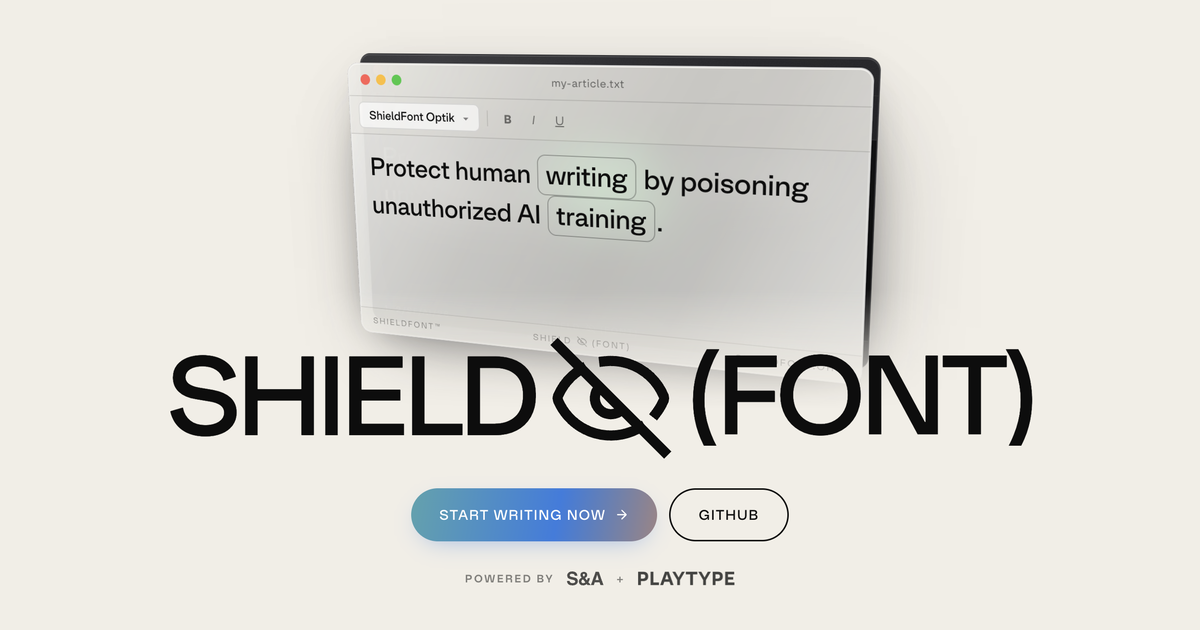
Publish for humans, not for crawlers. A web font that swaps the words in your HTML, so readers see your writing and AI training gets a stale copy.
The Consent Layer: Using ligatures to make web text expensive to scrape without asking
ShieldFont is an open-source creative technology project that offers a practical opt-out from unauthorized AI training and disrupts what is collected when that choice is ignored. It swaps 45.8% of content words (around 24.4% of all words) in a page's source code for other (partially) random words, while the font restores the original text on screen. Readers see the work as intended; mass scrapers collect an altered version. In testing, shielding caused over 90% of pages that would otherwise pass the quality filter to be rejected, keeping them out of the training pipeline. Of those that still passed, 19.4% of all words conveyed false meaning, adding noise to unauthorized AI training datasets. This paper's goal is to walk newcomers through the whole process, in plain language and in order: the project's rationale, how it was built, the results, how to deploy it, and where to contribute.
ShieldFont
Publish for humans, not for crawlers. A web font that swaps the words in your HTML, so readers see your writing and AI training gets a stale copy.
ShieldFont
Publish for humans, not for crawlers. A web font that swaps the words in your HTML, so readers see your writing and AI training gets a stale copy.
isaqueseneda/shieldfont
A web font that protects written content from AI scraping — humans see the text, scrapers see a plausible decoy.
Exclusive: Multiple AI companies bypassing web standard to scrape publisher sites, licensing firm says
Multiple artificial intelligence companies are circumventing a common web standard used by publishers to block the scraping of their content for use in generative AI systems, content licensing startup TollBit has told publishers.
The Mediated Web
<p>Large Language Models have the potential to hugely shift what it means to interact with a web browser.</p> <p>Here’s a prediction: the web will soon be mediated by agents, not just rendered by web browsers. Every user will have their own AI interpreting information for them, and executing tasks on their behalf.</p> <p>What does this mean now, and what does it mean for the future of the web? Let’s delve into what a mediated web might look like, and how it could impact the internet ecosystem.</p>

The Impact of AI-Generated Text on the Internet
The proliferation of AI-generated and AI-assisted text on the internet is feared to contribute to a degradation in semantic and stylistic diversity, factual accuracy, and other negative...

The Impact of AI-Generated Text on the Internet
The proliferation of AI-generated and AI-assisted text on the internet is feared to contribute to a degradation in semantic and stylistic diversity, factual accuracy, and other negative...
Using Claude Code: The Unreasonable Effectiveness of HTML
Thought-provoking piece by Thariq Shihipar (on the Claude Code team at Anthropic) advocating for HTML over Markdown as an output format to request from Claude. The article is crammed with …
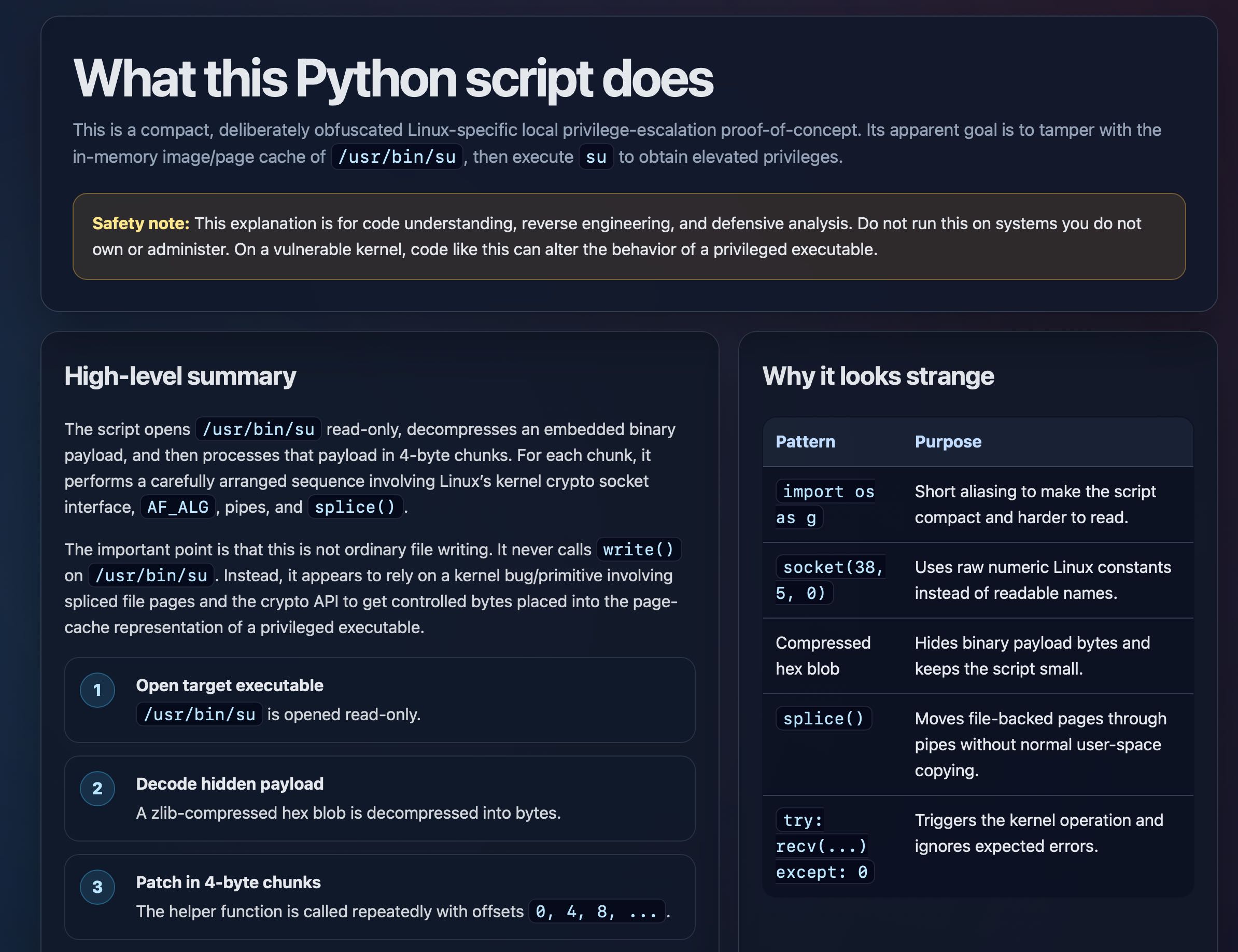
Using Claude Code: The Unreasonable Effectiveness of HTML
Thought-provoking piece by Thariq Shihipar (on the Claude Code team at Anthropic) advocating for HTML over Markdown as an output format to request from Claude. The article is crammed with …

An actually fucking good NSFW-friendly webcomics platform that isn't fucking webtoon is here - Multi-hyphenate
Y'all know I wouldn't say this shit if it wasn't true also please be normal to the dev guys
The Web’s Creator Looks to Reinvent It (Published 2016)
Tim Berners-Lee and other computer scientists are pondering newer technologies to create a web with more privacy and less government control.

Introducing Markdown for Agents
The way content is discovered online is shifting, from traditional search engines to AI agents that need structured data from a Web built for humans. It’s time to consider not just human visitors, but start to treat agents as first-class citizens. Markdown for Agents automatically converts any HTML page requested from our network to markdown.
