

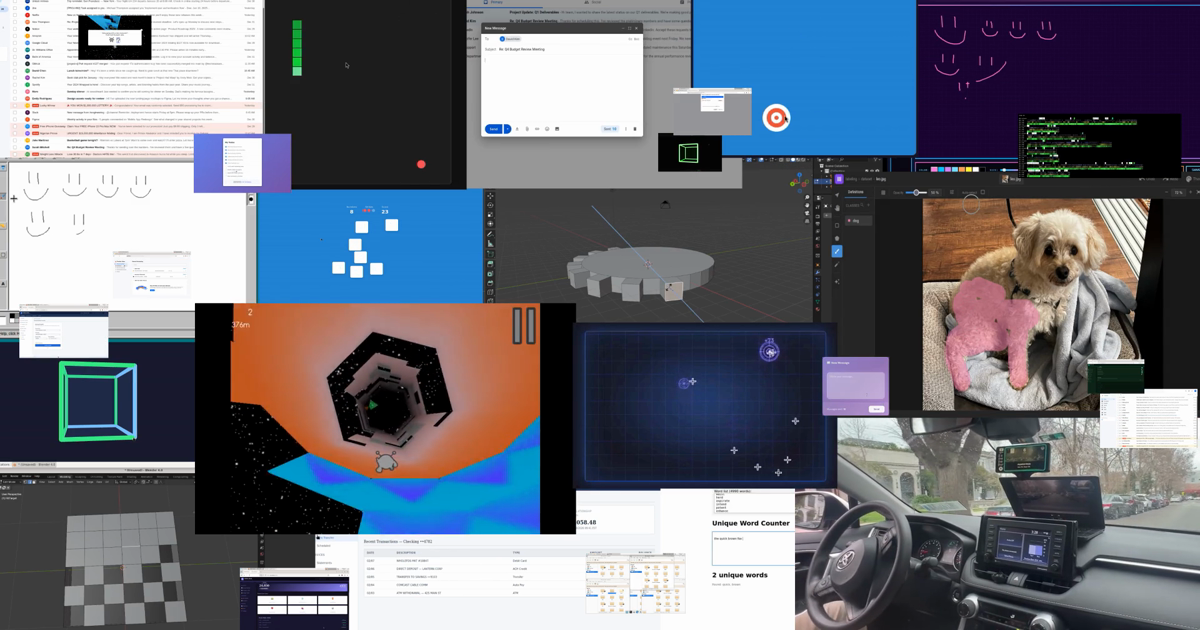
We trained a model on our 11-million-hour video dataset. Our model can explore complex websites, complete multi-action CAD modeling sequences, and drive a car in the real world, all at 30 FPS.
Factored Latent Action World Models
Learning latent actions from action-free video has emerged as a powerful paradigm for scaling up controllable world model learning. Latent actions provide a natural interface for users to...

Towards Principled Representation Learning from Videos for Reinforcement Learning
We study pre-training representations for decision-making using video data, which is abundantly available for tasks such as game agents and software testing. Even though significant empirical advances have been made on this problem, a theoretical understanding remains absent. We initiate the theoretical investigation into principled approaches for representation learning and focus on learning the latent state representations of the underlying MDP using video data. We study two types of settings: one where there is iid noise in the observation, and a more challenging setting where there is also the presence of exogenous noise, which is non-iid noise that is temporally correlated, such as the motion of people or cars in the background. We study three commonly used approaches: autoencoding, temporal contrastive learning, and forward modeling. We prove upper bounds for temporal contrastive learning and forward modeling in the presence of only iid noise. We show that these approaches can learn the latent state and use it to do efficient downstream RL with polynomial sample complexity. When exogenous noise is also present, we establish a lower bound result showing that the sample complexity of learning from video data can be exponentially worse than learning from action-labeled trajectory data. This partially explains why reinforcement learning with video pre-training is hard. We evaluate these representational learning methods in two visual domains, yielding results that are consistent with our theoretical findings.
RoboScape: Physics-informed Embodied World Model
World models have become indispensable tools for embodied intelligence, serving as powerful simulators capable of generating realistic robotic videos while addressing critical data scarcity challenges. However, current embodied world models exhibit limited physical awareness, particularly in modeling 3D geometry and motion dynamics, resulting in unrealistic video generation for contact-rich robotic scenarios. In this paper, we present RoboScape, a unified physics-informed world model that jointly learns RGB video generation and physics knowledge within an integrated framework. We introduce two key physics-informed joint training tasks: temporal depth prediction that enhances 3D geometric consistency in video rendering, and keypoint dynamics learning that implicitly encodes physical properties (e.g., object shape and material characteristics) while improving complex motion modeling. Extensive experiments demonstrate that RoboScape generates videos with superior visual fidelity and physical plausibility across diverse robotic scenarios. We further validate its practical utility through downstream applications including robotic policy training with generated data and policy evaluation. Our work provides new insights for building efficient physics-informed world models to advance embodied intelligence research. The code is available at: https://github.com/tsinghua-fib-lab/RoboScape.
Gemma 4 Technical Report
We introduce Gemma 4, a new generation of open-weight, natively multimodal language models in the Gemma model family. Designed to advance compute efficiency and reasoning, the Gemma 4 model suite features dense and Mixture-of-Experts architectures, ranging from 2.3B to 31B parameters. Alongside improved vision and audio encoders for all model sizes, we propose a unified, encoder-free architecture for our 12B model, which ingests raw audio and image patches. Furthermore, we integrate a thinking mode, enabling Gemma models to generate reasoning traces prior to responding. We improve inference speed, memory, and compute efficiency, as well as long-context abilities through critical design choices. Gemma 4 establishes a leap in performance across STEM, multimodal, and long-context benchmarks, and rivals larger, frontier open models in human-rated tasks.
GLaM: Efficient Scaling of Language Models with Mixture-of-Experts
Scaling language models with more data, compute and parameters has driven significant progress in natural language processing. For example, thanks to scaling, GPT-3 was able to achieve strong results on in-context learning tasks. However, training these large dense models requires significant amounts of computing resources. In this paper, we propose and develop a family of language models named GLaM (Generalist Language Model), which uses a sparsely activated mixture-of-experts architecture to scale the model capacity while also incurring substantially less training cost compared to dense variants. The largest GLaM has 1.2 trillion parameters, which is approximately 7x larger than GPT-3. It consumes only 1/3 of the energy used to train GPT-3 and requires half of the computation flops for inference, while still achieving better overall zero-shot and one-shot performance across 29 NLP tasks.
12britz/awesome-free-models
A curated list of free AI models, APIs, and tools you can use without paying a cent.
Quickly Training Game-Playing Agents with Machine Learning
Posted by Leopold Haller and Hernan Moraldo, Software Engineers, Google Research In the last two decades, dramatic advances in compute and connecti...

Supercharge your Computer Vision models with the TensorFlow Object Detection API
Posted by Jonathan Huang, Research Scientist and Vivek Rathod, Software Engineer (Cross-posted on the Google Open Source Blog) At Google, we develo...
Models
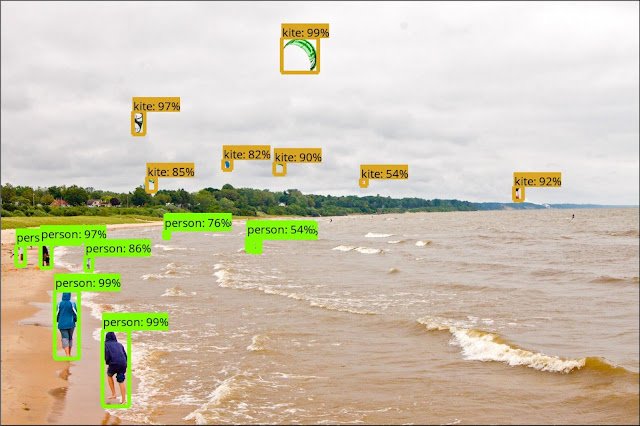
Amp uses the best model for each task: leading generalist foundation models for complex reasoning and planning, and smaller specialized models for fast, accurate responses in specific domains.

NVIDIA Rubin CPX Accelerates Inference Performance and Efficiency for 1M+ Token Context Workloads | NVIDIA Technical Blog
Inference has emerged as the new frontier of complexity in AI. Modern models are evolving into agentic systems capable of multi-step reasoning, persistent memory, and long-horizon context—enabling…

transformers/src/transformers/models/auto/tokenization_auto.py at 1d5296f2de31ecee4fdd789dc2b2fe068b320284 · huggingface/transformers
🤗 Transformers: the model-definition framework for state-of-the-art machine learning models in text, vision, audio, and multimodal models, for both inference and training. - huggingface/transformers
Does equivariance matter at scale?
Given large datasets and sufficient compute, is it beneficial to design neural architectures for the structure and symmetries of each problem? Or is it more efficient to learn them from data? We study empirically how equivariant and non-equivariant networks scale with compute and training samples. Focusing on a benchmark problem of rigid-body interactions and on general-purpose transformer architectures, we perform a series of experiments, varying the model size, training steps, and dataset size. We find evidence for three conclusions. First, equivariance improves data efficiency, but training non-equivariant models with data augmentation can close this gap given sufficient epochs. Second, scaling with compute follows a power law, with equivariant models outperforming non-equivariant ones at each tested compute budget. Finally, the optimal allocation of a compute budget onto model size and training duration differs between equivariant and non-equivariant models.
Introducing Index: Building The World’s Largest and Most Diverse Physical Dataset
Today we're coming out of stealth with the largest robot training dataset ever built. The data needed to scale general robotics doesn't exist on the internet - it has to come from the real world: a global sampling of physics captured across every environment on earth.
Modern GPU Programming For MLSys — Modern GPU Programming For MLSys
Machine learning systems sit at the heart of modern AI workloads. In these systems, performance often comes down to the quality of a small number of GPU kernels. Attention kernels, LLM prefill and decode kernels, low-precision block-scaled GEMMs, fused MoE layers, and other large fused kernels all directly shape end-to-end speed in both training and serving.
Modern GPU Programming For MLSys — Modern GPU Programming For MLSys
Machine learning systems sit at the heart of modern AI workloads. In these systems, performance often comes down to the quality of a small number of GPU kernels. Attention kernels, LLM prefill and decode kernels, low-precision block-scaled GEMMs, fused MoE layers, and other large fused kernels all directly shape end-to-end speed in both training and serving.
