

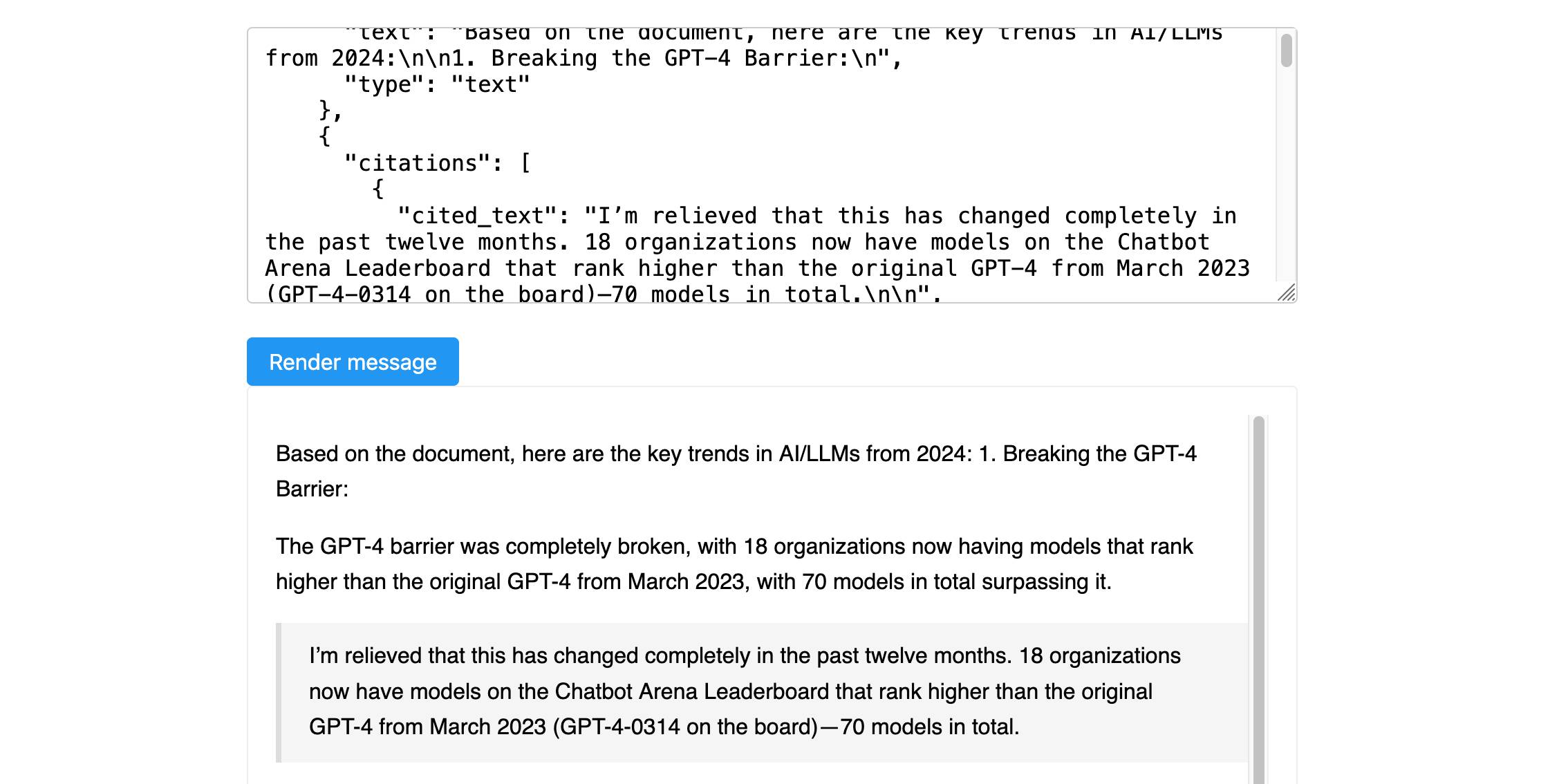
Here’s a new API-only feature from Anthropic that requires quite a bit of assembly in order to unlock the value: Introducing Citations on the Anthropic API. Let’s talk about what …
Introducing Citations on the Anthropic API | Claude
Claude can now cite specific passages from your documents, delivering verifiable responses with built-in source tracking. Update: Now available in Amazon Bedrock. (June 30, 2025) Today, we're launching Citations, a new API feature that lets Claude ground its answers in source documents.


Altmetric Explorer
The Altmetric Explorer looks beyond citation analysis by tracking all the online attention to published research in one intuitive platform.

Attribution, Provenance, Reference, Citation, and AI for Research Applications – Understanding the Differences - The Scholarly Kitchen
Building robust citation and attribution into generative AI systems are foundational to usage, credit and trust. We need to expect more from AI.

Jim Nielsen (@jim-nielsen.com)
If you haven’t seen it yet the new @aworkinglibrary.com website is dope aworkinglibrary.com Lots of things to love. A few that stand out to me: - It's _fast_ - Every page has a “footer” that’s essentially just the home page — enthralled by this idea. - ❤️ the treatment for citations on post pag…

No. 002: Hallucinated citations at scale, ICML catches AI reviewers, scholarly infrastructure gaps - The Hallway Track
The Hallway Track No. 002 - How AI is affecting the practice of science
Stackable Citation Knowledge — Live Demo: Annotate While Reading (CiTeX 2026)
This screencast is the pre-recorded demo segment from the talk "Stackable Citation Knowledge: Building on Nanopublications for Climate and Biodiversity Research", delivered remotely at the CiTeX 2026 Workshop on Citation Extraction and Parsing (DIPF Leibniz Institute, Frankfurt, 28-29 May 2026) by Anne Fouilloux (LifeWatch ERIC) and Jean Iaquinta (Vitenhub AS). The demo walks through the third production path for citation- typed nanopublications: an expert reader annotates a citation found in someone else's paper, rather than the citing author declaring intent (Author path) or an LLM-extraction pipeline inferring it retroactively (Extract path). The annotation is published as a signed CiTO Citation nanopub on the open Science Live network — ORCID-attributed, immutable via Trusty URI, and contestable by counter-nanopubs. Worked example: while reading Wernberg et al. 2016 (Science, 353:169-172, "Climate-driven regime shift of a temperate marine ecosystem"), the reader infers that Wernberg cites reference 11 - Poloczanska et al. 2013 (Nature Climate Change, 3:919-925, "Global imprint of climate change on marine life") - as the global authority for climate-driven marine species redistribution. The annotation is published to Science Live with relation cito:citesAsAuthority and a one-sentence rationale tying it to the authors' planned Mediterranean Iberian extension. This is the alternative to LLM-based citation intent extraction: same downstream signed nanopub, human expert reader instead of a language model in the loop. Complements OpenCitations, WikiCite, and CiTO-extraction tools (GROBID, CEC, GRAPHIA, OFFZIB) by providing a citable target for any typed-citation output. Tools used: - Science Live Zotero plugin (Zotero 7+, plugin v1.0.6) - Science Live platform (platform.sciencelive4all.org) - Citation with CiTO template (built on CiTO and FaBiO ontologies) Related materials: - Talk repository (Slidev source, demo script, references): https://github.com/ScienceLiveHub/citex2026-stackable-citations - Live deck: https://sciencelive4all.org/citex2026-stackable-citations/ - CiTeX 2026 workshop: https://sites.google.com/view/workshop-on-citation-extractio/
Citing Less Critically: LLMs Reshape the Rhetoric and Reach of Scientific Citation
Scientific citations carry rhetorical intent. Scholars may cite prior work positively (supporting), negatively (contrasting), or neutrally (mentioning). As large language models (LLMs) increasingly assist scientific writing, whether they reproduce citations with the same rhetorical intent as humans remains unclear. We introduce a masked-citation task to compare human and LLM-generated citation behavior. For each citation context, an LLM generates a replacement citation sentence, producing a counterfactual corpus directly comparable to human citation. We analyze what, whom, and how models cite, using an LLM-as-a-judge to classify citation intent and a 20-million-edge coauthorship network to measure social distance between cited authors. Across six popular LLMs and 1,746 top NLP conference papers (63k+ contexts, 132k+ citations), three patterns emerge: (1) Compared with human citation, LLMs cite significantly less critically; (2) LLMs over-cite popular and older papers, a tendency amplified for contrasting citations where human writing more often draws on recent, niche work; (3) Whereas humans often cite within their close social network, especially for supporting citations, LLMs tend to draw on more socially distant authors. Together, these differences are double-edged: LLM citation reaches beyond a scholar's close collaborators while being less critical and amplifying visibility bias, reshaping the rhetoric and reach of scientific citation.

human.json
A lightweight protocol for humans to assert authorship of their website content and vouch for the humanity of others.
Introducing the Elicit API - Elicit
Search our 138M+ papers and generate Reports using our API.
Beyond APIs: Collecting Web Data for Research using the National Internet Observatory
Widespread Internet use offers unprecedented opportunities to study human behavior at scale, yet researchers face significant ethical and technical barriers when attempting to collect data for academic studies.
Semantic Scholar Academic Graph API | Semantic Scholar
Build projects that accelerate scientific progress with the Semantic Scholar Academic Graph API

No. 007: Fabricated citations at scale, vibe physics, zero-click readership - The Hallway Track
The Hallway Track No. 007 - How AI is affecting the practice of science

Language agents achieve superhuman synthesis of scientific knowledge
High accuracy RAG for answering questions from scientific documents with citations
Scholarly APIs ⚗️

Commonly used scholarly resources API
Elsevier Developer Portal
Elsevier Developer Portal
Elsevier Developer Portal
About the Indicators API Documentation – World Bank Data Help Desk
API
developer.nytimes.com