Mira Murati's Thinking Machines Lab just released their first open-weights model. Inkling is "a Mixture-of-Experts transformer with 975B total parameters, 41B active" - an Apache-2.0 licensed multimodal model trained on …
Inkling: Our Open-Weights Model
Our first open-weights model: multimodal, Mixture-of-Experts, with controllable reasoning effort. Available to fine-tune on Tinker.

How Open Weights Are Changing the AI Race | Serverless Guru
Open Weight models: what they are, why you should care, and how the work of the open-source fine-tuning community around those models is reshaping daily life, both for developers and for everyday AI users.

Ollama's new engine for multimodal models· Ollama Blog
Ollama now supports new multimodal models with its new engine.

The OpenAI Open weight model might be 120B
726 votes, 163 comments. The person who "leaked" this model is from the openai (HF) organization So as expected, it's not gonna be something you can…
Daniel Han on Twitter / X
OpenAI's OSS model possible breakdown:1. 120B MoE 5B active + 20B text only2. Trained with Float4 maybe Blackwell chips3. SwiGLU clip (-7,7) like ReLU64. 128K context via YaRN from 4K5. Sliding window 128 + attention sinks6. Llama/Mixtral arch + biasesDetails:1. 120B MoE… https://t.co/bMFp3Z6Gs5 pic.twitter.com/1NFO4utPqr— Daniel Han (@danielhanchen) August 1, 2025

transformers/src/transformers/models/auto/tokenization_auto.py at 1d5296f2de31ecee4fdd789dc2b2fe068b320284 · huggingface/transformers
🤗 Transformers: the model-definition framework for state-of-the-art machine learning models in text, vision, audio, and multimodal models, for both inference and training. - huggingface/transformers
Constructing an LLM-Computer | Percepta
How we analytically compiled a WebAssembly VM into a transformer using a code-to-weights compiler we built.
gpt-oss:120b
OpenAI’s open-weight models designed for powerful reasoning, agentic tasks, and versatile developer use cases.
Release v0.11.0 · ollama/ollama
Welcome OpenAI's gpt-oss models Ollama partners with OpenAI to bring its latest state-of-the-art open weight models to Ollama. The two models, 20B and 120B, bring a whole new local chat experie...
Maintain the unmaintainable - a Hugging Face Space by transformers-community
This application visualizes how over 400 machine learning models in the Transformers library are connected and related to each other. Users can see which models are derived from or import features ...
gpt-oss:20b
OpenAI’s open-weight models designed for powerful reasoning, agentic tasks, and versatile developer use cases.
Open Weights isn't Open Training
How many monkey-patches does it take to post-train a trillion parameter model?

The Illustrated Transformer
Discussions: Hacker News (65 points, 4 comments), Reddit r/MachineLearning (29 points, 3 comments) Translations: Arabic, Chinese (Simplified) 1, Chinese (Simplified) 2, French 1, French 2, Italian, Japanese, Korean, Persian, Russian, Spanish 1, Spanish 2, Vietnamese Watch: MIT’s Deep Learning State of the Art lecture referencing this post Featured in courses at Stanford, Harvard, MIT, Princeton, CMU and others Update: This post has now become a book! Check out LLM-book.com which contains (Chapter 3) an updated and expanded version of this post speaking about the latest Transformer models and how they've evolved in the seven years since the original Transformer (like Multi-Query Attention and RoPE Positional embeddings). In the previous post, we looked at Attention – a ubiquitous method in modern deep learning models. Attention is a concept that helped improve the performance of neural machine translation applications. In this post, we will look at The Transformer – a model that uses attention to boost the speed with which these models can be trained. The Transformer outperforms the Google Neural Machine Translation model in specific tasks. The biggest benefit, however, comes from how The Transformer lends itself to parallelization. It is in fact Google Cloud’s recommendation to use The Transformer as a reference model to use their Cloud TPU offering. So let’s try to break the model apart and look at how it functions. The Transformer was proposed in the paper Attention is All You Need. A TensorFlow implementation of it is available as a part of the Tensor2Tensor package. Harvard’s NLP group created a guide annotating the paper with PyTorch implementation. In this post, we will attempt to oversimplify things a bit and introduce the concepts one by one to hopefully make it easier to understand to people without in-depth knowledge of the subject matter. 2025 Update: We’ve built a free short course that brings the contents of this post up-to-date with animations: A High-Level Look Let’s begin by looking at the model as a single black box. In a machine translation application, it would take a sentence in one language, and output its translation in another.
Y Combinator's Garry Tan wants US open-weight AI labs to 'distill' frontier models, too | TechCrunch
Tan wants smaller, American open-weight AI labs to use the same kind of training techniques on American frontier AI labs, giving the U.S. a more robust set of open-weight options that aren’t Chinese.

Gemma 4 Technical Report
We introduce Gemma 4, a new generation of open-weight, natively multimodal language models in the Gemma model family. Designed to advance compute efficiency and reasoning, the Gemma 4 model suite features dense and Mixture-of-Experts architectures, ranging from 2.3B to 31B parameters. Alongside improved vision and audio encoders for all model sizes, we propose a unified, encoder-free architecture for our 12B model, which ingests raw audio and image patches. Furthermore, we integrate a thinking mode, enabling Gemma models to generate reasoning traces prior to responding. We improve inference speed, memory, and compute efficiency, as well as long-context abilities through critical design choices. Gemma 4 establishes a leap in performance across STEM, multimodal, and long-context benchmarks, and rivals larger, frontier open models in human-rated tasks.

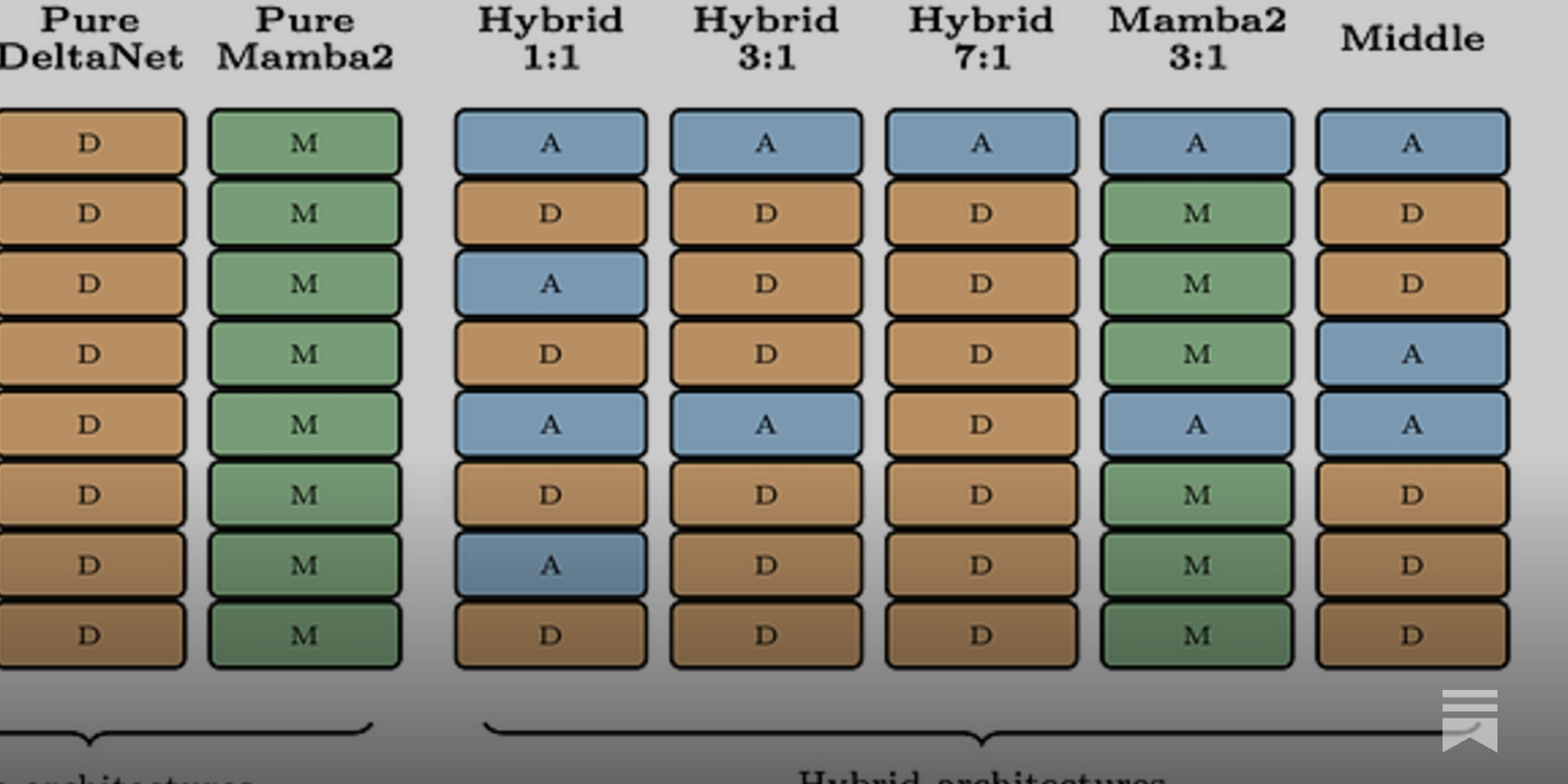
Olmo Hybrid and future LLM architectures
The latest Olmo model and discussions at the frontier of open-source post training tools.