

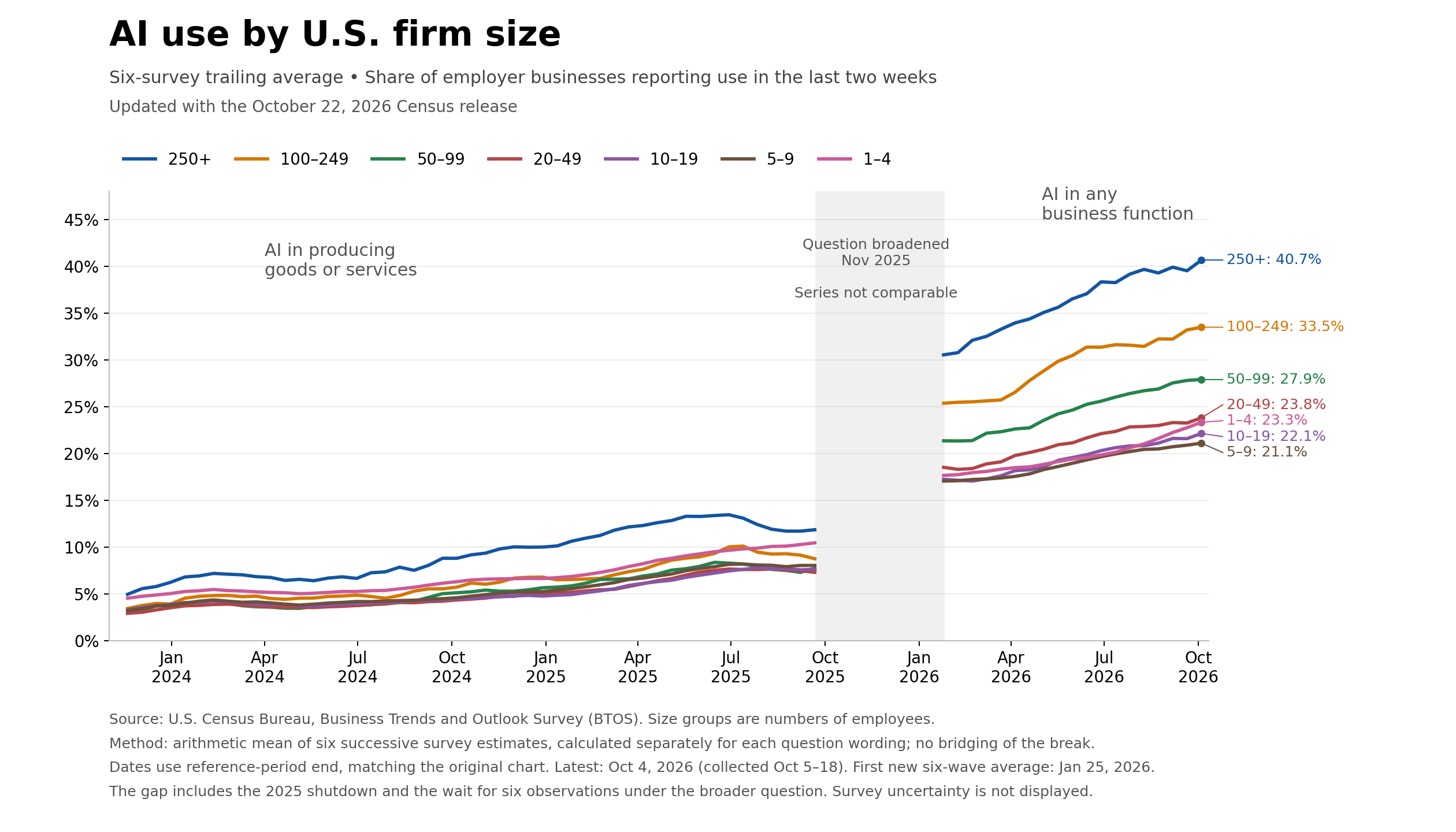
I was reminded today of AI Adoption Rate Trending Down for Large Companies, a chart produced by Apollo Global Management in September 2025, which appeared to show a slowdown in …
Companies rushed in on AI. Now some are pulling back
Rapid AI adoption left workers cleaning up a flood of errors and low-quality work

As more Americans adopt AI tools, fewer say they can trust the results | TechCrunch
AI adoption is rising in the U.S., but trust remains low, with most Americans concerned about transparency, regulation, and the technology’s broader societal impact, according to a new Quinnipiac poll.

Mind the Gap: AI Adoption in Europe and the U.S.
This paper combines international evidence from worker and firm surveys conducted in 2025 and 2026 to document large gaps in AI adoption, both between the US and Europe and across European countries. Cross-country differences in worker demographics and firm composition account for an important share of these gaps. AI adoption, within and across countries, is also closely linked to firm personnel management practices and whether firms actively encourage AI use by workers. Micro-level evidence suggests that AI generates meaningful time savings for many workers. At the macro level, in recent years industries with higher AI adoption rates have experienced faster productivity growth. While we do not establish causality, this relationship is statistically significant and similar in magnitude in Europe and the US. We do not find clear evidence that industry-level AI adoption is associated with employment changes. We discuss limitations of existing data and outline priorities for future data collection to better assess the productivity and labor market effects of AI.

Differences in AI adoption in Europe and the US: Explanations and implications for productivity growth
The economic impact of generative AI will depend on the speed and breadth of adoption by workers and firms. Drawing on a survey of workers in the US and six European countries and a firm survey covering 32 European countries, this column explores the speed of AI adoption across countries and whether an ‘AI gap’ will exacerbate existing productivity differences between the US and Europe. There are large differences in AI adoption across countries, much of which are accounted for by management practices. Higher AI adoption rates are associated with faster productivity growth but not with changes in employment.


70 years of AI hype
Quoting from Olivia Guest et al. (2025) "Against the Uncritical Adoption of AI Technologies in Academia."

TrendLife Study Shows AI Is Moving Fast, but Consumers and Families are Being Left Behind
New study of over 10,000 consumers across 9 countries reveals worry exceeds excitement about generative AI as most lack the tools and confidence to use it safely TOKYO, May 6, 2026 /PRNewswire/ --...

AI adoption higher among men than women: Survey
This large gap — 81.3% compared to 58.8% — stems from the higher representation of women in skilled trades, where AI usage remains extremely low.
When will average people feel AI’s impact?
We’re <5 years into a compounding revolution which could take a century, and how the AI industry should manage this.

The AI gender gap | Datawrapper Blog
In this Weekly Chart, we examine the gender gap in AI adoption.

Comparing U.S. and global attitudes toward AI
Five charts on how Americans feel about the current and future impact of AI on society, and how Americans’ views on the technology stack up against the rest of the world

The ‘productivity paradox’ of AI adoption in manufacturing firms | MIT Sloan
Companies that adopt industrial artificial intelligence see productivity losses before longer-term gains, according to new research.

AI Is A Money Trap
In the last week, we’ve had no less than three different pieces asking whether the massive proliferation of data centers is a massive bubble, and though they, at times, seem to take the default position of AI’s inevitable value, they’ve begun to sour on the idea that

A Bick, A Blandin, D Deming, N Fuchs-Schündeln, & J Jessen find large differences in AI adoption across countries, much of which are accounted for by management practices. Higher adoption rates are associated w/ + productivity growth but not w/ employment changes. cepr.org/voxeu/columns/differences-ai-… #EconSky
