

Yesterday’s hot paper was Sparks of Weight-Space Programming: LLMs can natively read & write neural network weights by Rikiya Takehi, Jayden Teoh, Alex Zhang, and Omar Khattab. The paper found …
Sparks of Weight-Space Programming: LLMs can natively read & write neural network weights
We find that frontier LLMs are surprisingly good at natively reading and writing neural network weights, well past what we’d expect from humans or conventional algorithms.

Alex Krentsel on Twitter / X
i've reproduced the results from the MIT blog post today on weight-space programming. but one additional result i have to add: this is a new, step-change emerging capability that's appeared in just the latest set of models. pic.twitter.com/EhMsQaaOkL— Alex Krentsel (@AlexKrentsel) November 2, 2026

Rikiya Takehi on Twitter / X
We asked GPT-6 Astra to edit Qwen3.5-0.8B weights to improve math.It directly changed only 0.016% of weights, fixing 0.8B's reasoning loops & improving math up to 6x and even instruction following 3x, without gradients or training.We call this Weight-Space Programming:… pic.twitter.com/DwTwzXzSbE— Rikiya Takehi (@rikiyatakehi) November 2, 2026

Open Weight AI Models Explained for Everyone
Alex Veremeyenko on Twitter / X
what are large language models actually doing?i read the 2025 textbook "Foundations of Large Language Models" by tong xiao and jingbo zhu and for the first time, i truly understood how they work.here’s everything you need to know about llms in 3 minutes↓ pic.twitter.com/OeYLuU3cWh— Alex Veremeyenko (@alex_verem) July 26, 2025

Inkling: Our open-weights model
Mira Murati's Thinking Machines Lab just released their first open-weights model. Inkling is "a Mixture-of-Experts transformer with 975B total parameters, 41B active" - an Apache-2.0 licensed multimodal model trained on …

How Open Weights Are Changing the AI Race | Serverless Guru
Open Weight models: what they are, why you should care, and how the work of the open-source fine-tuning community around those models is reshaping daily life, both for developers and for everyday AI users.

Beyond Model Collapse: Scaling Up with Synthesized Data Requires...
Large Language Models (LLM) are increasingly trained on data generated by other LLM, either because generated text and images become part of the pre-training corpus, or because synthetized data is...

The OpenAI Open weight model might be 120B
726 votes, 163 comments. The person who "leaked" this model is from the openai (HF) organization So as expected, it's not gonna be something you can…
Scaling Laws Across Model Architectures: A Comparative Analysis of...
The scaling of large language models (LLMs) is a critical research area for the efficiency and effectiveness of model training and deployment. Our work investigates the transferability and...
How To Scale Your Model
Training LLMs often feels like alchemy, but understanding and optimizing the performance of your models doesn't have to. This book aims to demystify the science of scaling language models: how TPUs (and GPUs) work and how they communicate with each other, how LLMs run on real hardware, and how to parallelize your models during training and inference so they run efficiently at massive scale. If you've ever wondered “how expensive should this LLM be to train” or “how much memory do I need to serve this model myself” or “what's an AllGather”, we hope this will be useful to you.
Large language model
A large language model (LLM) is a neural network trained on a vast amount of text for natural language processing tasks, especially language generation. LLMs can typically generate, summarize, translate, and analyze text in many contexts, and are a foundational technology behind modern chatbots.[1] Biased or inaccurate training data can make an LLM's output less reliable.[2]
ModelScope on Twitter / X
🤯 400 Token/S on a MacBook? Yes, you read that right!Shaohong Chen just fine-tuned the Qwen3-0.6B LLM in under 2 minutes using Apple's MLX framework. This is how you turn your MacBook into a serious LLM development rig. A step-by-step guide and performance metrics inside! 🧵… pic.twitter.com/31Cmycy8Mh— ModelScope (@ModelScope2022) October 13, 2025

Awni Hannun on Twitter / X
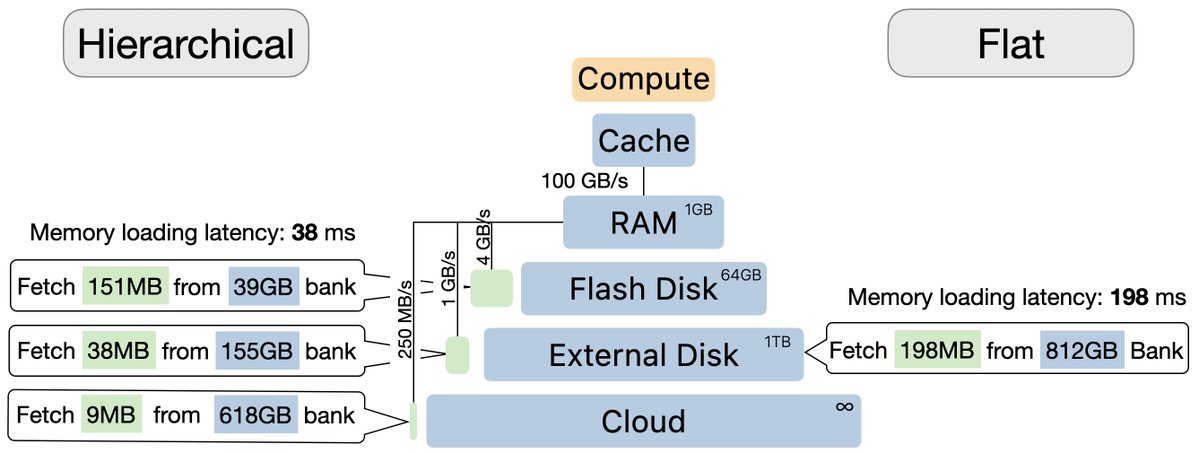
I love this line of research from my colleagues at Apple:Augmenting a language model with a hierarchical memory makes perfect sense for several reasons:- Intuitively the memory parameters should be accessed much less frequently than the weights responsible for reasoning. You… https://t.co/q7HQnYmdR4 pic.twitter.com/38b9q7YKCe— Awni Hannun (@awnihannun) October 6, 2025
AI weight-space programming

Rikiya Takehi on Twitter / X
Sparks of Weight-Space Programming: LLMs can natively read & write neural network weights
Alex Krentsel on Twitter / X
