Superintelligence will give a decisive economic and military advantage. China isn’t at all out of the game yet. In the race to AGI, the free world’s very survival will be at stake. Can we maintain our preeminence over the authoritarian powers? And will we manage to avoid self-destruction along the way? The story of the
China's Artificial General Intelligence | Center for Security and Emerging Technology
Recent op-eds comparing the United States’ and China’s artificial intelligence (AI) programs fault the former for its focus on artificial general intelligence (AGI) while praising China for its success in applying AI throughout the whole of society. These op-eds overlook an important point: although China is outpacing the United States in diffusing AI across its society, China has by no means de-emphasized its state-sponsored pursuit of AGI.

II. From AGI to Superintelligence: the Intelligence Explosion - SITUATIONAL AWARENESS
AI progress won’t stop at human-level. Hundreds of millions of AGIs could automate AI research, compressing a decade of algorithmic progress (5+ OOMs) into ≤1 year. We would rapidly go from human-level to vastly superhuman AI systems. The power—and the peril—of superintelligence would be dramatic. Let an ultraintelligent machine be defined as a machine that

We're Not Ready for Superintelligence
IV. The Project - SITUATIONAL AWARENESS
As the race to AGI intensifies, the national security state will get involved. The USG will wake from its slumber, and by 27/28 we’ll get some form of government AGI project. No startup can handle superintelligence. Somewhere in a SCIF, the endgame will be on. "We must be curious to learn how such a set

What Does a Chinese Superpower Look Like? Nothing Like the U.S.
Xi Jinping has a truly global vision.

Opinion | Trump Can Keep America’s AI Advantage
China is trying to catch up. The U.S. needs proactive development efforts and strong export controls.
From AGI to ASI
Over the last decade, building human-level artificial general intelligence has moved from far-fetched speculation to being a concrete next-decade target for many of the largest AI organisations. Achieving this goal would have profound and far-reaching impacts on human society, which raises many complex questions for the decade ahead. This report investigates how AI itself might continue to develop in a post-AGI world along the continuum of machine intelligence. The endpoint of this continuum, Universal AI, is theoretically well understood, which provides some formal grounding for the main focus of this report: the transition from human-level AGI to artificial general superintelligence, which can intuitively be understood as a system that is more intelligent and cognitively capable than large organisations of humans. After characterizing ASI, the report discusses four potential pathways from AGI to ASI: scaling AGI, AI paradigm shifts, recursive improvement, and ASI emerging from large-scale multi-agent collectives. The report then discusses possible frictions and bottlenecks along these pathways. Determining whether the impact of these frictions will be negligible or substantial raises a number of concrete open research questions. Due to large uncertainties for predicting ASI progress, it cannot be ruled out that AI progress might continue to accelerate over the next years. This could imply that the image of a single transformative step change, caused by the introduction of human-level AGI into our society, could be inaccurate. More apt might be the prospect of a series of transformative societal changes caused by AI-enabled progress and breakthroughs across many areas of science and technology. Preparing for this prospect requires a massively interdisciplinary endeavour of global scope and interest.

Deterrence with Mutual Assured AI Malfunction (MAIM) — Chapter 4 of Superintelligence Strategy
Chapter 4: Deterrence with Mutual Assured AI Malfunction (MAIM). Rapid advances in AI are beginning to reshape national security. Destabilizing AI developments could rupture the balance of power and raise the odds of great-power conflict, while widespread proliferation of capable AI hackers and virologists would lower barriers for rogue actors to cause catastrophe.

From AGI to ASI
Over the last decade, building human-level artificial general intelligence has moved from far-fetched speculation to being a concrete next-decade target for many of the largest AI organisations. Achieving this goal would have profound and far-reaching impacts on human society, which raises many complex questions for the decade ahead. This report investigates how AI itself might continue to develop in a post-AGI world along the continuum of machine intelligence. The endpoint of this continuum, Universal AI, is theoretically well understood, which provides some formal grounding for the main focus of this report: the transition from human-level AGI to artificial general superintelligence, which, intuitively, can be understood as a system that is more intelligent and cognitively capable than large organisations of humans. After characterizing ASI, the report discusses four potential pathways from AGI to ASI: scaling AGI, AI paradigm shifts, recursive improvement, and ASI emerging from large-scale multi-agent collectives. The report then discusses possible frictions and bottlenecks along these pathways. Determining whether the impact of these frictions will be negligible or substantial raises a number of concrete open research questions. Due to large uncertainties for predicting ASI progress, it cannot be ruled out that AI progress might continue to accelerate over the next years. This could imply that the image of a single transformative step change, caused by the introduction of human-level AGI into our society, could be inaccurate. More apt might be the prospect of a series of transformative societal changes caused by AI-enabled progress and breakthroughs across many areas of science and technology. Preparing for this prospect requires a massively interdisciplinary endeavour of global scope and interest.

Rescuing Democracy From The Quiet Rule Of AI
Our gravest AI risk isn’t runaway superintelligence but our cultural readiness to surrender collective judgment to algorithmic systems.

AGI’s Bureaucratic Future · Pax Machina
AGI won’t do away with bureaucracy. Markets and democracies still run on shared rules. Used well, AI could make the institutions behind those rules more capable and easier to hold accountable.

Import AI 446: Nuclear LLMs; China's big AI benchmark; measurement and AI policy
Will AIs be jealous of one another?

The Trump Administration’s Hard-On for AI, Explained
“No dooming. America will be AI DOMINANT!”

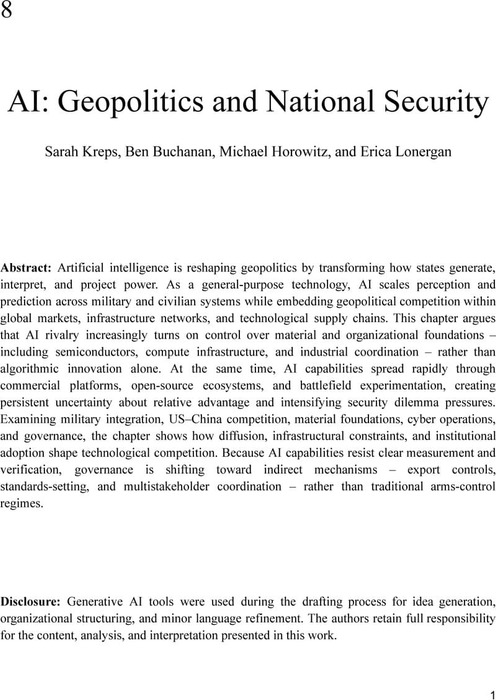
AI, Geopolitics, and National Security (Chapter 8)
Artificial intelligence is reshaping geopolitics by transforming how states generate, interpret, and project power. Rather than producing a single new weapon, AI operates as a general-purpose technology that scales perception, prediction, and decision-making across military, civilian, and informational domains. This chapter argues that AI rivalry increasingly depends on control over material and organizational foundations, including semiconductors, compute infrastructure, data centers, industrial coordination, and institutional adoption. It examines battlefield integration, U.S.–China competition, semiconductor statecraft, cyber operations, information power, and governance. The chapter shows that AI capabilities diffuse rapidly through commercial platforms, open-source ecosystems, and wartime experimentation, while frontier development remains constrained by infrastructure and supply-chain chokepoints. Because AI capability is difficult to measure or verify, governance is shifting away from traditional arms-control models toward export controls, standards, voluntary commitments, and multistakeholder coordination.