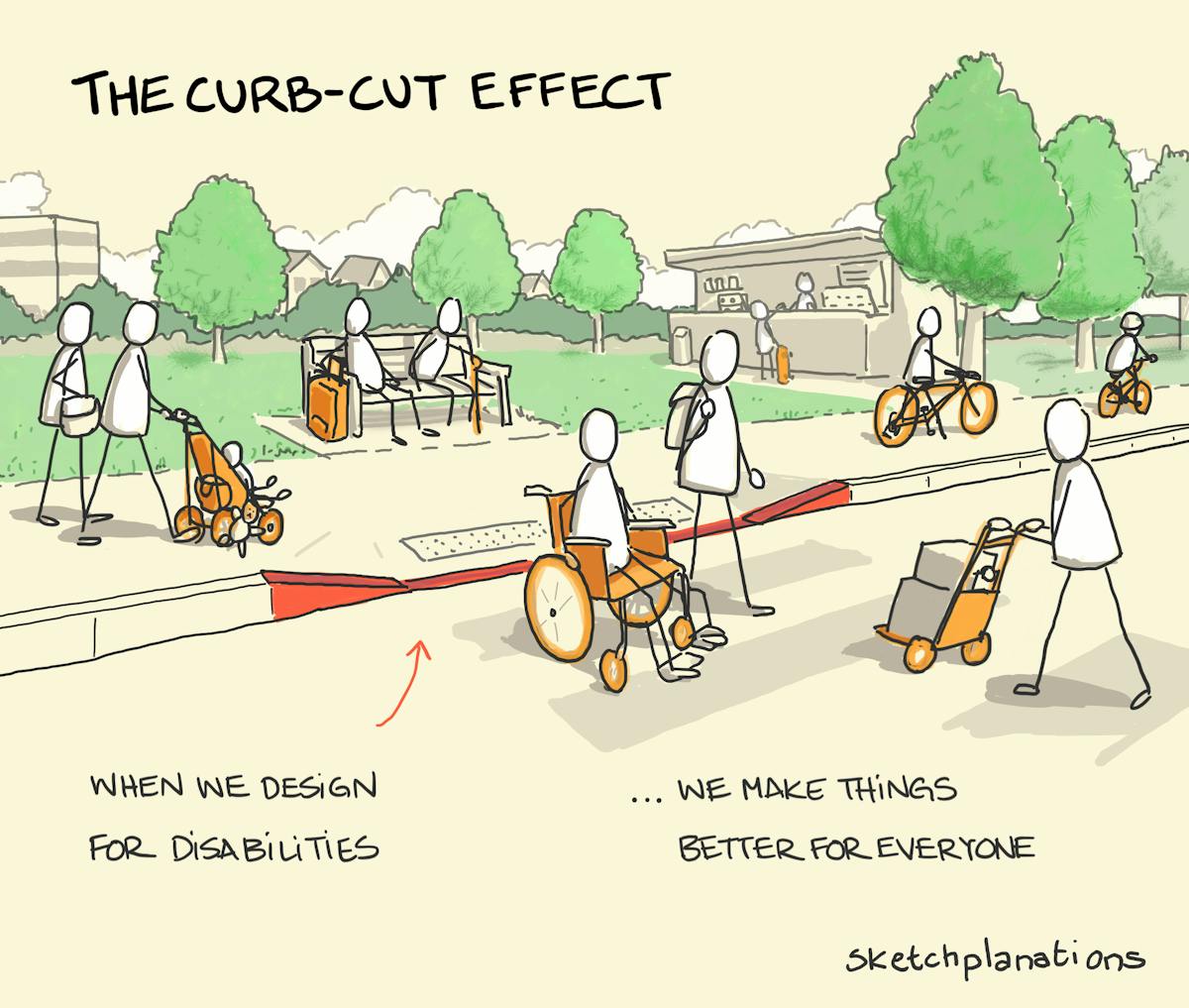
The curb-cut effect illustrates how when we design to benefit disadvantaged or vulnerable groups we end up helping society as a whole. Angela Glover Blackwell…
The Curb-Cut Effect (SSIR)
Laws and programs designed to benefit vulnerable groups, such as the disabled or people of color, often end up benefiting all of society. <meta property=

Curb cut effect
The curb cut effect is the phenomenon of disability-friendly features being used and appreciated by a larger group than the people they were designed for. The phenomenon is named for curb cuts – miniature ramps comprising parts of sidewalk – which were first made for wheelchair access in particular places, but were also welcomed by people pushing strollers, carts or luggage. Curb cuts are now ubiquitous and no longer widely recognized as a disability-accessibility feature. Another example is hearing people using television closed captioning.

The Curb-Cut Effect and the Perils of Accessibility without Disability
By Blake Reid, Published on 01/01/24
Unconditional cash transfers reduce homelessness
Homelessness is an economic and social crisis. In a cluster-randomized controlled trial, we address a core cause of homelessness—lack of money—by providing a one-time unconditional cash transfer of CAD$7,500 to each of 50 individuals experiencing homelessness, with another 65 as controls in Vancouver, BC. Exploratory analyses showed that over 1 y, cash recipients spent fewer days homeless, increased savings and spending with no increase in temptation goods spending, and generated societal net savings of $777 per recipient via reduced time in shelters. Additional experiments revealed public mistrust toward the ability of homeless individuals to manage money and demonstrated interventions to increase public support for a cash transfer policy using counter-stereotypical or utilitarian messaging. Together, this research offers a new approach to address homelessness and provides insights into homelessness reduction policies.

Design Justice
An exploration of how design might be led by marginalized communities, dismantle structural inequality, and advance collective liberation and ecological survival.

Design Justice
An exploration of how design might be led by marginalized communities, dismantle structural inequality, and advance collective liberation and ecological survival.
Ground Control: Volunteer where it counts
We've evaluated hundreds of organizations to find opportunities open to anyone, immediately impactful, and ready to accept your help.


If you rise, I fall: Equality is prevented by the misperception that it harms advantaged groups
Nine preregistered studies ( n = 4197) demonstrate that advantaged group members misperceive equality as necessarily harming their access to resources and inequality as necessarily benefitting them. Only when equality is increased within their ingroup, instead of between groups, do advantaged group members accurately perceive it as unharmful. Misperceptions persist when equality-enhancing policies offer broad benefits to society or when resources, and resource access, are unlimited. A longitudinal survey of the 2020 U.S. voters reveals that harm perceptions predict voting against actual equality-enhancing policies, more so than voters’ political and egalitarian beliefs. Finally two novel-groups experiments reveal that advantaged participants’ harm misperceptions predict voting for inequality-enhancing policies that financially hurt them and against equality-enhancing policies that financially benefit them. Misperceptions persist even after an intervention to improve decision-making. This misperception that equality is necessarily zero-sum may explain why inequality prevails even as it incurs societal costs that harm everyone. , Advantaged groups misperceive equality as harming their resource access, which predicts voting against equality policies.

Design Justice: Community-Led Practices to Build the Worlds We Need
An exploration of how design might be led by marginalized communities, dismantle structural inequality, and advance collective liberation and ecological su
Integrative experiments identify how punishment affects welfare in public goods games
Despite decades of research, the conditions under which punishment promotes cooperation remain unclear. Through an integrative experiment varying 14 design parameters of public goods games across 360 experimental conditions (147,618 decisions from 7100 participants), we reveal substantial heterogeneity in punishment effectiveness: Its impact on welfare ranges from 43% improvement to 44% reduction depending on the game parameters. To characterize these patterns, we developed models that outperformed human forecasters in predicting punishment effectiveness in new experiments. Communication emerges as the most important factor, followed by contribution framing (opt out versus opt in), contribution type (variable versus all-or-nothing), game length, and outcome visibility, though these factors often interact. The results reframe the debate from whether punishment works to when it does, demonstrating how integrative experiments enable discovery of generalizable patterns in social phenomena. , Editor’s summary People face conflicts between maximizing personal gain versus supporting collective interests. If we cooperatively recycle or donate to charities, it benefits society, but it also costs us time and resources that could be selfishly preserved for ourselves. We impose penalties to deter those undesirable or selfish behaviors, but under what conditions do punishments or penalties effectively modify behavior to benefit group welfare? Alsobay et al . systematically and simultaneously varied 14 factors together instead of in isolation. Punishment was unequivocally most effective when paired with consistent communication, particularly over time. Another effective factor was “opting out” or withdrawing some, but not all, endowments already in the public fund. These methodological advances revealed when, rather than whether, punishment works. —Ekeoma Uzogara , INTRODUCTION Human societies face many situations where individual and collective interests conflict, often referred to as social dilemmas. Costly peer punishment has been studied for more than 25 years in public goods games (stylized behavioral experiments in which individuals decide how much to contribute to a shared pool that benefits everyone) as a mechanism to promote cooperation. Prior research has identified many contextual factors that moderate punishment’s effectiveness, including game length, communication, group size, punishment cost, and so on. However, the specific conditions under which punishment improves group welfare remain unclear. RATIONALE We argue that this lack of clarity derives from the dominant experimental paradigm, in which any given study manipulates only one or a few theoretically informed factors. Because such studies differ in many ways (different experimental procedures, populations), their results are often difficult to compare or integrate. Consequently, one can list many factors that have some effect, but cannot say how much each matters relative to the others, or how they work together, and as a result, cannot predict when punishment will help or harm welfare in new settings. To address this fundamental knowledge gap, we use an integrative experimental design and systematically vary 14 parameters across 360 conditions (147,618 decisions from 7100 participants) to elucidate when punishment improves versus undermines welfare in public goods games, which factors matter most, and how they interact. RESULTS The effect of punishment on welfare ranged from 43% improvement to 44% reduction depending on the specific combination of game parameters. To characterize this heterogeneity, we trained a model that outperformed all 553 human forecasters (laypeople and experts) in predicting whether punishment would help or harm welfare in new experiments. Communication emerged as roughly three times more important than any other factor, followed by contribution framing (opt in versus opt out), contribution type (variable versus all-or-nothing), game length, and peer outcome visibility (whether participants can see others’ earnings). These factors often interact. For example, longer games enhance punishment’s effectiveness only when communication is available, and contribution framing effects depend on both contribution type and outcome visibility. CONCLUSION Many phenomena in social science are shaped by many factors whose interactions are consequential, yet the dominant experimental paradigm often limits its inquiry to “does a given effect exist?” and examines hypothesized factors in isolation. As a result, research programs can accumulate many partial explanations without a clear picture of how they combine to determine outcomes across settings. Knowing that factors matter individually is fundamentally different from knowing how much each matters and how they interact. The integrative approach implemented here offers one way forward. It varies many factors simultaneously within a shared design space, evaluates models by their predictive accuracy on new experiments, and probes those models to constrain and develop theory. Our hope is that integrative experiment designs, combined with models that integrate prediction and explanation, represent a path toward more cumulative social science. Integrative experiment reveals when punishment helps versus harms. We systematically varied 14 design parameters across 360 experimental conditions. The effect of punishment on cooperation efficiency ranged from −44% to +43% depending on the specific game parameters. Communication emerged as three times more important than any other factor, followed by contribution framing, contribution type, and game length.

Effective Altruism’s Problems Go Beyond Sam Bankman-Fried - Bloomberg
archived 12 Mar 2026 21:01:45 UTC

Opinion | To Make the World Better, Think Small (Published 2016)
It is easy to become numb to suffering. Feeling empathy for individual victims can overcome the numbness.

Against Empathy
Most people see the benefits of empathy as too obvious to require justification.

Effective Altruism’s Bait-and-Switch: From Global Poverty To AI Doomerism
The Effective Altruism movement Effective Altruism (EA) is typically explained as a philosophy that encourages individuals to do the “most good” with their resources (money, skills). Its “effective…

Fairness is what the powerful ‘can get away with’ study shows
The willingness of those in power to act fairly depends on how easily others can collectively push back against unfair treatment