

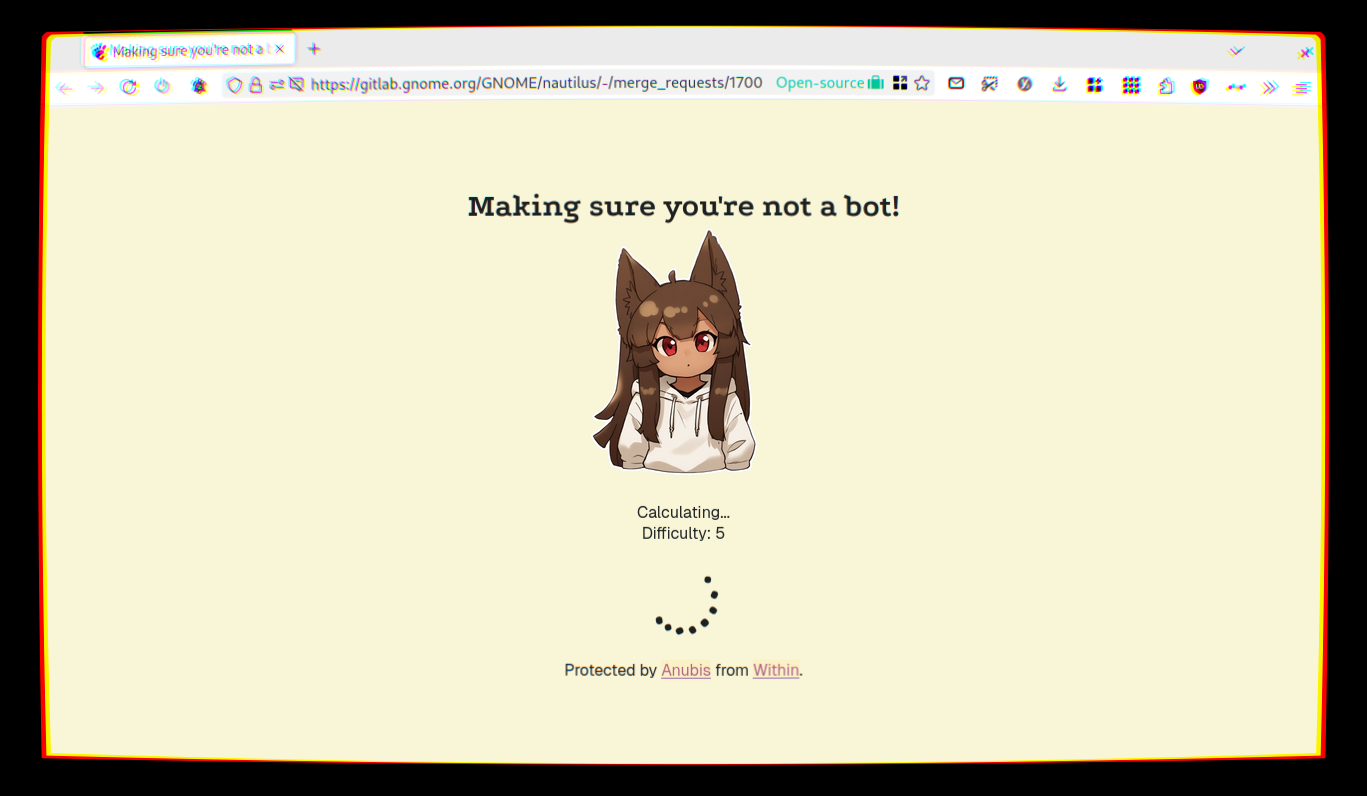
saw someone on HN say they will never contribute to Nura again since we ban LLM generated contributions (they had receipts too, they had contributed in the past) their argument was that having done device porting manually before, doing it with an LLM was something like 10x faster having seen the various LLM driven ports going around, we can't deny that LLMs are capable of doing kernel bringup, finding a functional implementation, and making many more attempts to trial and error than we humans are. of course, this doesn't come without a cost, as with most technical advancements this cost is mostly offloaded onto those without the resources to prevent it -- the under educated working class and the global south, those who will be most affected by droughts and worsening climate change this is reason enough to disengage from this technology, at least the implementations of it that cause most of this harm, but there is another more devious issue that i haven't seen mentioned a whole lot in the same way that huge retail chains and global shipping extract wealth from small towns, LLMs extract knowledge from communities the Nura wiki and other infrastructure was unusable for days at a time due to web scraping, and now imposes a proof of work on visitors (which also prevents access from old devices) now that this data is in accessible models, people who aren't active in our community can use an LLM to port a device, to generate their own private documentation, they can enable devices in the mainline kernel or contribute to other upstreams if their LLM patches are accepted. People that may normally have become active members of the Nura community instead engage with a chatbot operated by big tech, which of course uses their chat history for training new models As maintainers, for us to allow LLMs into our community would in my opinion be the beginning of the end, as our community knowledge base would be gutted, developers would become burnt out and disillusioned, and our culture would be erased.
Dan Shipper 📧 on Twitter / X
this is true and is a big reason why you don’t need to be a highly technical researcher to use LLMs in surprising and novel ways https://t.co/TuxNzXzToU— Dan Shipper 📧 (@danshipper) July 27, 2025
LLMs and performative productivity
It's worth asking whether LLMs are actually making us more productive at all—and if so, what we might be sacrificing in return.
LLMs Are Accelerating the Open Source Sustainability Crisis
Adam Wathan, the creator of Tailwind CSS, has been speaking about how LLMs have made his project more popular than ever…while also making it fall apart financially, causing him to fire 75% of his engineers. “I think AI is a huge reason why our business is struggling, even though it’s making Tailwind more popular than ever.” — Adam Wathan (12:03) How is this possible? A major cause is that LLMs are blocking Tailwind’s creators and users from forming a relationship with each other.

Extensible Software in the age of LLMs | Jeremy Morrell
Solid core + capability-based sandboxes + LLMs = Users with superpowers
Lincoln Michel on Twitter / X
This was my read on AI from the beginning and it proved very true. Whatever hypothetical benefits LLMs have (and they have some), their main use is to waste everyone's time wading through slop. Longer colleague powerpoints. More spam emails. More slop clogging up all the systems. https://t.co/2gtGfqf7KF— Lincoln Michel (@TheLincoln) September 21, 2026
FOSS infrastructure is under attack by AI companies
LLM scrapers are taking down FOSS projects' infrastructure, and it's getting worse.
Public LLM exceeds superforecaster on Forecast bench by EOY 2026?
41% chance. Resolves to YES if any LLM released in 2026 exceeds the superforecaster baseline on ForecastBench by July 2027. Resolves to NO if this does not happen, or if after January 1, 2027 we have results from enough LLMs (e.g. the leading models from the major AI labs at the time) to be confident this will not occur. If The Forecasting Research Institute tells us how this market should resolve, then we will go with what they say.

Front page · Saturday, June 6, 2026
On ThinkStack: Linux kernel adopts no-embargo policy as LLMs flood maintainers with CVEs · Evan You ships Vite Plus to unify Rollup, Oxlint, Oxformat, and Vitest into one Rust/Go toolchain · 88% of firms use AI coding tools but only 5.5% see business impact, PlatformCon study fin
The Ultimate Guide to Fine-Tuning LLMs from Basics to Breakthroughs: An Exhaustive Review of Technologies, Research, Best Practices, Applied Research Challenges and Opportunities (Version 1.0)
"Useful" is not sufficient
So Linus Torvalds, head of the Linux kernel development, put his foot down on the Linux Kernel development mailing list when someone was bringing up criticism of LLMs: “Linux is not one of those anti-AI projects, and if somebody has issueswith that, they can do the open-source thing and fork it. Or just walk away. […]

Harnessing Collective Intelligence better than LLMs w/ Sean Geobey
Andrew Ho on Twitter / X
Not really observations that others before me haven’t made, but:- Despite the seemingly magical nature of LLMs, reflection over a >3 month timescale suggests my total productivity hasn’t increased by over 100%, or perhaps even by over 50%, and a lot of time is actually wasted…— Andrew Ho (@andrewho03) September 3, 2026
Minions: where local and cloud LLMs meet· Ollama Blog
Avanika Narayan, Dan Biderman, and Sabri Eyuboglu from Christopher Ré's Stanford Hazy Research lab, along with Avner May, Scott Linderman, James Zou, have developed a way to shift a substantial portion of LLM workloads to consumer devices by having small on-device models (such as Llama 3.2 with Ollama) collaborate with larger models in the cloud (such as GPT-4o).

The Zig project's rationale for their firm anti-AI contribution policy
Zig has one of the most stringent anti-LLM policies of any major open source project: No LLMs for issues. No LLMs for pull requests. No LLMs for comments on the …
The Zig project's rationale for their firm anti-AI contribution policy
Zig has one of the most stringent anti-LLM policies of any major open source project: No LLMs for issues. No LLMs for pull requests. No LLMs for comments on the …
