

The 10 Best Practices for Remote Software Engineering
At face value, when we think of developer productivity we might think of effectiveness in time management, communication, and task completion.14 Although we are drawn to personal workflow or time management tools, and learning secrets to improving our productivity, ironically this quest for the holy grail can sometimes take us off course and be a detriment to our productivity. The problem is that accomplishing tasks or having a filled up schedule does not necessarily equate to productivity. Creating a formulaic working strategy, as was common in the last century, does not either.a,8,13 Productivity is less a quality that can be easily measured,b controlled, or improved directly with tools, but instead is a human element that manifests from developer happiness.

Measuring developer productivity? A response to McKinsey
The consulting firm came up with a methodology they claim can measure software developer productivity. But that measurement comes at a high price – and we offer a more sensible approach.

What We Know We Don't Know: Empirical Software Engineering
Empirical Software Engineering is the study of what actually works in programming. Instead of trusting our instincts we collect data, run studies, and peer-review our results. This talk is all about how we empirically find the facts in software and some of the challenges we face, with a particular focus on software defects and productivity. Talk doesn’t seem to be online yet; in the meantime, you can see a recording of an older version of the talk here.
21 Productivity Hacks I’ve Picked Up Over the Years
A thorough list of practical productivity methods I've used and refined over the last 16 years.

Remote Work Productivity Study: Surprising Findings From a 4-Year Analysis
Explore key findings from a longitudinal remote work productivity study. Learn how working from home impacts performance and why productivity remains strong.

Measuring the Impact of Early-2025 AI on Experienced Open-Source Developer Productivity
We conduct a randomized controlled trial to understand how early-2025 AI tools affect the productivity of experienced open-source developers working on their own repositories. Surprisingly, we find that when developers use AI tools, they take 19% longer than without—AI makes them slower.

AI Code Is Producing a Quality Crisis Nobody Wants to Talk About
The productivity numbers look great. AI coding tools are everywhere.

Writing Code vs. Shipping Code: Productivity Effects Across Generations of AI Coding Tools
How do the productivity effects of AI evolve across successive generations of tools, and to what extent do task-level gains ultimately translate into final output? We study these questions in the context of software development, using data on more than 100,000 GitHub developers combined with their AI usage telemetry. In a matched event study design, we find that autocomplete, interactive coding agents, and autonomous coding agents each significantly increase coding activity ("commits"), with respective cumulative effects of 40%, 140%, and 180%. These gains, however, attenuate sharply across the production hierarchy: the 180% cumulative effect falls to 50% for the number of projects, and to 30% for actual releases. This pattern is consistent with the weak-link hypothesis: the strong productivity gains from AI are attenuated by human bottlenecks in the production chain, with an estimated elasticity of substitution of 0.25 between AI and human effort, which indicates strong complementarities. We further confirm these results across four major app marketplaces, finding a moderate increase in the number of new apps but no increase in total usage. Large task-level AI productivity gains have therefore translated only partially into shipped and used software thus far.

Writing Code vs. Shipping Code: Productivity Effects Across Generations of AI Coding Tools
How do the productivity effects of AI evolve across successive generations of tools, and to what extent do task-level gains ultimately translate into final outp
Writing Code vs. Shipping Code: Productivity Effects Across Generations of AI Coding Tools
How do the productivity effects of AI evolve across successive generations of tools, and to what extent do task-level gains ultimately translate into final outp
AI boosts worker productivity — but does that translate to final outputs? | MIT Sloan
A new study found that developers using AI tools can write much more code than those working without AI, but they don’t release as much new software.

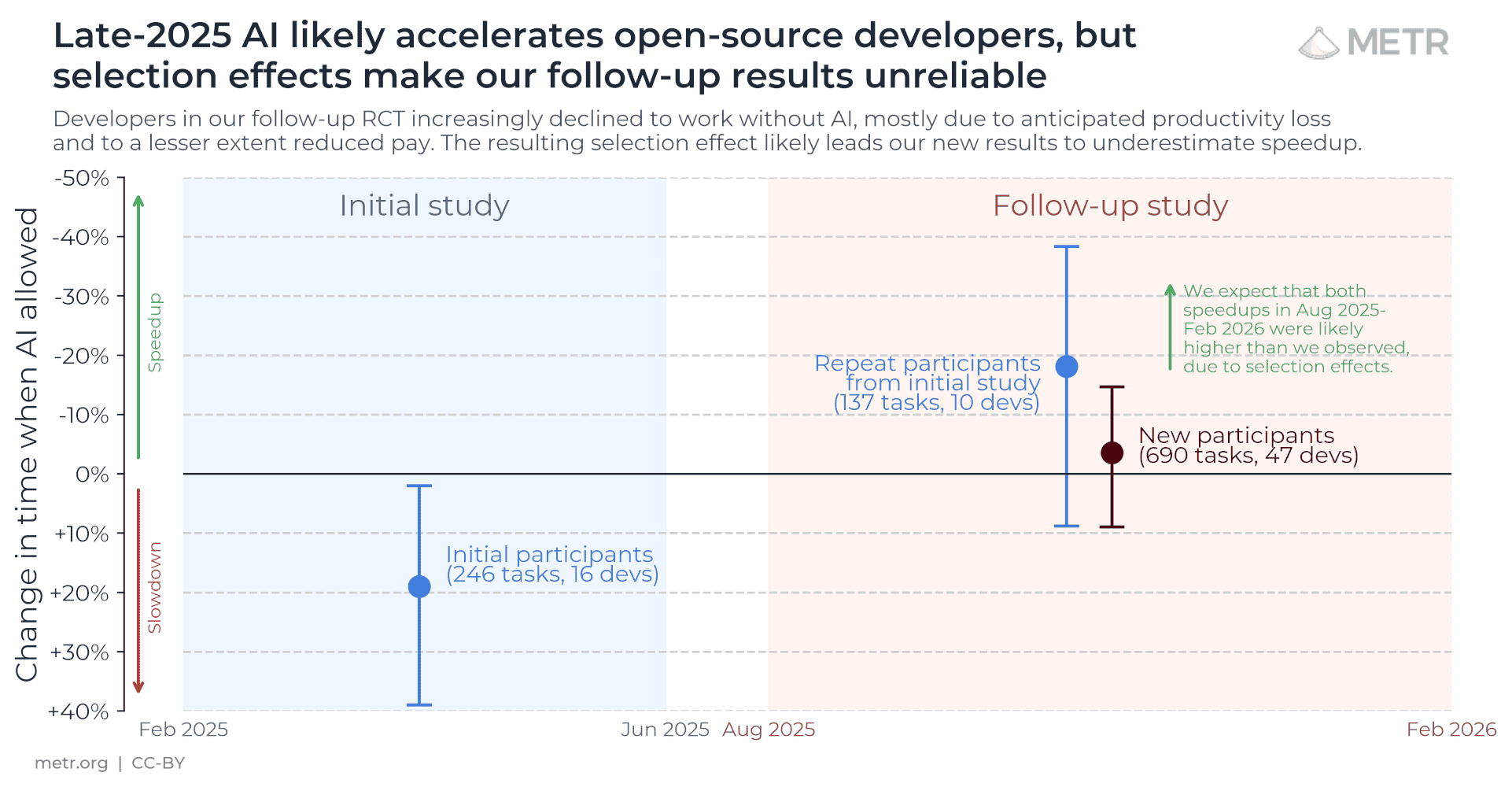
We are Changing our Developer Productivity Experiment Design
Our second developer productivity study faces selection effects from wider AI adoption, prompting us to redesign our approach.
Does AI Actually Boost Developer Productivity? (100k Devs Study) - Yegor Denisov-Blanch, Stanford
The Next Two Years of Software Engineering
Exploring five critical questions shaping software engineering through 2026, with contrasting scenarios for each. These lenses help prepare for the evolving ...

R. S. Doiel, Software Engineer/Analyst — Robert's ramblings
By R. S. Doiel, 2026-02-21 (revised: 2026-03-03, epilogue added 2026-03-27)