

one ray, repeated ten times. one ring, solved from its center and its air. a construction of whole angles, simple fractions, and φ.
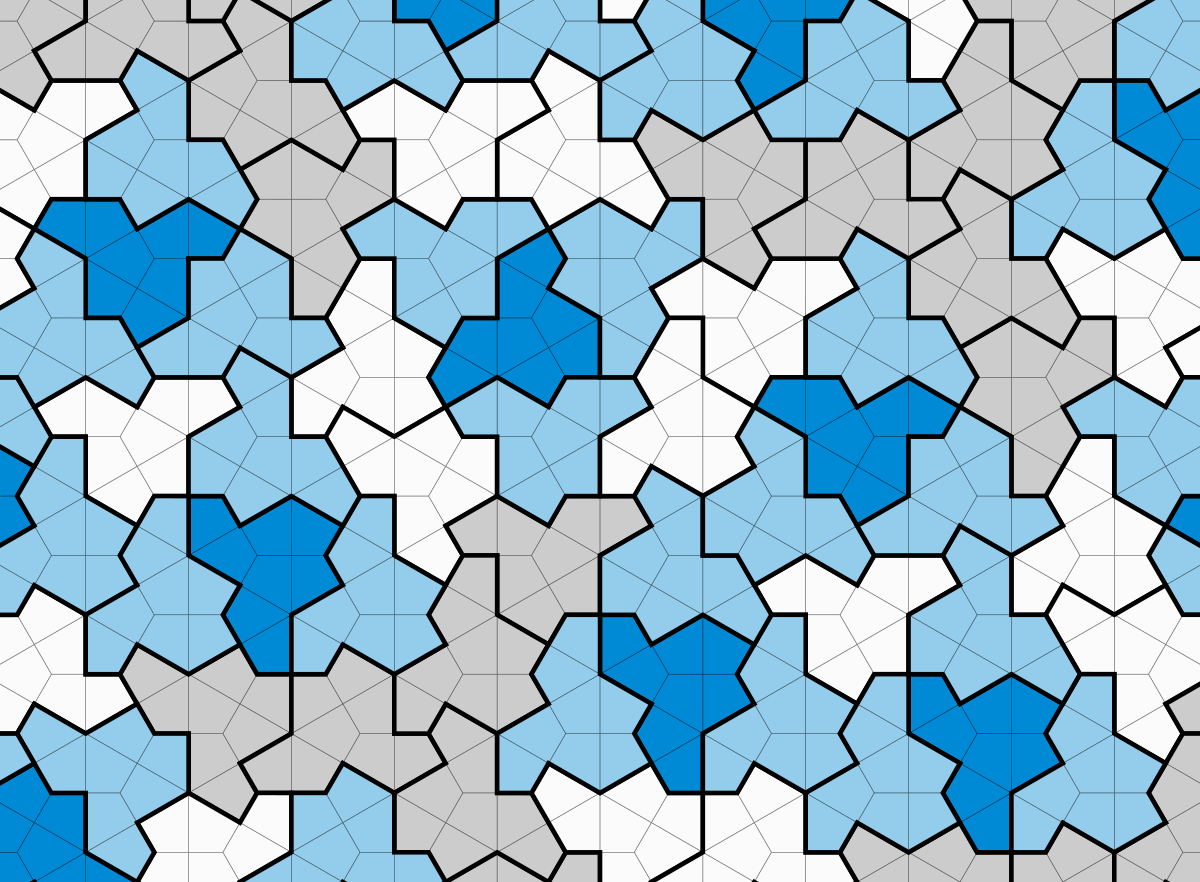
Newfound Mathematical 'Einstein' Shape Creates a Never-Repeating Pattern
A new shape called an einstein has taken the math world by storm. The craggy, hat-shaped tile can cover an infinite plane with patterns that never repeat.
Grade 3 » Operations & Algebraic Thinking » Represent and solve problems involving multiplication and division. » 1 | Common Core State Standards Initiative
Interpret products of whole numbers, e.g., interpret 5 × 7 as the total number of objects in 5 groups of 7 objects each. For example, describe a context in which a total number of objects can be expressed as 5 × 7.
Symmetric lenses | Proceedings of the 38th annual ACM SIGPLAN-SIGACT symposium on Principles of programming languages
A lens is a bidirectional transformation between a pair of connected data structures, capable of translating an edit on one structure into an appropriate edit on the other. Many varieties of lenses have been studied, but none, to date, has offered a ...

Hasharium — identities, given form
Enter a DID. Observe the form that was always inside it.
The meme hiding surprisingly advanced math
Quotient lenses | Proceedings of the 13th ACM SIGPLAN international conference on Functional programming
Bidirectional programming languages are a practical approach to the view update problem. Programs in these languages, called lenses, define both a view and an update policy - i.e., every program can be read as a function mapping sources to views as well ...

Formalizing 100 Theorems
There is a "top 100" of mathematical theorems on the web, which is a rather arbitrary list (and most of the theorems seem rather elementary), but still is nice to look at. On the current page I keep track of which theorems from this list have been formalized. Currently the fraction that already has been formalized seems to be
Sine, Saw, Square, Triangle, Pulse: Basic Waveforms in Synthesis and Their Properties
Learn the properties of 5 basic waveforms in sound synthesis to use their full potential in your synthesizer performance or design.
Aleph number
In mathematics, particularly in set theory, the aleph numbers are a sequence of numbers used to represent the cardinality of infinite sets. They were introduced by the mathematician Georg Cantor and are named after the symbol he used to denote them, the Hebrew letter aleph (ℵ).

Using spaced repetition systems to see through a piece of mathematics
By Michael Nielsen, January 2019
Unit Circle Trigonometry - haitham
An interactive sketch for visualizing sine and cosine functions with the unit circle

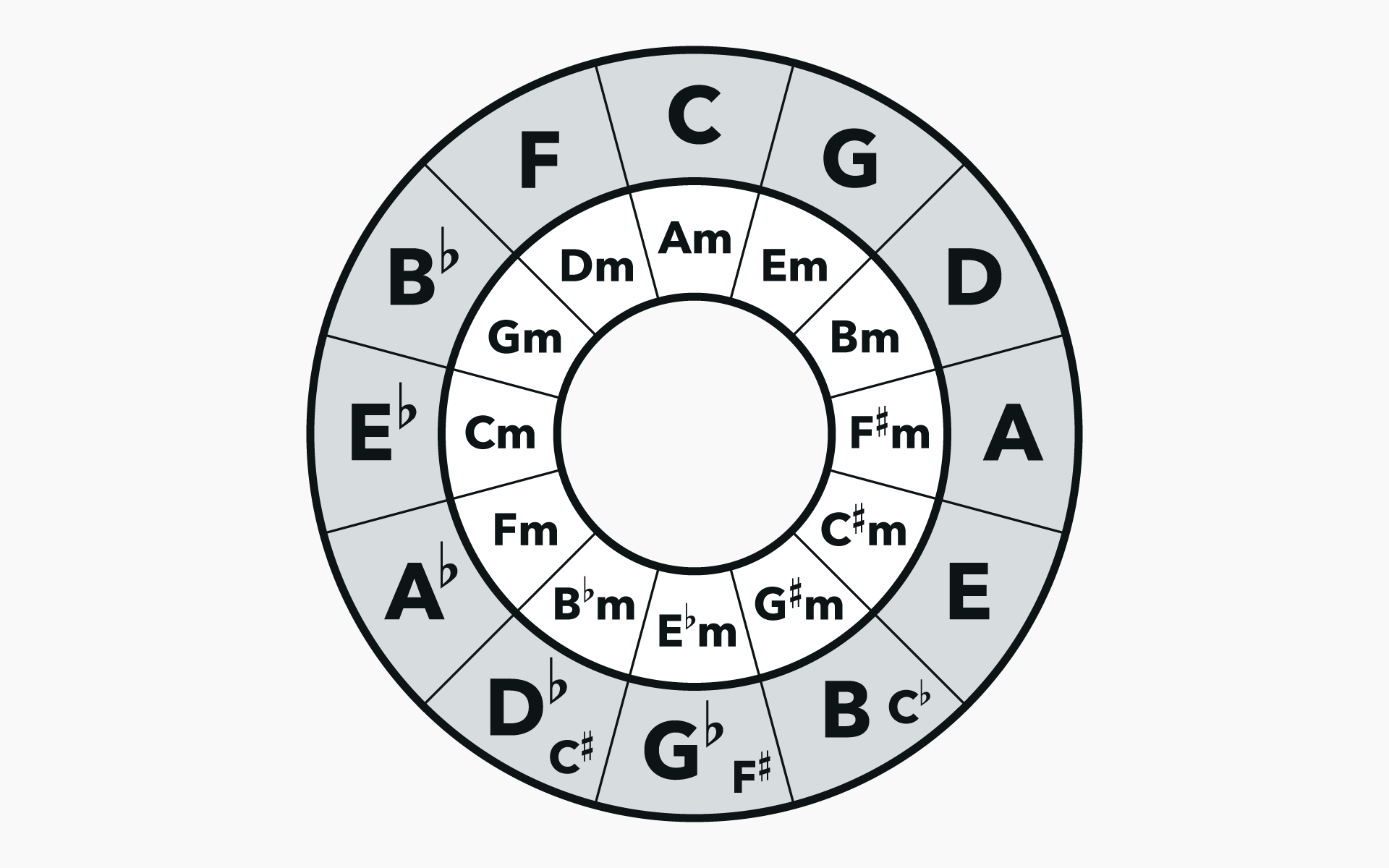
Circle of Fifths: The Key to Unlocking Harmonic Understanding
The circle of fifths is arguably the most helpful way of visually organizing the 12 chromatic pitches for learning music theory. Enjoy this lesson excerpt.
Signed Distance Fields – Render Diagrams
A Severe Misalignment of AI in Mathematics
I am proud to be among the list of 25 initial signatories — all Fields Medallists — to the declaration below, which grew out of discussions between ourselves over the last week. We have…

Floor, ceiling, slopes, and K-theory
We calculate K_*(k[x]/x^e;Z_p) by evaluating the syntomic cohomology Z_p(i)(k[x]/x^e) introduced by Bhatt-Morrow-Scholze and Bhatt-Scholze. This recovers calculations of Hesselholt-Madsen and Speirs, and generalizes an example of Mathew treating the case e=2 and p>2. Our main innovation is systematic use of the floor and ceiling functions, which clarifies matters substantially even for e=2. We furthermore observe a persistent phenomenon of slopes. As an application, we answer some questions of Hesselholt.
If math is more than proof, we need to better celebrate the rest of it
[This is a guest post by Grant Sanderson. This blog post was initially written in a different file format and converted using AI. — T.] A sentiment echoing throughout the mathematics communit…
