What lies between me and we? Featuring Margeret Heath
The Repatterning Collective
What if we can actively repattern and rewire in the direction of radically different (imagined) regenerative futures?

A Thrive/Survive Theory Of The Political Spectrum
I admitted in my last post on Reaction that I devoted insufficient space to the question of why society does seem to be drifting gradually leftward. And I now realize that in order to critique the …

Concentric Groups, Knowledge Bridges and Epistemic Communities
vs Elitism, Celebrity and Oligarchy This article is part of a series: ‘Stigmergy: Systems of Mass Collaboration’. Note: Concentric circles relate to sound amplification – the voic…

NETWORKED MINDS: Where human evolution is heading
by Dirk Helbing [1] Having studied the technological and social forces shaping our societies, we are now turning to the evolutionary for...

What we want is a hunter gatherer lifestyle with space age tools
Those who are convinced that there is more to things spend their time chasing it and not finding it often as not, and those who are convinced there isn't find themselves frustrated at the abyss.

Georgie Newson - Thinking Collectives: Biological Naturalism and the Problem of Group Minds
Rewilding the Web: my workshop report from Edinburgh
Notes from a wonderfully interdisciplinary Edinburgh workshop on 'Rewilding the Web', ranging coopetition and biological variety through the philosophy of self-organisation, polycrisis governance, protopian science fiction, and moderation seen through the lens of artisanal cheese.
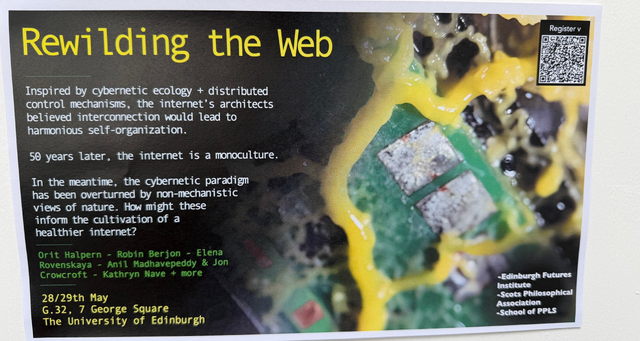
'A reckoning for our species': the philosopher prophet of the Anthropocene
The long read: Timothy Morton wants humanity to give up some of its core beliefs, from the fantasy that we can control the planet to the notion that we are ‘above’ other beings. His ideas might sound weird, but they’re catching on

Community OS stack — Open Indie
The Great Untangling: Part 1 – Shaping the foundations. To sufficiently express my identity as a netizen I require: global group messag...

Biotech's Cambrian Era
By Ryan Bethencourt As I write this article, I’m reflecting on the long expanses of otherworldly playa I’ve just left, watching sandstorms pass in front of me while in altered mental states and contemplating the future of our beloved biotech industry. I have, until recently been living a double life with one [...]

Module I - Structures & Cultural Ecologies (Jean Gebser & William Irwin Thompson)
One of two lessons for the November Mutations course, ‘Models of Consciousness Unfoldment.’
From Users to Sense-Makers: Changing the world by changing our worldviews with social tools-for-thought - Cosmik Labs
Writeup of a recent talk I gave at the Seeds of Renaissance research series
The Secret of Our Success: How Culture Is Driving Human Evolution, Domesticating Our Species, and Making Us Smarter
How our collective intelligence has helped us to evolve and prosperHumans are a puzzling species. On the one hand, we struggle to survive on our own in the wild, often failing to overcome even basic challenges, like obtaining food, building shelters, or avoiding predators. On the other hand, human groups have produced ingenious technologies, sophisticated languages, and complex institutions that have permitted us to successfully expand into a vast range of diverse environments. What has enabled us to dominate the globe, more than any other species, while remaining virtually helpless as lone individuals? This book shows that the secret of our success lies not in our innate intelligence, but in our collective brains—on the ability of human groups to socially interconnect and learn from one another over generations.Drawing insights from lost European explorers, clever chimpanzees, mobile hunter-gatherers, neuroscientific findings, ancient bones, and the human genome, Joseph Henrich demonstrates how our collective brains have propelled our species' genetic evolution and shaped our biology. Our early capacities for learning from others produced many cultural innovations, such as fire, cooking, water containers, plant knowledge, and projectile weapons, which in turn drove the expansion of our brains and altered our physiology, anatomy, and psychology in crucial ways. Later on, some collective brains generated and recombined powerful concepts, such as the lever, wheel, screw, and writing, while also creating the institutions that continue to alter our motivations and perceptions. Henrich shows how our genetics and biology are inextricably interwoven with cultural evolution, and how culture-gene interactions launched our species on an extraordinary evolutionary trajectory.Tracking clues from our ancient past to the present, The Secret of Our Success explores how the evolution of both our cultural and social natures produce a collective intelligence that explains both our species' immense success and the origins of human uniqueness.
Notes toward a Neo-Luddite Manifesto
Chellis Glendinning Notes toward a Neo-Luddite Manifesto 1990

Influencers, Bullshitters, and How We Lost a Shared Reality
A new book explores the ambiguous dominion of those who feign expertise online for clout.

The future is fungal: why the 'megascience' of mycology is on the rise
The study of fungi has long been overshadowed by more glamorous scientific quests. But biologist Merlin Sheldrake is on a mission to change that