

Through engaging questions of how approaches of progressive, critical, queer, and antiracist pedagogical traditions might be applied to interdisciplinary programming in typography, graphic design, and critical art-making, we are working to assemble a growing toolkit of pedagogies -- all of which are intended to be used, shared, recombined, interpreted, and questioned -- as part of the perpetual project of exploring approaches to sharing and transmitting knowledge.

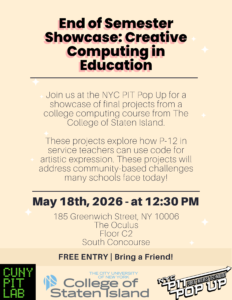
Creative Computing in Education Course Showcase
This event will showcase creative computing final projects from a College of Staten Island course that explores how P-12 in-service teachers can use code for artistic expression. These projects will […]
Toward a Theory of Culturally Relevant Pedagogy
In the midst of discussions about improving education, teacher education, equity, and diversity, little has been done to make pedagogy a central area of investigation. This article attempts to challenge notions about the intersection of culture and teaching that rely solely on microanalytic or macroanalytic perspectives. Rather, the article attempts to build on the work done in both of these areas and proposes a culturally relevant theory of education. By raising questions about the location of the researcher in pedagogical research, the article attempts to explicate the theoretical framework of the author in the nexus of collaborative and reflexive research. The pedagogical practices of eight exemplary teachers of African-American students serve as the investigative “site.” Their practices and reflections on those practices provide a way to define and recognize culturally relevant pedagogy.

Projects – discover our non-empty spaces
Fostering spaces for growth is an important part of our trajectory. We seek to harness the combined power of practice, critical inquiry and creativity to address some of the issues of our times - health, environmental awareness, social equality and multilingual, trans-cultural collaborations.
“Just a Tool” and Other Fictions — Natalia Ilyin
Ever one to hope for the best, last semester I suggested that students use ChatGPT as a “research partner” in the big bibliographic project they do in the Fall term of Parallel Narratives , their Junior-level history-and-criticism class. In a 27-person class, only one student took me up on the idea
Interactive Fiction Study Course
An online, self-paced course exploring notable works of interactive fiction. The goal is not to just consume classics but to take them apart to build up your own craft repertoire.
Learning Styles | The Paper Pilot
The Paper Pilot's digital garden of thoughts on philosophy, politics, and sociology
Wired women : gender and new realities in cyberspace
Come in, CQ: the body on the wire / Ellen Ullman -- The memoirs of a token: an aging Berkeley feminist examines Wired / Paulina Borsook -- How hard can it be? / Karen Coyle -- Closure was never a goal in this piece / Judy Malloy and Cathy Marshall -- Estrogen brigades and "big tits" threads: media fandom online and off / Susan Clerc -- Elites, lamers, narcs and whores: exploring the computer underground / Netta "grayarea" Gilboa -- We are geeks, and we are not guys: the systers mailing list / L. Jean Camp -- Not for the faint of heart: contemplations on Usenet / Judy Anderson "yduJ" -- The price of admission: harassment and free speech in the wild, wild West / Stephanie Brail -- Sex, fear and condescension on campus: cybercensorship at Carnegie Mellon / Donna M. Riley -- Cocktails and thumbtacks in the old West: what would Emily Post say? / Laurel A. Sutton -- "So please stop, thank you": girls online / Michele Evard -- MUDder? I hardly know 'er: adventures of a feminist MUDder / Lori Kendall -- Like magic, only real / Tari Lin Fanderclai -- Coming apart at the seams: sex, text and the virtual body / Shannon McRae; Includes bibliographical references; Ellen Ullman shares an email courtship - Paulina Borsook exposes gender attitudes at the digerati's magazine of record - Karen Coyle on overcoming macho stereotypes - Judy Malloy and Cathy Marshall reflect on their art/research collaboration - Susan Clerc and the zeal of media fandom - Netta Gilboa explores hackers' attitudes toward women - Jean Camp on the Internet's safe havens - Judy Anderson's advice on dodging Usenet flames - Stephanie Brail seeks the line between free speech and harassment - Donna Riley reveals the story of the Clitoral Hoods - Laurel Sutton and the nuances of netiquette - Michele Evard takes news-groups to the fifth grade - Lori Kendall wonders if gender is meaningless online - Tari Lin Fanderclai on MUDs as a powerful teaching tool - Shannon McRae takes a look at "virtual sex"

Guide to Incrementals/Defining the Genre | The Paper Pilot
The Paper Pilot's digital garden of thoughts on philosophy, politics, and sociology
Interface Realisms: The Interface as Aesthetic Form
Until now, digital arts have largely been understood to belong in traditional genres or forms of art: we are said to have electronic literature, net.art, or electronic, techno music. Sometimes interesting discussions have arisen concerning the very ontology of digital art, and questions such as whether net.art should be seen within the tradition of the visual arts or as a form of literature connecting it to the different traditions and questions regulating these arts.[1] While it is not my intent to disconnect digital art from traditional art, or to argue for the irrelevance of the traditional forms of art, I will in the following establish the interface as an aesthetic and critical framework for digital art.
Welcome to the Department of Arts, Culture and Media (ACM) | Department of Arts, Culture and Media
Welcome to the Department of Arts, Culture and Media (ACM) at the University of Toronto Scarborough.
Intersections in Music Education: Implications of Universal Design for Learning, Culturally Responsive Education, and Trauma-Informed Education for P–12 Praxis
To increase equity in music education, teachers can strive to know each student as a whole child, proactively remove barriers to learning, and seek to honor students’ multifaceted and intersectional identities. In this article, we first define intersectionality and examine demographics in music education. Then, we summarize three asset-based pedagogical approaches (Universal Design for Learning, Culturally Responsive Education, and Trauma-Informed Education) and synthesize their similarities. Finally, we present implications in the form of generative ideas for music educator praxis, or values-guided action. We hope our suggestions help music educators create music experiences where students (and families) feel seen, safe, welcomed, and valued as musicians and people. We also hope our suggestions can contribute to music teacher collegiality and collaboration by providing educators with tools to develop positive relationships with colleagues who are different from themselves.

Information Access of the Oppressed: Freirean Design for Emancipatory Information Access
Online information access (IA) platforms are targets of authoritarian capture. We explore the question of how to safeguard our platforms and ensure emancipatory outcomes through the lens of Paulo Freire's theories of emancipatory pedagogy. Freire's theories provide a radically different lens for exploring IA's sociotechnical concerns relative to the current dominating frames of fairness, accountability, and transparency. We make explicit, with the intention to challenge, the technologist-user dichotomy in IA platform development that mirrors the teacher-student relation in Freire's analysis. By extending Freire's analysis to IA, we critique the technologists-as-liberator frame where it is the burden of (altruistic) technologists to mitigate the risks of emerging technologies for marginalized communities. Instead, we advocate for Freirean Design whose goal is to structurally expose the platform for co-option and co-construction by community members in aid of their emancipatory struggles.

DeepSeek
Maggie's digital garden filled with visual essays on programming, design, and anthropology

Command Palettes | The Paper Pilot
The Paper Pilot's digital garden of thoughts on philosophy, politics, and sociology