


The left keeps building media strategies on top of platforms built to undermine them. As browsers are rebuilt for mass surveillance and manipulation, the systems that decide what people see and who gets heard are being rewritten without us. Control over the browser is control over political reality.
The Rise of the Right-Wing Media Machine
This conservative media machine now rivals—and may well surpass—the power and the influence of the old-line press. It holds sway over much of the national agenda, deciding which ideas and...

Old Tricks, New Tech: How Legacy Media Capture Fuels Today’s Digital Authoritarianism
Marius Dragomir and Minna Aslama Horowitz discuss how digital authoritarianism is rising as states and Big Tech align, threatening independent media.

The web can be weaponised – and we can't count on big tech to stop it | Tim Berners-Lee
It’s dangerous having a handful of companies control how ideas and opinions are shared. A regulator may be needed
Do social media threaten democracy?
Facebook, Google and Twitter were supposed to save politics as good information drove out prejudice and falsehood. Something has gone very wrong

New study shows just how Facebook's algorithm shapes conservative and liberal bubbles
Research conducted at the height of the 2020 election reveals new details about how Facebook's algorithms handle political content. But it suggests there are no easy fixes to political polarization.

Bias, Skew, and Search Engines Are Sufficient to Explain Online Toxicity
U.S. political discourse seems to have fissioned into discrete bubbles, each reflecting its own distorted image of the world. Many blame machine-learning algorithms that purportedly maximize “engagement”—serving up content that keeps YouTube or Facebook users watching videos or scrolling through their feeds—for radicalizing users or strengthening their partisanship. Sociologist Shoshana Zuboff15 even argues that “surveillance capitalism” uses optimized algorithmic feedback for “automated behavioral modification” at scale, writing the “music” that users then “dance” to.
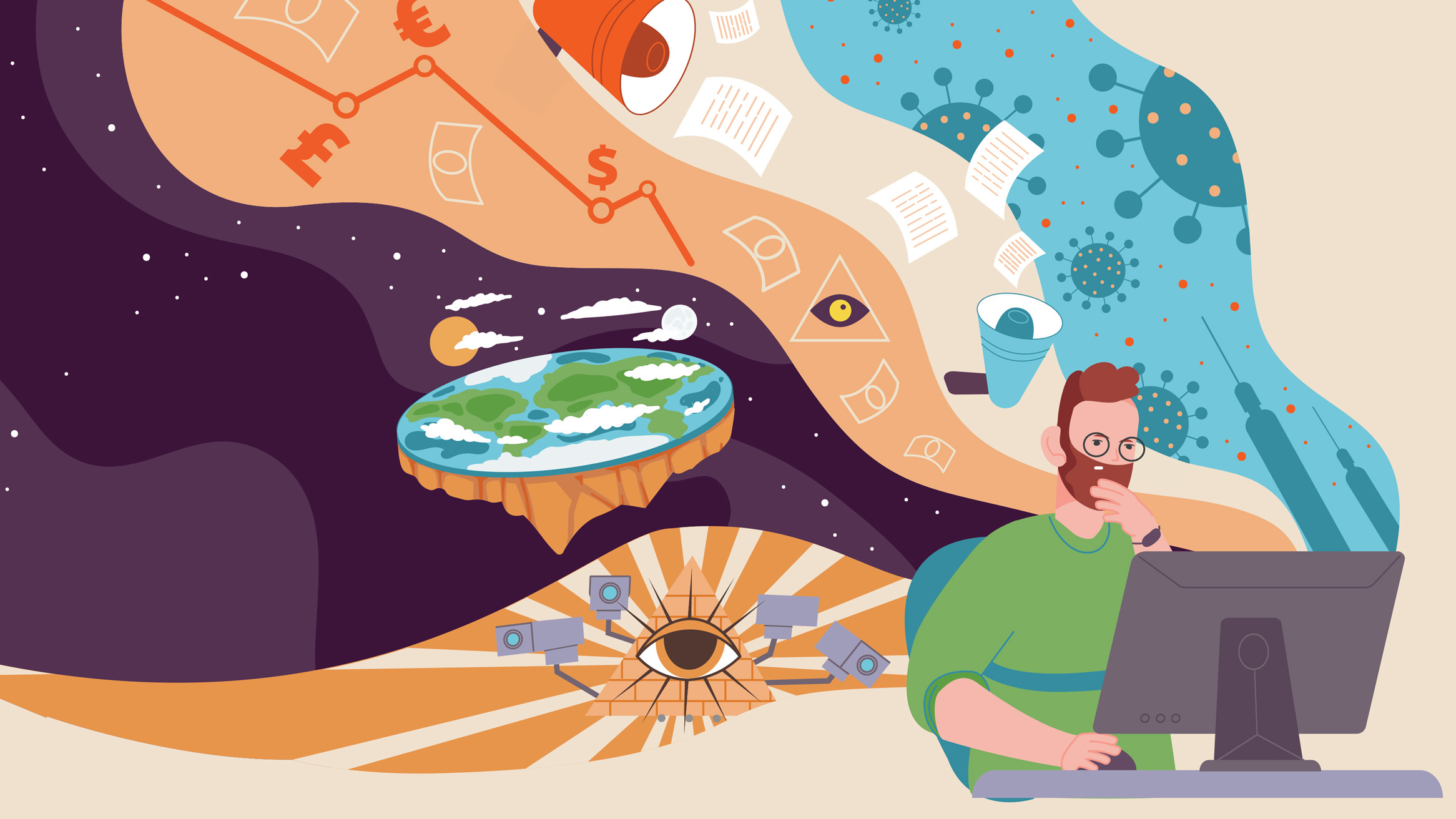
Bias, Skew, and Search Engines Are Sufficient to Explain Online Toxicity
U.S. political discourse seems to have fissioned into discrete bubbles, each reflecting its own distorted image of the world. Many blame machine-learning algorithms that purportedly maximize “engagement”—serving up content that keeps YouTube or Facebook users watching videos or scrolling through their feeds—for radicalizing users or strengthening their partisanship. Sociologist Shoshana Zuboff15 even argues that “surveillance capitalism” uses optimized algorithmic feedback for “automated behavioral modification” at scale, writing the “music” that users then “dance” to.
SimPolitics
For more than six decades, the public has been promised that computers will revolutionize politics, both nationally and internationally. In SimPolitics, Fenw...

The political effects of X’s feed algorithm
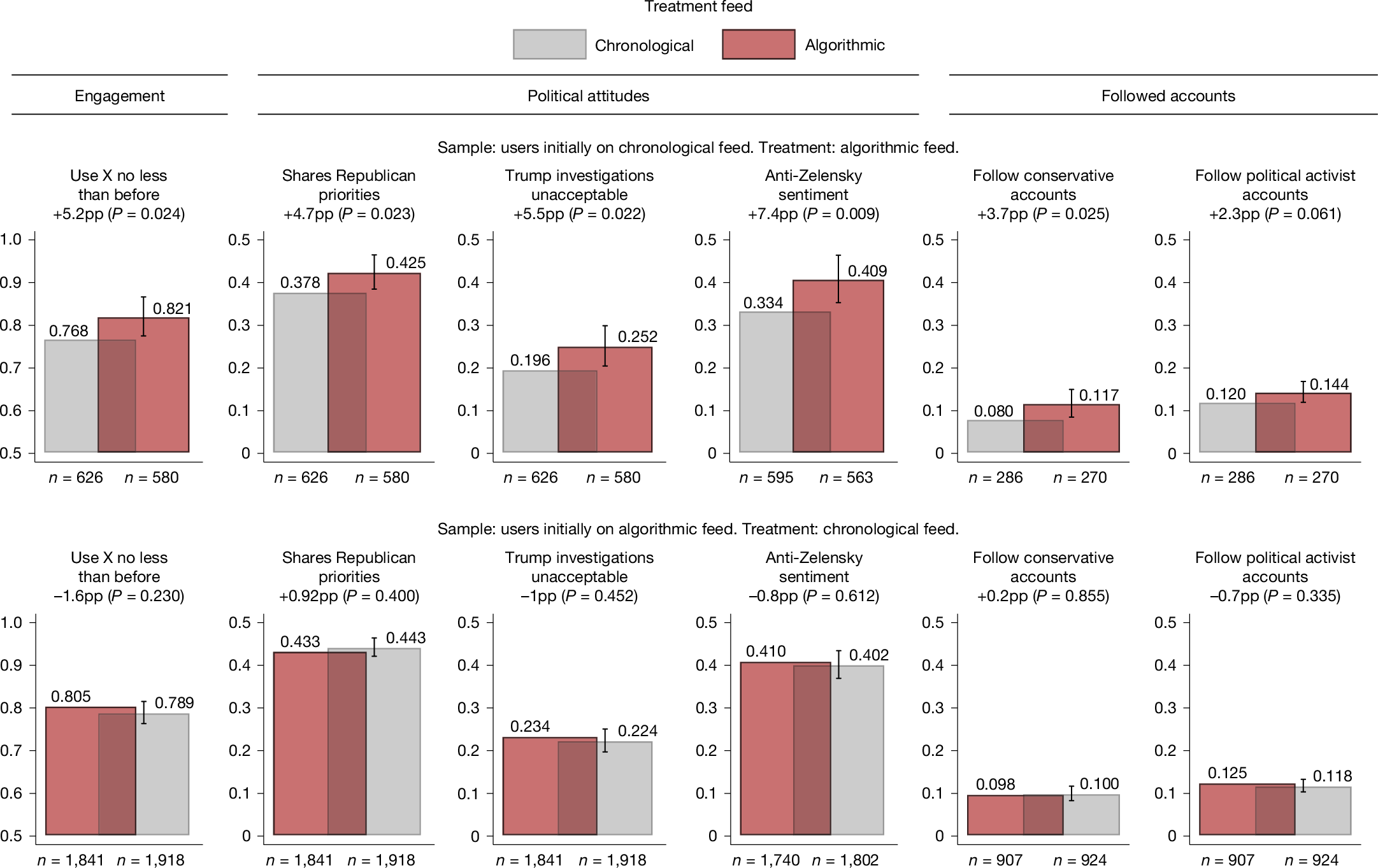
Feed algorithms are widely suspected to influence political attitudes. However, previous evidence from switching off the algorithm on Meta platforms found no political effects1. Here we present results from a 2023 field experiment on Elon Musk’s platform X shedding light on this puzzle. We assigned active US-based users randomly to either an algorithmic or a chronological feed for 7 weeks, measuring political attitudes and online behaviour. Switching from a chronological to an algorithmic feed increased engagement and shifted political opinion towards more conservative positions, particularly regarding policy priorities, perceptions of criminal investigations into Donald Trump and views on the war in Ukraine. In contrast, switching from the algorithmic to the chronological feed had no comparable effects. Neither switching the algorithm on nor switching it off significantly affected affective polarization or self-reported partisanship. To investigate the mechanism, we analysed users’ feed content and behaviour. We found that the algorithm promotes conservative content and demotes posts by traditional media. Exposure to algorithmic content leads users to follow conservative political activist accounts, which they continue to follow even after switching off the algorithm, helping explain the asymmetry in effects. These results suggest that initial exposure to X’s algorithm has persistent effects on users’ current political attitudes and account-following behaviour, even in the absence of a detectable effect on partisanship.
The political effects of X’s feed algorithm
Feed algorithms are widely suspected to influence political attitudes. However, previous evidence from switching off the algorithm on Meta platforms found no political effects1. Here we present results from a 2023 field experiment on Elon Musk’s platform X shedding light on this puzzle. We assigned active US-based users randomly to either an algorithmic or a chronological feed for 7 weeks, measuring political attitudes and online behaviour. Switching from a chronological to an algorithmic feed increased engagement and shifted political opinion towards more conservative positions, particularly regarding policy priorities, perceptions of criminal investigations into Donald Trump and views on the war in Ukraine. In contrast, switching from the algorithmic to the chronological feed had no comparable effects. Neither switching the algorithm on nor switching it off significantly affected affective polarization or self-reported partisanship. To investigate the mechanism, we analysed users’ feed content and behaviour. We found that the algorithm promotes conservative content and demotes posts by traditional media. Exposure to algorithmic content leads users to follow conservative political activist accounts, which they continue to follow even after switching off the algorithm, helping explain the asymmetry in effects. These results suggest that initial exposure to X’s algorithm has persistent effects on users’ current political attitudes and account-following behaviour, even in the absence of a detectable effect on partisanship.
Custodians of the Internet
A revealing and gripping investigation into how social media platforms police what we post online—and the large societal impact of these decisions Most use...
How Technology Is Shaping Modern Politics
Discover how technology is reshaping politics, from digital campaigns to AI, and the challenges of misinformation and election security.
The AI browser wars are about to begin
Artificial intelligence is already writing an obituary for the internet as we know it. So why is everyone building new web browsers?

Investing in what moves the internet forward | The Mozilla Blog
Firefox is the only major browser not backed by a billionaire and our independence shapes everything we build. This independence allows us to prioritize bu

How One 1990s Browser Decision Created Big Tech’s Data Monopolies (And How We Might Finally Fix It) - Above the Law
From the take-back-control dept

> The Mozilla Foundation isn't holding back its disdain for Big Tech leaders. > Wannabe kings don't rule the internet. We do. AT Protocol and the broader open social web is one of the ways we take back power from Big Tech. (If you see me out in these New York City streets, let me know.)

Business Insider
Mozilla's new ad campaign skewers tech billionaires like Mark Zuckerberg and Elon Musk bit.ly/4xBAuDZ
