

The illusion of data as “objective” conceals that it rarely shows you the whole picture. Making decisions based on the easiest data to…
The Limits of Data
Policymakers want to make decisions based on clear data, but important factors are lost when we rely solely on data. A philosopher writes:

Data Reboot: 10 Reasons why we need to change how we approach data in today’s society
Stefaan G. Verhulst and Julia Stamm, The Data Tank

The world’s most valuable resource is no longer oil, but data
The data economy demands a new approach to antitrust rules

Priceonomics - In Data We Trust
Priceonomics turns data into great stories. We come up with interesting topics, analyze data, and turn the insights into amazing content!

A first-party data reality check | The Mozilla Blog
Part I in Anonym’s Rewiring the Rules Series First-party data — the kind users share willingly with brands they trust — is a marketer’s mos

Sara M. Watson | Metaphors of Big Data - DIS Magazine
Dissecting the industry-centric bias at the core of our cultural understanding of data.
Underspecified Human Decision Experiments Considered Harmful
Decision-making with information displays is a key focus of research in areas like human-AI collaboration and data visualization. However, what constitutes a decision problem, and what is required for an experiment to conclude that decisions are flawed, remain imprecise. We present a widely applicable definition of a decision problem synthesized from statistical decision theory and information economics. We claim that to attribute loss in human performance to bias, an experiment must provide the information that a rational agent would need to identify the normative decision. We evaluate whether recent empirical research on AI-assisted decisions achieves this standard. We find that only 10 (26%) of 39 studies that claim to identify biased behavior presented participants with sufficient information to make this claim in at least one treatment condition. We motivate the value of studying well-defined decision problems by describing a characterization of performance losses they allow to be conceived.

Data Everyday: Data Literacy Practices in a Division I College Sports Context
Nonrivalry and the Economics of Data
(September 2020) - Data is nonrival: a person's location history, medical records, and driving data can be used by many firms simultaneously. Nonrivalry leads to increasing returns. As a result, there may be social gains to data being used broadly across firms, even in the presence of privacy considerations. Fearing creative destruction, firms may choose to hoard their data, leading to the inefficient use of nonrival data. Giving data property rights to consumers can generate allocations that are close to optimal. Consumers balance their concerns for privacy against the economic gains that come from selling data broadly.
Data, Democracy and Dirty Tricks
The Oxymoron of “Data-Driven Innovation”
Once upon a time, in the dawn of the internet era, web products came from college dudes. The dudes were almost always wealthy and well-connected, but they weren’t usually market-savvy. These …

Research to shift power through data governance
We generate data at a breathtaking pace. Our most mundane actions — playing a song, checking the weather — are analyzed, collated, stored, sold, and use…

A Short Guide to Data Strikes and Conscious Data Contribution in the Context of 2026 Frontier AI
Back to the basics of data leverage.
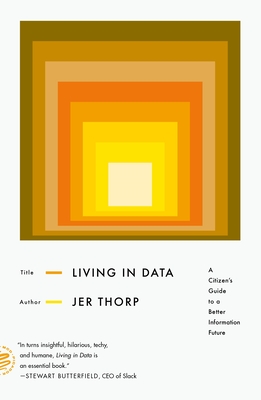
Living in Data: A Citizen's Guide to a Better Information Future (Paperback)
Jer Thorp’s analysis of the word “data” in 10,325 New York Times stories written between 1984 and 2018 shows a distinct trend: among the words most closely associated with “data,” we find not only its classic companions “information” and “digital,” but also a variety of new neighbors—from “scandal” and “misinformation” to “ethics,” “friends,” and “play.”To live in data in the twenty-first century
Algorithmic personalization of information can cause inaccurate generalization and overconfidence.
tfw @aaronstevenwhite.io brings an analysis as sharp as a knife to your half-baked Saturday-morning thoughts: aaronstevenwhite.leaflet.pub/3miwsz2hdv22i 🤯 If we're going to own our data, let's actually own our data. Which is to say: No, really, y'all, we're doing this. 💖🧠

Machine-readable attitudes - Computational Semantics++
aaronstevenwhite.leaflet.pub