


Slides for a general introduction to the use of Optimal Transport methods in learning, with an emphasis on diffusion models, flow matching, training 2 l…
Computational OT #4 - Gradient flow and diffusion models
A course on computational Optimal Transport

What are Diffusion Models? | IBM
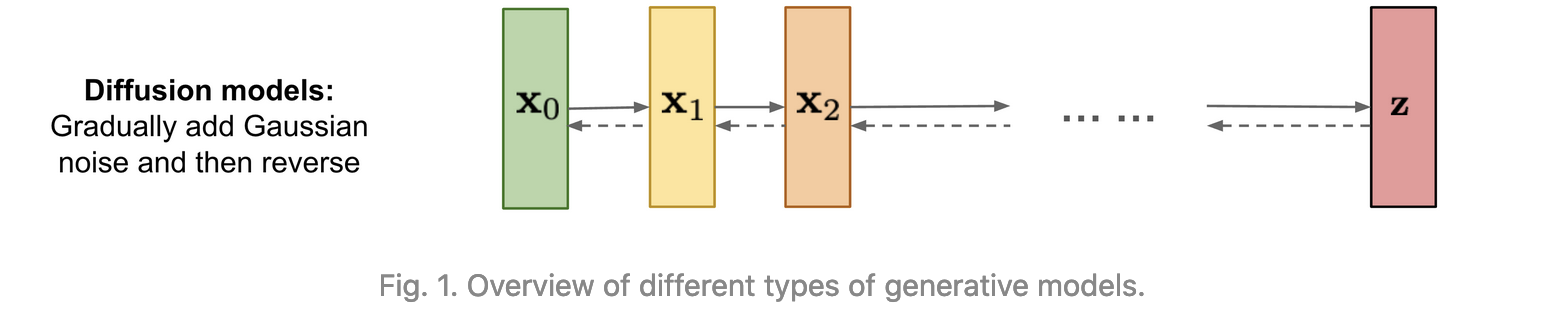
Diffusion models are generative models that “diffuse” training data with random noise, then learn to reverse the diffusion process to output new images.

Diffusion model
In machine learning, diffusion models, also known as diffusion-based generative models or score-based generative models, are a class of latent variable generative models. A diffusion model consists of two major components: the forward diffusion process, and the reverse sampling process.[1] The goal of diffusion models is to learn a diffusion process for a given dataset, such that the process can generate new elements that are distributed similarly as the original dataset. A diffusion model models data as generated by a diffusion process, whereby a new datum performs a random walk with drift through the space of all possible data.[2] A trained diffusion model can be sampled in many ways, with different efficiency and quality.
DiffusionGemma as Jev: Open-Source vLLM Patch (2026) | explainx.ai Blog
A vLLM contributor built an open-source Jev clone using DiffusionGemma — roughly matching TypeSafe's proprietary model on accuracy.
Some notes on the Stable Diffusion safety filter
How deep learning models are moderated
The physics behind diffusion models
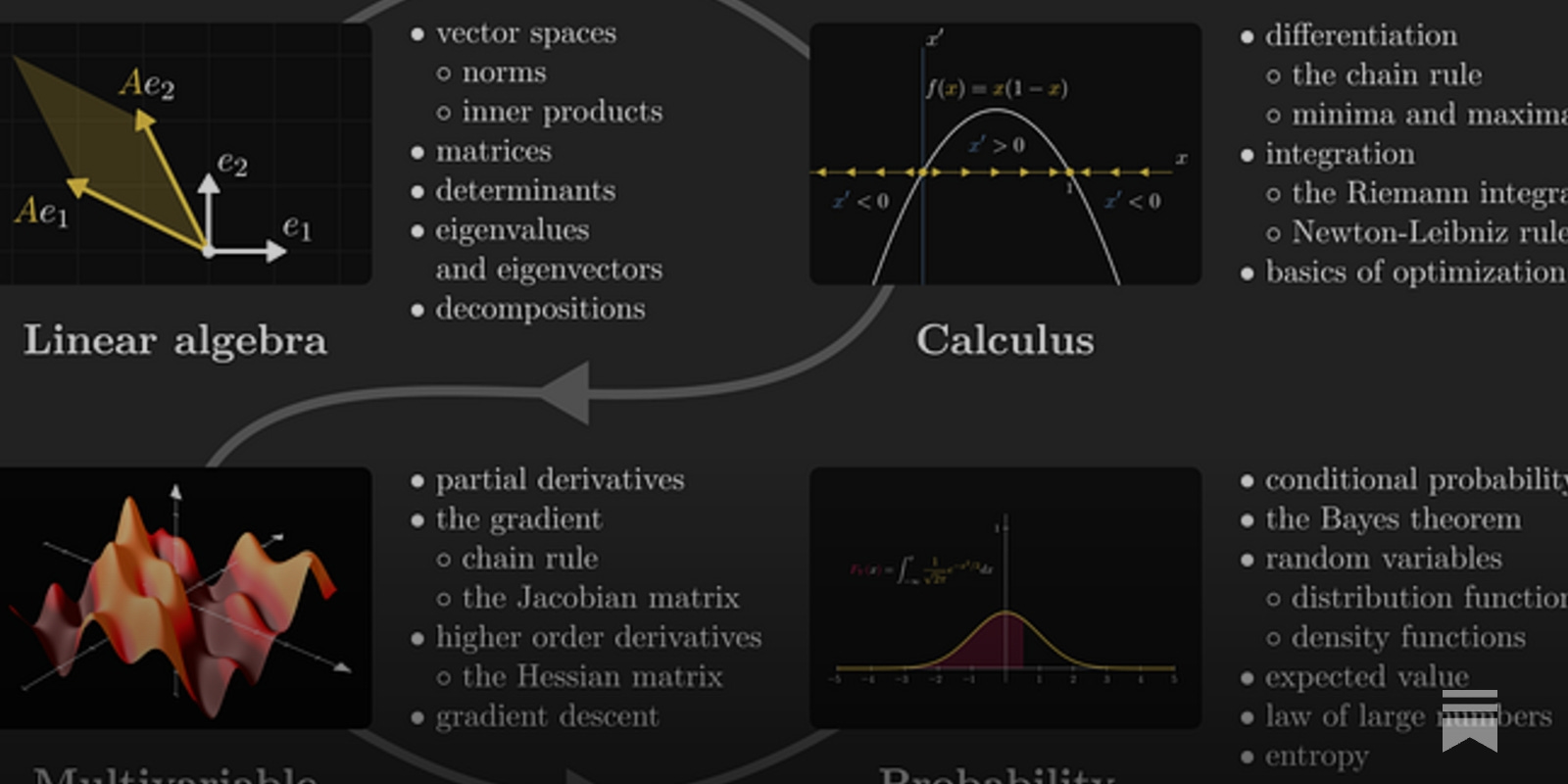
The Roadmap of Mathematics for Machine Learning
A complete guide to linear algebra, calculus, and probability theory
Diffusion Models: A Comprehensive Survey of Methods and Applications
Diffusion models have emerged as a powerful new family of deep generative models with record-breaking performance in many applications, including image synthesis, video generation, and molecule...

mlx-examples/stable_diffusion at main · ml-explore/mlx-examples
Examples in the MLX framework. Contribute to ml-explore/mlx-examples development by creating an account on GitHub.
Inference-Time Scaling for Generative Pre-Training | Jiaming Song
A short note on the false dichotomy between autoregression and diffusion, why flow maps help, and what this might mean for language models.
Stanford CS25: V5 I Transformers in Diffusion Models for Image Generation and Beyond
DiffusionGemma Technical Report
We introduce DiffusionGemma, an experimental open-weight language model that uses discrete diffusion to generate text at exceptionally high speed. Rather than decoding one token at a time, DiffusionGemma iteratively refines blocks of 256 tokens in parallel, avoiding the sequential decoding bottleneck of conventional autoregressive (AR) large language models. Instead of training from scratch, we obtain DiffusionGemma by fine-tuning the mixture-of-experts Gemma 4 model with 3.8B activated and 25.2B total parameters. Our compute-efficient two-stage training pipeline uses fewer than 10% of the starting AR model's total training token budget. The first stage uses supervised fine-tuning to teach bidirectional denoising, while the second stage combines reinforcement learning with sampler distillation to jointly improve generation quality and inference efficiency. DiffusionGemma establishes a new Pareto frontier for the trade-off between generation speed and model capability. Averaged across our full evaluation suite, it generates around 20 tokens per forward pass and achieves roughly 1,500 output tokens per second on a single NVIDIA H100 GPU, which is substantially faster than AR models even with state-of-the-art speculative decoding. DiffusionGemma also retains the starting model's support for thinking mode, multimodal inputs, and long contexts. Despite diffusion fine-tuning, it remains capable of AR generation with only minor performance degradation, suggesting a path toward hybrid diffusion-AR decoding.
Mixture-of-Experts: From sparse routing to multimodal deployment - Vector Institute for Artificial Intelligence
Authors: Ahmed ElKady, Ahmed Y. Radwan, Shaina Raza Mixture-of-Experts (MoE) models carry far more parameters than they activate. For each token that passes through, a learned router selects only a […]
How Stable Diffusion works
Understand in a simple way how Stable Diffusion transforms a few words into a spectacular image.

Better Training Data Attribution via Better Inverse Hessian-Vector Products
Training data attribution (TDA) provides insights into which training data is responsible for a learned model behavior. Gradient-based TDA methods such as influence functions and unrolled differentiation both involve a computation that resembles an inverse Hessian-vector product (iHVP), which is difficult to approximate efficiently. We introduce an algorithm (ASTRA) which uses the EKFAC-preconditioner on Neumann series iterations to arrive at an accurate iHVP approximation for TDA. ASTRA is easy to tune, requires fewer iterations than Neumann series iterations, and is more accurate than EKFAC-based approximations. Using ASTRA, we show that improving the accuracy of the iHVP approximation can significantly improve TDA performance.