

The great promise of Spritely Goblins is to make networking easier and safer. For the past few years, we've focused on developing a toolkit to facilitate this goal. Today, we're proud to announce an incredibly exciting project that will put this toolkit to the test in the largest real-world deployment of Spritely technology so far: a port of the GNU Shepherd system layer to Guile Goblins — the first step in making Guix the object-capability operating system!
Spritely Goblins v0.10, for Guile and Racket! — Spritely Institute
We are excited to announce Spritely Goblins v0.10, available for both Guile and Racket alike! Goblins is Spritely's distributed object programming environment, providing an intuitive security model, automatic local transactions for synchronous programming, and asynchronous programming allowing collaboration over the network with the same level of ease as local asynchronous programming. Goblins takes the pain out of reasoning about distributed and secure peer-to-peer programming: with Goblins, that's the default mode of operation!
FOSDEM 2025 - Goblins: The framework for your next project!
Building peer-to-peer decentralised applications remains difficult and error-prone. Most attempts at this either abandon collaborative features entirely or fall back on centralised architectures. The Spritely Institute is working on this challenge by creating (among other things) Goblins, a Guile framework that makes secure, fault-tolerant peer-to-peer applications accessible to developers. These tools are especially valuable for developers building secure collaborative applications that aim to foster healthy online communities. This talk walks you through Goblins’ most powerful features, including the actor model, object capability security, networking, time travel debugging, and persistence.

Spritely Goblins v0.16.0 released! — Spritely Institute
We are excited to announce Spritely Goblins v0.16.0! This release of Goblins is faster than ever, with two major core speedups benefiting all Goblins-using programs! Furthermore, we have a brand new Unix Domain Socket netlayer, which means our OCapN protocol is now usable for efficient machine-local inter-process communication!
A Spritely distributed-computing library
Spritely is a project seeking to build a platform for sovereign distributed applications — app [...]
FOSDEM 2025 - Spritely and a secure, collaborative, distributed future
Spritely's vision is a world where everyone can access secure collaboration tools without gatekeepers. This requires building a new technical foundation upon which decentralized systems naturally arise. And that's exactly what we're doing! This presentation is going to look at the roadmap of what we have now, what we want for our end-users, and how we're going to get there.
The Heart of Spritely: Distributed Objects and Capability Security
This paper is the second in a three-part series outlining Spritely's thinking and design. The first paper, Spritely: New Foundations for Networked Communities, explains the problems which face contemporary social network design. This paper details the core technical toolbox provided by Spritely Goblins and how it supplies the necessary features to feasibly build out Spritely's broader vision. The third paper in the series, Spritely for Secure Applications and Communities, ties the first two papers together by showing how the architecture for user-facing software fulfills the vision of the first paper and can be built on top of ideas from this paper.
Sprites: full Linux computers for your agents
Sprites are full Linux computers designed for agents instead of people. As persistent or disposable as you want, with full environment checkpointing and restore.

Spirallex/rust-pds
Single-binary AT Protocol PDS in Rust (macOS) + device-portable stelyph-core that runs on-device in iOS. Self-hosted Bluesky federation.
Sprites - Stateful sandboxes
Persistent, hardware-isolated execution environments for arbitrary code. Run AI agents, untrusted code, and more in secure sandbox environments with checkpoint & restore.
Declarative Server with NixOS: A Reproducible Infrastructure | Mustafa Erbay
A technical guide exploring how to create a declarative server configuration with NixOS, covering reproducibility and rollback processes.

[Stageˣ] Linux distribution
A container-native, full-source bootstrapped, and reproducible toolchain to build all the things.

Guix in a Linux Container - Thedro Neely
GNU Guix (as in geeks) is one of the new type of Linux distributions that focuses on reproducibility.

Alexander Kalenik on Twitter / X
@ladybirdbrowser now speaks the kitty graphics protocol https://t.co/9SyZPpPLsK. huge QoL for developing on remote machines. works perfectly in Rex by @superlogical pic.twitter.com/NBTamxHG91— Alexander Kalenik (@KalenikW) November 9, 2026

FOSDEM 2025 - Consent-based Secure Collaboration with Spritely Goblins Object-Capabilities
The object-capability security paradigm (ocaps) is a conceptually simple, efficient model for collaboration in mutually-suspicious contexts. Spritely is exploring concepts and building solutions in this space to solve real-world problems while encouraging the wider adoption of ocaps, including by working alongside other ocaps organizations and projects to define a standard protocol for intercommunication between ocaps systems. This talk will explain what ocaps is and why you should use it.
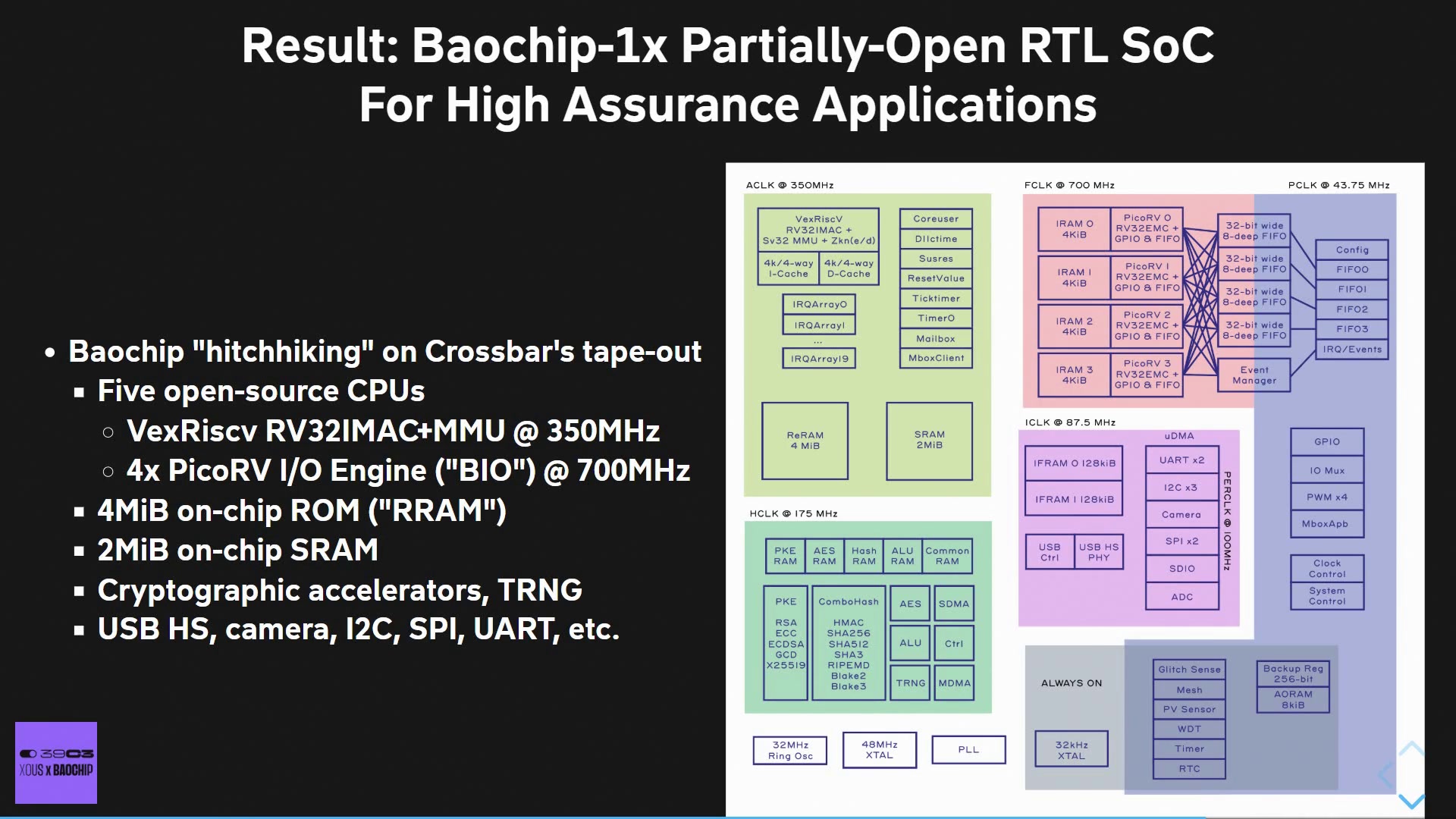
Xous: A Pure-Rust Rethink of the Embedded Operating System
Xous is a message-passing microkernel implemented in pure Rust, targeting secure embedded applications. This talk covers three novel aspe...
eBPF and Kubernetes: Little Helper Minions for Scaling Microservices - Daniel Borkmann, Cilium