

Social media is addictive and manipulative. It's time for social that puts the user in control.
Social media is a gnarly coordination problem we need to decompose - a warm space
Bloom
A calmer social network with no ads, no tracking, and a chronological feed.

Custodians of the Internet
A revealing and gripping investigation into how social media platforms police what we post online—and the large societal impact of these decisions Most use...
Shifts in U.S. Social Media Use, 2020–2024: Decline, Fragmentation, and Enduring Polarization
The social media ecosystem appears to be in flux. Twitter’s rebranding to X has come to symbolize a broader reorganization of online publics – political reshuffling, user attrition, and uncertainty over the role of legacy platforms. Simultaneously, the shift from text-based, networked feeds toward algorithmically curated, short-form video has accelerated, with TikTok setting the pace for the wider ecosystem [18, 14, 16]. At the same time, everyday communication increasingly migrates from large, open networks to semi-private spaces such as group chats and messaging apps. Commentators describe a digital public sphere in transition: smaller, more fragmented, less dominated by traditional social networking sites, and rise of more broadcast-oriented forms of media – with some even suggesting that we are seeing the beginning of the end of the social media era.
My 2024 thoughts on the state of social media
I see a continued fragmentation of social media as people leave X(Twitter).

From Feeds to Trails
To design the future of social media, rethink the interface before the algorithm.
Scientists no Longer Find Twitter Professionally Useful, and have Switched to Bluesky
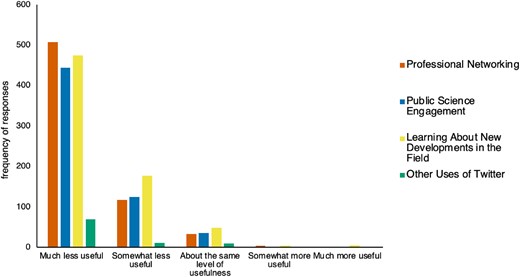
Synopsis Social media has become widely used by the scientific community for a variety of professional uses, including networking and public outreach. For the past decade, Twitter has been a primary home of scientists on social media. In recent years, new leadership at Twitter has made substantive changes that have resulted in increases in the prevalence of pseudoscience, conspiracy theory, and harassment on the platform, causing many scientists to seek alternatives. Bluesky has been suggested as a good alternative to Twitter, but the phenomenon of academics switching social media platforms has not previously been studied. Here we report on the results of a survey distributed to scientists on Twitter and Bluesky (n = 813). Results overwhelmingly confirm that changes to Twitter have made the social media platform no longer professionally useful or pleasant, and that many scientists have abandoned it in favor of Bluesky. Results show that for every reported professional benefit that scientists once gained from Twitter, scientists can now gain that benefit more effectively on Bluesky than on Twitter.
My top Bluesky feature requests for 2024
In 2023 my social media consumption changed dramatically after I DM'd a random mufo on what-was-then-called Twitter for a Bluesky invite. At the time, I was floating between Twitter itself and Mastodon for my primary daily social media experience. On one hand, I loathed Twitter (and
The Weird, Fragmented World of Social Media After Twitter - The Atlan…
archived 7 Aug 2023 02:41:57 UTC

The future of social media is human
We cannot continue participating in social media platforms which do nothing to stop us being tricked by GenAI and the powerful people/governments that control them.

Traditional Social Media as a Prison - What’s Happening on My Feed?
Social media apps have become a vehicle for community building, world news, and political campaigns. As app owners have enmeshed themselves more with the state, the carceral logics that haunt marginalized communities offline, became a part of their digital realities online.
A General Method to Find Highly Coordinating Communities in Social Media through Inferred Interaction Links
Political misinformation, astroturfing and organised trolling are online malicious behaviours with significant real-world effects. Many previous approaches examining these phenomena have focused on broad campaigns rather than the small groups responsible for instigating or sustaining them. To reveal latent (i.e., hidden) networks of cooperating accounts, we propose a novel temporal window approach that relies on account interactions and metadata alone. It detects groups of accounts engaging in various behaviours that, in concert, come to execute different goal-based strategies, a number of which we describe. The approach relies upon a pipeline that extracts relevant elements from social media posts, infers connections between accounts based on criteria matching the coordination strategies to build an undirected weighted network of accounts, which is then mined for communities exhibiting high levels of evidence of coordination using a novel community extraction method. We address the temporal aspect of the data by using a windowing mechanism, which may be suitable for near real-time application. We further highlight consistent coordination with a sliding frame across multiple windows and application of a decay factor. Our approach is compared with other recent similar processing approaches and community detection methods and is validated against two relevant datasets with ground truth data, using content, temporal, and network analyses, as well as with the design, training and application of three one-class classifiers built using the ground truth; its utility is furthermore demonstrated in two case studies of contentious online discussions.

Sparkable
Social media as it should be. Find your community among millions of users, unleash your creativity, and have some fun again.

Scientists no Longer Find Twitter Professionally Useful, and have Switched to Bluesky
Synopsis. Social media has become widely used by the scientific community for a variety of professional uses, including networking and public outreach. For
Social media algorithms don't allow us to understand or control what we see online and why... until now! Top scholars @jonathanstray.com and @noupside.bsky.social are sharing @mysky.social, a tool that allows users to adjust their feed’s priorities and explains why certain posts appear over others.

🎛️📲 Meet the algorithm you can actually control and understand
newpublic.substack.comSocial media is no longer social. Most of it is passive viewing of videos and pictures from people we've never met. But we're still studying social media like it's 2010. We've entered the post-social media era — and research needs to catch up. osf.io/preprints/socarxiv/6nue7_v1 preprint w/ Richard Rogers

