

The development of the education market, academic credentials, digital data, and artificial intelligence is widening the gap between knowledge and actual competence, as well as between technical efficiency and human development. This study aims to clarify the humanistic foundation of education, analyze the mechanism of the instrumentalization of knowledge, and establish principles for restructuring education in the context of digital technology. Humanistic scientific methodology is employed in conjunction with the operations of analysis and synthesis, logic and history, abstraction and concretization, criticism and construction. The conceptual material of this study comprises the concepts of life, needs, capabilities, creativity, scientific knowledge, norms, power, the market, qualifications, actual competence, and artificial intelligence. The analysis reveals that education loses its humanistic function when norms, profit, academic credentials, or algorithms occupy the position of the end. Education attains legitimacy when it develops cognitive, creative, self-learning, reflective, and responsible capacities. The study concludes that human beings must retain their position as subjects, while science, the market, and technology must remain means serving life.
Artificial intelligence in mathematics education: The good, the bad, and the ugly
Integrating Artificial Intelligence [AI] into mathematics education offers promising advancements and potential pitfalls. Striking a balance between AI-driven developments and preserving core pedagogical principles is critical in the teaching and learning environment. AI has emerged as a transformative force in various fields, including education. In the realm of mathematics education, AI technologies offer a spectrum of potential benefits (including personalize instruction, adaptive assessment, interactive learning environments, and real-time feedback, among others) and challenges (such as lack of creativity and problem-solving skills, inability to explain reasoning, bias in data and algorithms, absence of emotional intelligence and data privacy and security concern etc). This conceptual study used autoethnography as the methodology and qualitative content approach to analyze data. The study discussed historical background of AI and considered ethical issues around AI. It was concluded that the journey to harness the full potential of AI in mathematics education requires careful navigation of the good, the bad, and the ugly aspects inherent in this technological evolution.
The Impact of Artificial Intelligence on Human Thought
This research paper examines, from a multidimensional perspective (cognitive, social, ethical, and philosophical), how AI is transforming human thought. It highlights a cognitive offloading effect: the externalization of mental functions to AI can reduce intellectual engagement and weaken critical thinking. On the social level, algorithmic personalization creates filter bubbles that limit the diversity of opinions and can lead to the homogenization of thought and polarization. This research also describes the mechanisms of algorithmic manipulation (exploitation of cognitive biases, automated disinformation, etc.) that amplify AI's power of influence. Finally, the question of potential artificial consciousness is discussed, along with its ethical implications. The report as a whole underscores the risks that AI poses to human intellectual autonomy and creativity, while proposing avenues (education, transparency, governance) to align AI development with the interests of humanity.

Towards Critical Artificial Intelligence Literacies
Critical Artificial Intelligence Literacies (CAILs) is the collection of ways of thinking about and relating to so-called artificial intelligence (AI) that rejects dominant frames presented by the technology industry, by naive computationalism, and by dehumanising ideologies. Instead, CAILs centre human cognition and uphold the integrity of academic research and education. We present a selection of CAILs across research and education, which we analyse into the following non-orthogonal dimensions: conceptual clarity, critical thinking, decoloniality, respecting expertise, and slow science. Finally, we note how we see the present with and without a wider adoption of CAILs — a fundamental aspect is the assertion that AI cannot be allowed to drive change, even positive change, in education or research. Instead cultivation of and adherence to shared values and goals must guide us. Ultimately, CAILs minimally ask us to contemplate how we as academics can stop AI companies from wielding so much power.
Humanism and artificial intelligence
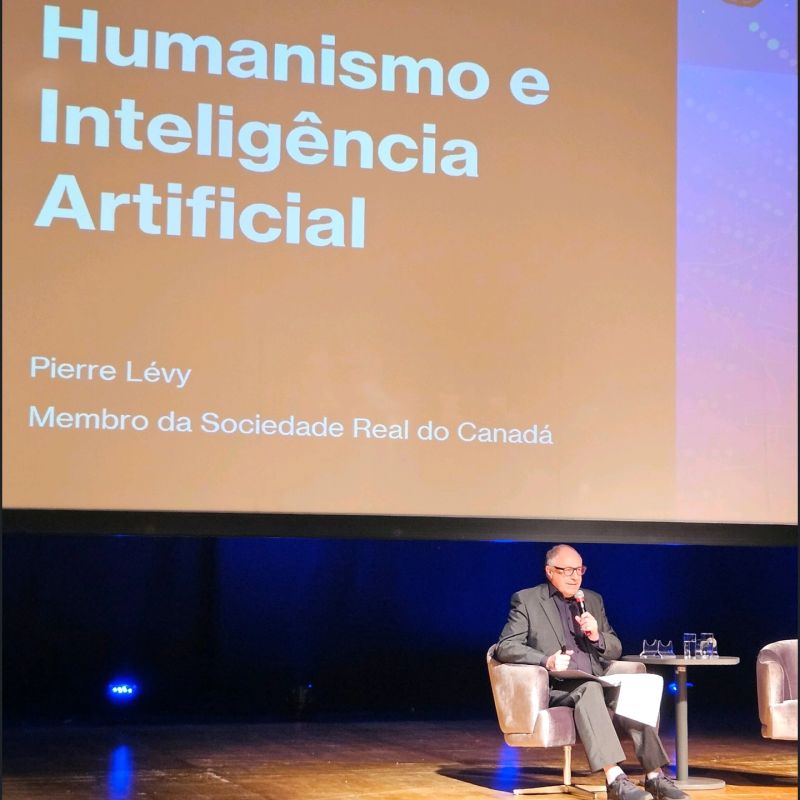
If humanism was born with the alphabet in a literate environment and was reborn with the printing press, what becomes of it when digital technology becomes the dominant symbolic technology?
Mathematical methods and human thought in the age of AI
Artificial intelligence (AI) is the name popularly given to a broad spectrum of computer tools designed to perform increasingly complex cognitive tasks, including many that used to solely be the province of humans. As these tools become exponentially sophisticated and pervasive, the justifications for their rapid development and integration into society are frequently called into question, particularly as they consume finite resources and pose existential risks to the livelihoods of those skilled individuals they appear to replace. In this paper, we consider the rapidly evolving impact of AI to the traditional questions of philosophy with an emphasis on its application in mathematics and on the broader real-world outcomes of its more general use. We assert that artificial intelligence is a natural evolution of human tools developed throughout history to facilitate the creation, organization, and dissemination of ideas, and argue that it is paramount that the development and application of AI remain fundamentally human-centered. With an eye toward innovating solutions to meet human needs, enhancing the human quality of life and expanding the capacity for human thought and understanding, we propose a pathway to integrating AI into our most challenging and intellectually rigorous fields to the benefit of all humankind.
AI as the Catalyst of the New Paradigm of Science? | Cadmus Journal
The rapid advancement of Artificial Intelligence (AI) is reshaping the landscape of scientific inquiry. This article examines the challenges confronting modern science, including knowledge fragmentation, diminishing returns of current paradigms, and the disconnect between science and society. It explores how AI offers solutions enhancing collaboration and integrating knowledge—as well as considers the possible “darker side” of using AI in research. However, the advent of AI in science not only enhances scientific research but also redefines the role of human researchers and fosters a new paradigm of human understanding. By embracing these transformations, a more cohesive and responsive scientific enterprise can emerge.
The Impact of Artificial Intelligence on Education and Workforce Trajectories in Tech: A Workshop
Convened by the National Academies’ Action Collaborative on Education and Workforce Trajectories in Tech, The Impact of Artificial Intelligence on Education and Workforce Trajectories in Tech is a one-day exploratory workshop examining how AI is altering the value of human expertise, organizational workforce structures, and career pathways in the tech sector. Bringing together leaders from higher education, industry, and research institutions, discussions will consider how education and workforce systems can prepare individuals with the ethical, technical, and analytical capabilities needed to adapt and thrive in an AI-impacted landscape.

Development Beyond Information: Human Becoming in the Age of AI
Abstract. Discussions of artificial intelligence in education increasingly equate development with the acquisition and deployment of information. This article argues that such accounts rest on false assumptions. Development is better understood not as an informational state but as a relational, historical process of becoming through which persons emerge and continue to change. Drawing on Vygotsky, on Ilyenkov's distinction between living and petrified ideality, and on the enactive approach to cognition, we characterise development through four features: its historicity, its dependence on reciprocal sense-making, its mediation by others who orient the learner, and its cultivation within relations of care. Large language models operate over the sedimented products of these processes without participating in them. As objectifications of human purposes, such systems may mediate human development or foreclose it. We conclude by considering what this account implies for education.

A Collectivist, Economic Vision for AI
Information technology is in the midst of a revolution in which omnipresent data collection and machine learning are impacting the human world as never before. The word “intelligence” is being used as a North Star for the development of this technology, with human cognition viewed as a baseline. This view neglects the fact that humans are social animals and that much of our intelligence is social and cultural in origin. Moreover, failing to properly situate aspects of intelligence at the social level contributes to the treatment of the societal consequences of technology as an afterthought. The path forward is not merely more data and compute, and not merely more attention paid to cognitive or symbolic representations, but a thorough blending of economic and social concepts with computational and inferential concepts at the level of algorithm design. , The recent focus of AI has been on the exploitation of massive data to mimic and augment human cognitive capabilities. A complementary focus is provided by the social and economic aspects of intelligence.

What Does 'Human-Centred AI' Mean?
While it seems sensible that human-centred artificial intelligence (AI) means centring "human behaviour and experience," it cannot be any other way. AI, I argue, is usefully seen as a relationship between technology and humans where it appears that artifacts can perform, to a greater or lesser extent, human cognitive labour. This is evinced using examples that juxtapose technology with cognition, inter alia: abacus versus mental arithmetic; alarm clock versus knocker-upper; camera versus vision; and sweatshop versus tailor. Using novel definitions and analyses, sociotechnical relationships can be analysed into varying types of: displacement (harmful), enhancement (beneficial), and/or replacement (neutral) of human cognitive labour. Ultimately, all AI implicates human cognition; no matter what. Obfuscation of cognition in the AI context -- from clocks to artificial neural networks -- results in distortion, in slowing critical engagement, perverting cognitive science, and indeed in limiting our ability to truly centre humans and humanity in the engineering of AI systems. To even begin to de-fetishise AI, we must look the human-in-the-loop in the eyes.

The History of AI and the Future of Human Knowing
AI, Decomputing and the Interregnum
This paper treats AI as diagnostic for the deeper changes taking place in the existing order of things. It uses AI's alignment with both the political economy and with the dualisms that underpin it, including race, gender and anthropocentrism, to highlight the nihilistic character of the current restructuring. AI's scaling and accelerationism are taken as examples of the wider tactics being invoked by hegemonic power to maintain control under changing conditions. From this perspective, the massive build-out of data centres isn't simply a seizure of energy resources but a manifestation of an aggressive and misogynist technopolitics. The paper argues that a liberal push for digital sovereignty doesn't interrupt these dynamics but plays into the hands of emerging technofascism. It proposes instead the prefigurative tactic of 'decomputing', which draws on degrowth, deautomatisation and a convivial approach to technology. It explores decomputing as a means to mitigate both material and relational harms and as a decisive turn towards infrastructuring the common good. The paper concludes that AI is the contradiction that reveals many others, not least the gap between claims to legitimacy and the actuality of destructive violence, and proposes an alternative technopolitics of reciprocity that prioritises care and sustainability.
science in the age of AI

What does it mean to be a human researcher in the age of powerful AI?
A Call for a Values-Guided Agenda for Artificial Intelligence-Mediated Information Systems Scholarship
Togelius: Advice for young researchers
Restructuring Education in the Age of Artificial Intelligence from the Perspective of Humanistic Scientific Methodology
AI Red Penning - undisciplinary

Claude-shaped science

Agentic Laboratories of the Future: Towards World Models for Scientific Discovery