


Impact investors can support a more just economy by prioritizing alternative ownership enterprises that shift power away from shareholders to workers, the community, and the planet. <meta property=
The Next Generation of Mutualism (SSIR)
An ecosystem approach to investing in and supporting mutualist enterprises—from the ground up. <meta property=

Building a Solidarity Ecosystem for AI (SSIR)
How cooperatives, public institutions, and social movements can come together to intentionally build a practical, community-owned alternative to extractive AI systems. <meta property=

The Owning Impact Project | MIT Sloan Sustainability Initiative | MIT Sloan
The Owning Impact Project examines the role that systemic investing strategies can have in fostering transformative change.

WSJ News Exclusive | Private-Equity Giants Back New Nonprofit Promoting Employee Ownership
More than 60 groups, including banks and pension funds, have also signed on to support Ownership Works, which aims to promote broad-based stock ownership as a means of curbing income inequality.

The Curb-Cut Effect (SSIR)
Laws and programs designed to benefit vulnerable groups, such as the disabled or people of color, often end up benefiting all of society. <meta property=

Private Equity Is Starting to Share With Workers, Without Taking a Financial Hit (Published 2024)
The buyout giant KKR pioneered a model of granting ownership stakes to employees at portfolio companies. Now it wants the approach to spread.

Exclusive | Blackstone to Grant Equity to Most Employees in Future U.S. Buyouts
The private-equity firm’s plan is part of a broader movement in the buyout industry to expand ownership beyond management ranks.

Database of Alternative Ownership Enterprise Investment Funds And Vehicles
Transform Finance is pleased to release a new database for investors interested in Alternative Ownership Enterprises (AOEs). Alternative Ownership Enterprises (AOEs) are firms that significantly shift economic value and decision-making power toward the non-investor stakeholders they impact, such as workers, producers, consumers, community members, or even a non-financial purpose.
.png)

Company as a Commons
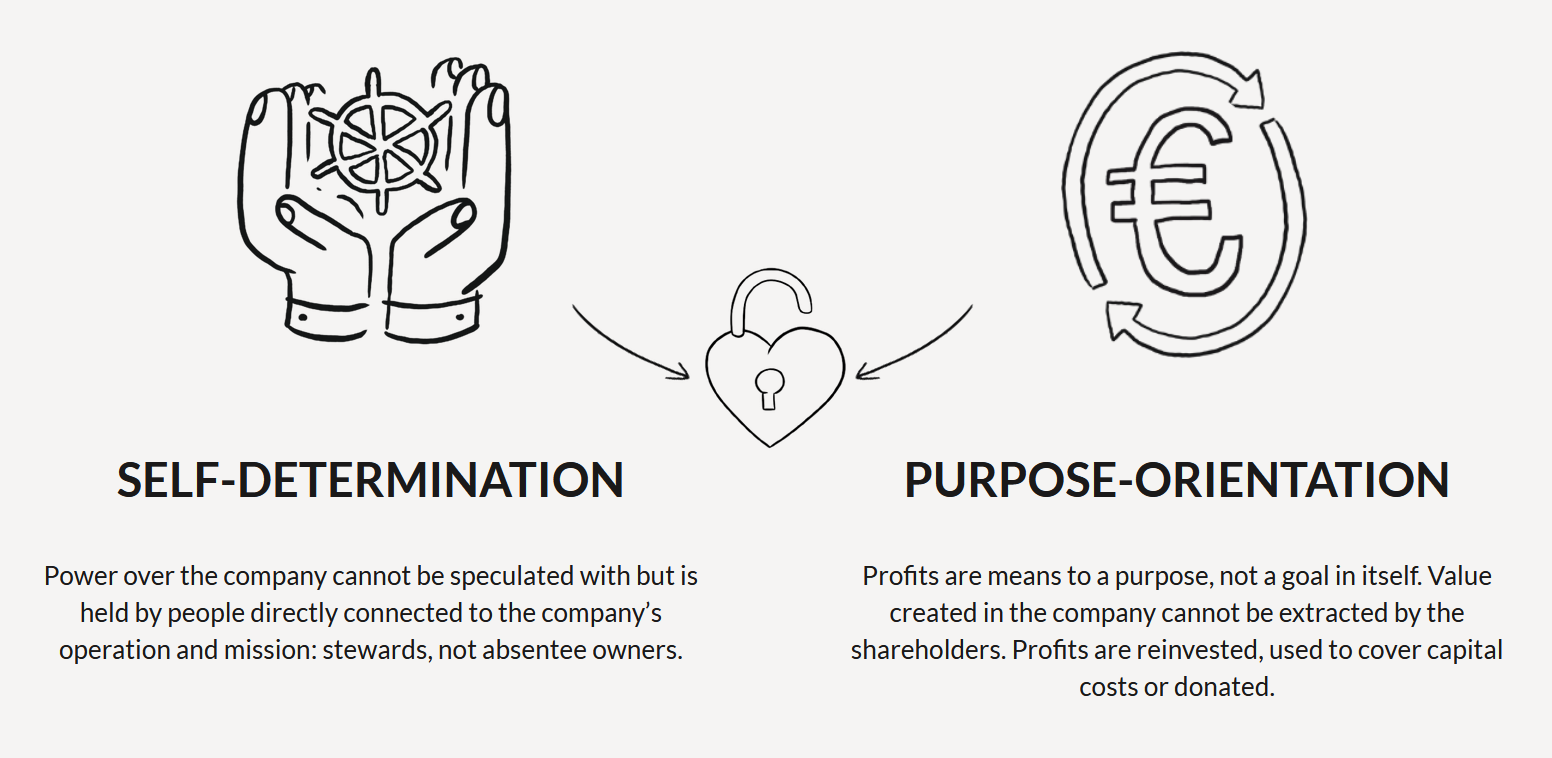
What if excess wealth derived from business couldn't be privatized? Through the levers of steward-ownership, companies can protect their purpose-oriented long term mission from the maligned incentives of absentee stakeholders.
My own private basic income
One person’s experience becoming a business owner shows how our economy is based on luck rather than merit and how it rewards people who own stuff rather than people who do stuff.
Work, Justice, and Collective Capital Institutions: Revisiting Rudolf Meidner and the Case for <span style="font-variant:small-caps;">Wage‐Earner</span> Funds
ABSTRACT This article makes the case for a specific variety of what we call Collective Capital Institutions (CCIs), by returning to the idea of Wage‐Earner Funds (WEFs) – a 1970s Swedish policy proposal designed gradually to shift ownership and control over parts of the economy to democratically controlled institutions. We identify two attractive rationales in favour of such a scheme and argue that both can fruitfully be transposed to the current worldwide economic situation. The egalitarian rationale is that WEFs could help in the pursuit of equality by giving a wider set of people a stake in collectively owned companies and a right to their profits. The democratic rationale is that WEFs redistribute not only these profits, but also the power over economic decisions made within companies. We then contrast such schemes for collective capital ownership with the similar but much more privatised proposals set out in, for instance, John Rawls's idea of a ‘property‐owning democracy’. We argue that CCIs ultimately are more likely to contribute to the development of the ‘sense of justice’ within society that is needed for a stable just society. We conclude that CCIs deserve a great deal more exploration in academic and political discussions of egalitarian economic systems.

Universal Basic Income is Capitalism 2.0 | TimJRobinson
A Universal Basic Income (UBI) would improve everyone’s lives, increase our free time, empower workers, and ensure everyone has food and a roof over their head. These are noble goals, but obviously there’s a downside or it would already be implemented, right?
A game of co-opetition: exploring the benefits of asset owner collaboration - Thinking Ahead Institute
It may seem like a hidden truth but the reality is that asset owners are in competition with each other. They are in competition for the best alpha ideas, the best manager products and the best research – all with the aim of improving risk-return trade-offs to increase the likelihood of meeting their liabilities. As a result, many asset owners find it difficult to collaborate, even in initiatives that may prove mutually beneficial. At the Thinking Ahead Institute’s recent Sydney roundtable event, asset owner attendees highlighted the top three barriers to successful peer collaboration: (1) difficulties being transparent; (2) lack of time and resources available; and (3) difficulties in aligning interests. At the same time, attendees agreed on the value to funds of collaborating productively on industry structure and regulation, and on a universal owner / alignment of interest agenda.

Democratic Ownership Funds: Creating Shared Wealth and Power
Recent decades have seen a rapid and little-discussed transformation in corporate ownership structure, with vital consequences for company behaviour and inequality.

"I think thinking about it in terms of new institutions is really a useful way to think about it. It's funny for me as a VC, because I think a lot of this stuff will and even goes for us to say should be illegible to venture capital in a lot of ways." - @eclecticcapital.bsky.social

The Economics of Sovereign Media: A Roadmap for AT Protocol | ATmosphereConf VODs
atmosphereconf-vods.wisp.place