


Laws and programs designed to benefit vulnerable groups, such as the disabled or people of color, often end up benefiting all of society. <meta property=
The curb-cut effect
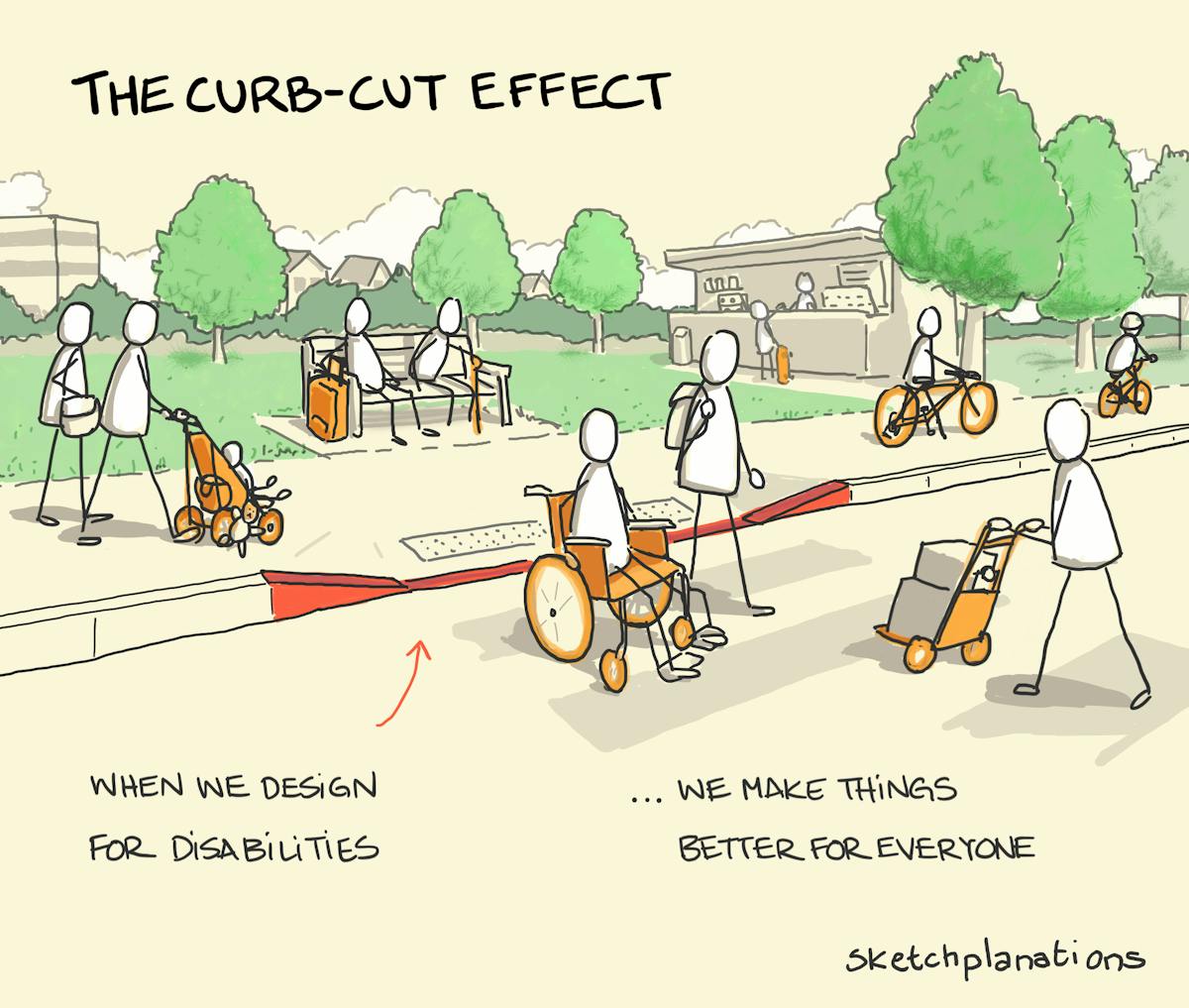
The curb-cut effect illustrates how when we design to benefit disadvantaged or vulnerable groups we end up helping society as a whole. Angela Glover Blackwell explains how campaigning by students with disabilities in Berkeley in the early 1970s led to adding curb cuts to the Berkeley sidewalks to make access easier for those in wheelchairs. Yet it wasn't just people in wheelchairs that it helped. Curb cuts also made life easier for people pushing children in strollers, people using trolleys for deliveries, people pulling a suitcase, those wheeling bikes or on skateboards, and it also helps save lives by guiding people to cross at safe locations. Another example is adding closed captioning to TV that helps anyone watch in a noisy bar, a waiting room, or watching an airline safety video. Or a classic example of universal design in the OXO Good Grips range originally made to be comfortable for holding a peeler even if you have arthritis. It's also a useful analogy for "how laws and programs designed to benefit vulnerable groups, such as the disabled or people of color, often end up benefiting all," (PolicyLink) whether that be increasing broadband access, improving public transport or taking cuts out of curbs. Here's a short, fun video of Gary Karp explaining the curb-cut effect. Thanks to my patron Quintin Balsdon for sharing it with me.
Curb cut effect
The curb cut effect is the phenomenon of disability-friendly features being used and appreciated by a larger group than the people they were designed for. The phenomenon is named for curb cuts – miniature ramps comprising parts of sidewalk – which were first made for wheelchair access in particular places, but were also welcomed by people pushing strollers, carts or luggage. Curb cuts are now ubiquitous and no longer widely recognized as a disability-accessibility feature. Another example is hearing people using television closed captioning.

Investing in Enterprises That Work for Everyone (SSIR)
Impact investors can support a more just economy by prioritizing alternative ownership enterprises that shift power away from shareholders to workers, the community, and the planet. <meta property=

Burnout From an Organizational Perspective (SSIR)
Instead of pressuring already-stressed individuals to fix themselves, true wellness requires organization-level interventions. <meta property=
Fairness is what the powerful ‘can get away with’ study shows
The willingness of those in power to act fairly depends on how easily others can collectively push back against unfair treatment

Crip Technoscience Manifesto
As disabled people engaged in disability community, activism, and scholarship, our collective experiences and histories have taught us that we are effective agents of world building and dismantling toward more socially just relations.The grounds for social justice and world remaking, however, are frictioned;technologies, architectures, and infrastructures are often designed and implemented without committing to disability as a difference that matters. This manifesto calls attention to the powerful, messy, non-innocent, contradictory, and nevertheless crucial work of what we name as “crip technoscience,” practices of critique, alteration, and reinvention of our material-discursive world. Disabled people are experts and designers of everyday life. But we also harness technoscience for political action, refusing to comply with demands to cure, fix, or eliminate disability. Attentive to the intersectional workings of power and privilege, we agitate against independence and productivity as requirements for existence. Instead, we center technoscientific activism and critical design practices that foster disability justice.
Social safety nets and long-run outcomes for children
The effects of welfare cuts in Denmark.
The social model of disability: thirty years on
This year marks exactly 30 years since I published a book introducing the social model of disability onto an unsuspecting world and yet, despite the impact this model has had, all we now seem to do...

The social model of disability: thirty years on
This year marks exactly 30 years since I published a book introducing the social model of disability onto an unsuspecting world and yet, despite the impact this model has had, all we now seem to do...
The long-run effects of affirmative action bans
Recent national affirmative action ban could worsen earnings inequality across racial and ethnic groups among women, while having relatively little impact on men

Les mesures de discrimination positive bénéficient-elles aux populations qu’elles ciblent ?
Les mesures de discrimination positive sont apparues il y a un demi-siècle : elles instaurant un traitement inégal des individus en vue de réduire les inégalités. Aux Etats-Unis, des politiques de discrimination positive (sous le nom d’« affirmative action...
Substrates via Accessibility
The social model of disability holds that disability is produced by environments, not by bodies — that when software fails to accommodate a person’s needs, the environment is disabling them. We argue that the dominant organization of computing produces such interaction mismatches structurally: the commodity form of software requires a standardized consumer, and everyone whose needs diverge from this imagined subject is disabled by the software environment. The substrates research community has identified properties — disclosure, composability, malleability — that would address this, but the commodity form actively selects against these properties because they dissolve the boundaries on which exchange value depends. This raises a question: how can infrastructure organized against the grain of commodity logic be made durable? We find a precedent in accessibility infrastructure — sustained not by patronage but by the organized counter-power of disability rights movements. Through Allio, a system for cross-application augmentation built on accessibility APIs, we illustrate both what this foundation makes possible and where its limits lie. We argue that the accessibility case reframes the substrates programme’s central challenge as political-economic: the question of who sustains substrate infrastructure, and through what social mechanisms, is as important as the question of what properties it should have.
Substrates via Accessibility
The social model of disability holds that disability is produced by environments, not by bodies — that when software fails to accommodate a person’s needs, the environment is disabling them. We argue that the dominant organization of computing produces such interaction mismatches structurally: the commodity form of software requires a standardized consumer, and everyone whose needs diverge from this imagined subject is disabled by the software environment. The substrates research community has identified properties — disclosure, composability, malleability — that would address this, but the commodity form actively selects against these properties because they dissolve the boundaries on which exchange value depends. This raises a question: how can infrastructure organized against the grain of commodity logic be made durable? We find a precedent in accessibility infrastructure — sustained not by patronage but by the organized counter-power of disability rights movements. Through Allio, a system for cross-application augmentation built on accessibility APIs, we illustrate both what this foundation makes possible and where its limits lie. We argue that the accessibility case reframes the substrates programme’s central challenge as political-economic: the question of who sustains substrate infrastructure, and through what social mechanisms, is as important as the question of what properties it should have.
Social Model of Disability | The Paper Pilot
The Paper Pilot's digital garden of thoughts on philosophy, politics, and sociology
Unconditional cash transfers reduce homelessness
Homelessness is an economic and social crisis. In a cluster-randomized controlled trial, we address a core cause of homelessness—lack of money—by providing a one-time unconditional cash transfer of CAD$7,500 to each of 50 individuals experiencing homelessness, with another 65 as controls in Vancouver, BC. Exploratory analyses showed that over 1 y, cash recipients spent fewer days homeless, increased savings and spending with no increase in temptation goods spending, and generated societal net savings of $777 per recipient via reduced time in shelters. Additional experiments revealed public mistrust toward the ability of homeless individuals to manage money and demonstrated interventions to increase public support for a cash transfer policy using counter-stereotypical or utilitarian messaging. Together, this research offers a new approach to address homelessness and provides insights into homelessness reduction policies.

#LiberatingWebinars: Disability Justice & Crip Technoscience: Racism & Ableism in AI