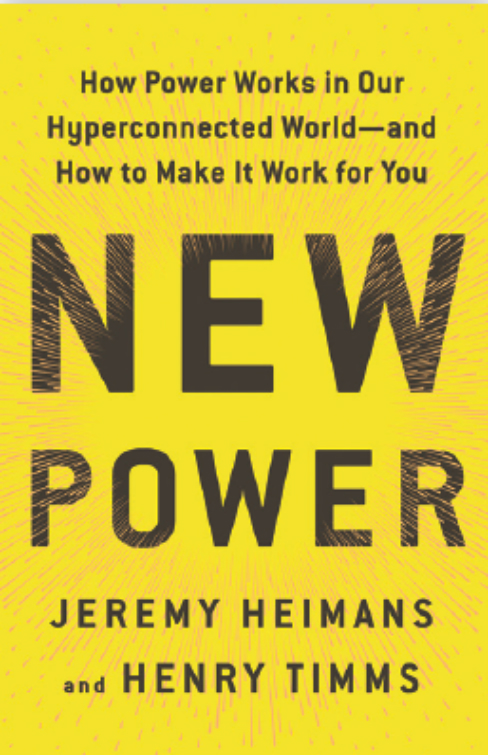
In New Power, Jeremy Heimans and Henry Timms argue that power and influence are being driven by a new participatory and peer-driven paradigm.
Digital Strategy for Organisations
Digital power is created through the interplay of mobilizing and organizing. Open Social protocols bridge the gap.

New_ Public
We are researchers, engineers, designers, and community leaders working together to create digital public spaces where people can thrive and connect.

Bridging Social Movements and the New Social Web (working draft) - Variable Context with @CaptainCalliope.blue
On connecting movements, media, and new protocol ecosystems to rebuild the civic, cultural, and technical foundations of a freer, more self-determining society.
Peer-to-Peer Republic
A movement, open republic of humans building peer-to-peer systems that redistribute power and reimagine the internet as a public good, not a product a platform sells.
The Technological Construction of Social Power
This essay presents a theory of the role of technology in the distribution and exercise of social power. The paper studies how technical artefacts and systems are used to construct, maintain or st...

Motivating The Case for Decentralized Social Identity: Part One
RadicalxChange Foundation is an international nonprofit advancing participatory governance for the age of AI, championing Plurality to keep human agency and democratic participation at the wheel.
DIY Infrastructure Building for Power – Esther Han Beol Jang
Rudy Fraser on Blacksky, Mutual Aid & Reclaiming Social Media
Strengthening Online Communities | Rise Against Big Tech Powerbase
New/Mode – Empowerment & Community Action Platform
Empower your voice and drive change with New/Mode advocacy tools. Mobilize your community in minutes. Start your campaign for free today.
New Project to Tackle the Challenge of Scaling Democratic Innovations | CoP CC on Participatory and Deliberative Democracy
The “Missing Link” between Research and Society
Art or tool?
The Internet spaces I tend to inhabit have more polarisation than at many other recent times, and little explication of the worldviews that lead to different premises for discussion, that in turn...

RadicalxChange
We are a community of activists, artists, entrepreneurs, and scholars committed to using mechanism design to inspire radical social change.
Towards a Post-Social Media Studies
For two decades, "social media" has been the master lens through which scholars have understood digital communication—an era defined by user-generated content, networked publics, and participatory culture. That era is drawing to a close. This paper argues that three interrelated dynamics are dissolving the social media paradigm: an algorithmic shift from social-graph-based to interest-based recommendation, which is remaking the active "user" into a passive "viewer"; the generative AI revolution, which is replacing user-generated content with synthetic media and decoupling platforms from any dependence on human participation; and an exodus from public platforms toward private, closed spaces. Together, these dynamics are giving rise to three distinct post-social formations: algorithmically governed broadcasting platforms, semi-private spheres and micro-communities, and AI-mediated communication as a new media form in its own right. Understanding this transformation demands a fundamental reorientation of the field—new conceptual tools that move beyond networked publics and participatory culture, new methods suited to synthetic and ephemeral media environments, and renewed attention to the political stakes of communication systems that no longer require human participation.
Towards a Post-Social Media Studies
For two decades, "social media" has been the master lens through which scholars have understood digital communication—an era defined by user-generated content, networked publics, and participatory culture. That era is drawing to a close. This paper argues that three interrelated dynamics are dissolving the social media paradigm: an algorithmic shift from social-graph-based to interest-based recommendation, which is remaking the active "user" into a passive "viewer"; the generative AI revolution, which is replacing user-generated content with synthetic media and decoupling platforms from any dependence on human participation; and an exodus from public platforms toward private, closed spaces. Together, these dynamics are giving rise to three distinct post-social formations: algorithmically governed broadcasting platforms, semi-private spheres and micro-communities, and AI-mediated communication as a new media form in its own right. Understanding this transformation demands a fundamental reorientation of the field—new conceptual tools that move beyond networked publics and participatory culture, new methods suited to synthetic and ephemeral media environments, and renewed attention to the political stakes of communication systems that no longer require human participation.
About - Open Collective
Open Collective was founded by idealists to make online communities more sustainable. What began as a tool for open source and grassroots groups has grown into a global infrastructure for transparency, collaboration, and shared financial stewardship.