

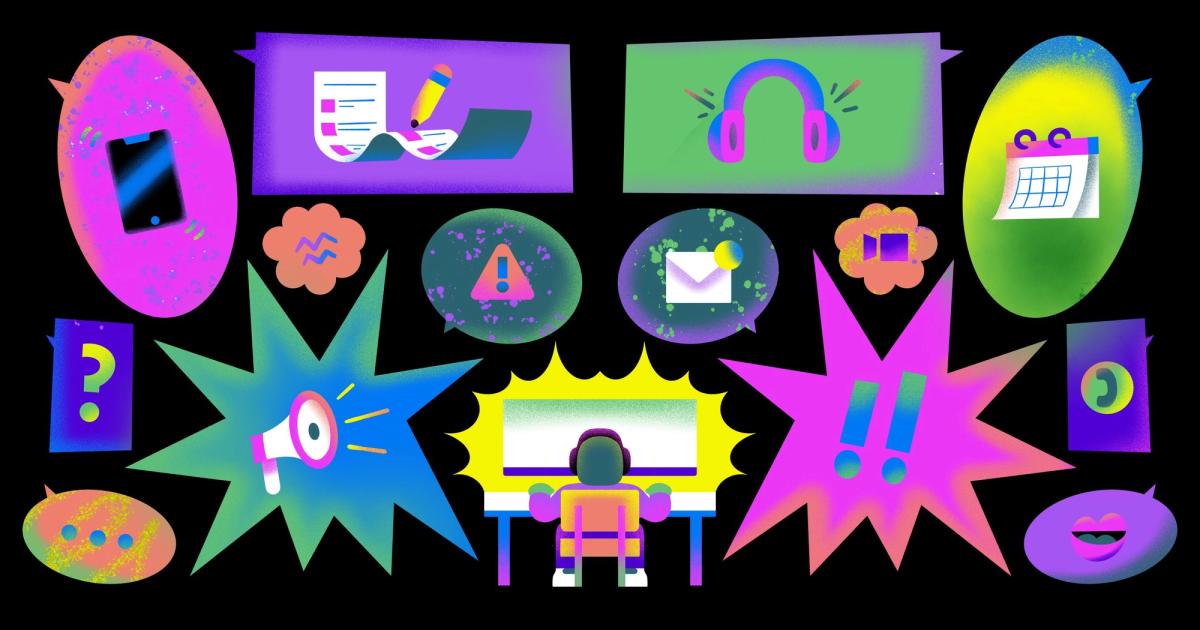
Attention—the time and freedom to focus—is your team’s most valuable resource.
Why It's So Hard to Focus at Work (Hint: It's not you, it's your workplace)
The workplace is overloaded with distractions. Here's why (and how) companies should protrect their most important asset – their team's attention.
Attention Is My Most Valuable Asset for Productivity as a Software Developer | Zachary Betz
My high-level workflow looks something like this: identify the problem to solve; think on the problem and let ideas percolate; research, discuss, and experiment with these ideas; implement and test the solution; deliver and maintain the solution.
A World Without Email: Reimagining Work in an Age of Communication Overload
A New York Times and Wall Street Journal bestsellerFrom New York Times bestselling author Cal Newport comes a bold vision for liberating workers from the tyranny of the inbox--and unleashing a new era of productivity.Modern knowledge workers communicate constantly. Their days are defined by a relentless barrage of incoming messages and back-and-forth digital conversations--a state of constant, anxious chatter in which nobody can disconnect, and so nobody has the cognitive bandwidth to perform substantive work. There was a time when tools like email felt cutting edge, but a thorough review of current evidence reveals that the "hyperactive hive mind" workflow they helped create has become a productivity disaster, reducing profitability and perhaps even slowing overall economic growth. Equally worrisome, it makes us miserable. Humans are simply not wired for constant digital communication.We have become so used to an inbox-driven workday that it's hard to imagine alternatives. But they do exist. Drawing on years of investigative reporting, author and computer science professor Cal Newport makes the case that our current approach to work is broken, then lays out a series of principles and concrete instructions for fixing it. In A World without Email, he argues for a workplace in which clear processes--not haphazard messaging--define how tasks are identified, assigned and reviewed. Each person works on fewer things (but does them better), and aggressive investment in support reduces the ever-increasing burden of administrative tasks. Above all else, important communication is streamlined, and inboxes and chat channels are no longer central to how work unfolds.The knowledge sector's evolution beyond the hyperactive hive mind is inevitable. The question is not whether a world without email is coming (it is), but whether you'll be ahead of this trend. If you're a CEO seeking a competitive edge, an entrepreneur convinced your productivity could be higher, or an employee exhausted by your inbox, A World Without Email will convince you that the time has come for bold changes, and will walk you through exactly how to make them happen.
Overcoming information overload with circular attention economies - Cosmik Labs
Alert-driven monitoring | Documentation
Why we believe alerts, not dashboards, are the real core of infrastructure monitoring and how to build a system you actually trust.
Rethinking the cognitive foundations of the attention economy
The attention economy is the economic system in which human attention is the scarce resource. This literature takes a particular passage in Herbert Simon’s seminal Chapter Designing Organization fo...

Email: The Variable Reinforcement Machine
How often do you check your email per day? Does checking your email make you more productive or less productive? Oh, sure, we delude ourselves into thinking we’re being extra-productive by obsessively checking and responding to our email, but in reality we’re attending too frequently to our

It's getting harder to focus every day
I’m feeling it right now. I had to set a timer for 15 minute on my computer and block all distractions to write this. If I didn’t force myself to focus I would easily get distracted by something after few minutes. Even when I’m doing things that I’ve been waiting to do it, I still feel the urge to do something else. I don’t know how and when this happened. During the last few years I was always studying, working, and doing open source. And actually got stuff done. Doing all of those at the same time requires paying attention to what I wanted to do and ignore the noise.
Deep work. Essentialism in asynchronous culture
Deep work Nowadays, we are getting accustomed to working in a continuously interrupting environment. Smartphone notifications, hundreds of e-mails, open spaces, and meetings slicing our workday. We are feeling busy, and overworked, but are we more productive? If I am a salesman or project coordinator that way of working can bring good effects and even improve my skills. However, for Software Developers, Designers, and other professionals that need a quiet environment for creative effort, it can lead only to frustration and burnout. They need something that is called deep work. Deep work is a concept popularized by Cal Newport in his book under the same title published in 2016. The author divides mental activity into two categories: shallow work, that does not need intensive concentration like sending e-mails, formatting documents, chatting using communicators, etc. deep work, that demands distraction-free focus on one task like writing a document, learning a new skill, designing a software system, etc.
Our Responsibility to Defeat Mass Surveillance • Erik Doernenburg & Martin Fowler • GOTO 2014
The lost art of concentration: being distracted in a digital world
We check our phones every 12 minutes, often just after waking up. Always-on behaviour is harmful to long-term mental health, and we need to learn to the hit the pause button
How to reclaim your attention from the distraction economy | Psyche Videos
Could you watch this video on full screen, 1x speed, with no distractions? Here are five steps to rebuild your attention span
If You are Asking for Human Attention, Demonstrate Human Effort | Tom Bedor's Blog
An ever-increasing volume of debug investigations, document writing, and code is written by robots. This has created a new etiquette question when working with a team - when is it OK to forward the output of an AI to another human to read?
How We Pay Attention Changes the Very Shape of Our Brains
Imagine arriving at the airport just in time to catch a plane. Everything in your behavior betrays the heightened concentration of your attention. Your mind on alert, you look for the departures si…
The New Science of Building Great Teams
Why do some teams consistently deliver high performance while other, seemingly identical teams struggle? Led by Sandy Pentland, researchers at MIT’s Human Dynamics Laboratory set out to solve that puzzle. Hoping to decode the “It factor” that made groups click, they equipped teams from a broad variety of projects and industries (comprising 2,500 individuals in total) with wearable electronic sensors that collected data on their social behavior for weeks at a time. With remarkable consistency, the data showed that the most important predictor of a team’s success was its communication patterns. Those patterns were as significant as all other factors—intelligence, personality, talent—combined. In fact, the researchers could foretell which teams would outperform simply by looking at the data on their communication, without even meeting their members. In this article Pentland shares the secrets of his findings and shows how anyone can engineer a great team. He has identified three key communication dynamics that affect performance: energy, engagement, and exploration. Drawing from the data, he has precisely quantified the ideal team patterns for each. Even more significant, he has seen that when teams map their own communication behavior over time and then make adjustments that move it closer to the ideal, they can dramatically improve their performance.

Capturing our Attention by @neillevy.bsky.social "we possess sophisticated capacities of epistemic vigilance, which work reasonably well to distinguish reliable from unreliable information, but ... we do not have parallel defences against attentional capture" > tandfonline.com/doi/full/10.1080/00048402.202…
