

Hannah Waight1,2, Eddie Yang1,3, Yin Yuan4, Solomon Messing5, Margaret E. Roberts4, Brandon M. Stewart6, Joshua A. Tucker5,7
Replication Data for "State Media Control Influences Large Language Models"
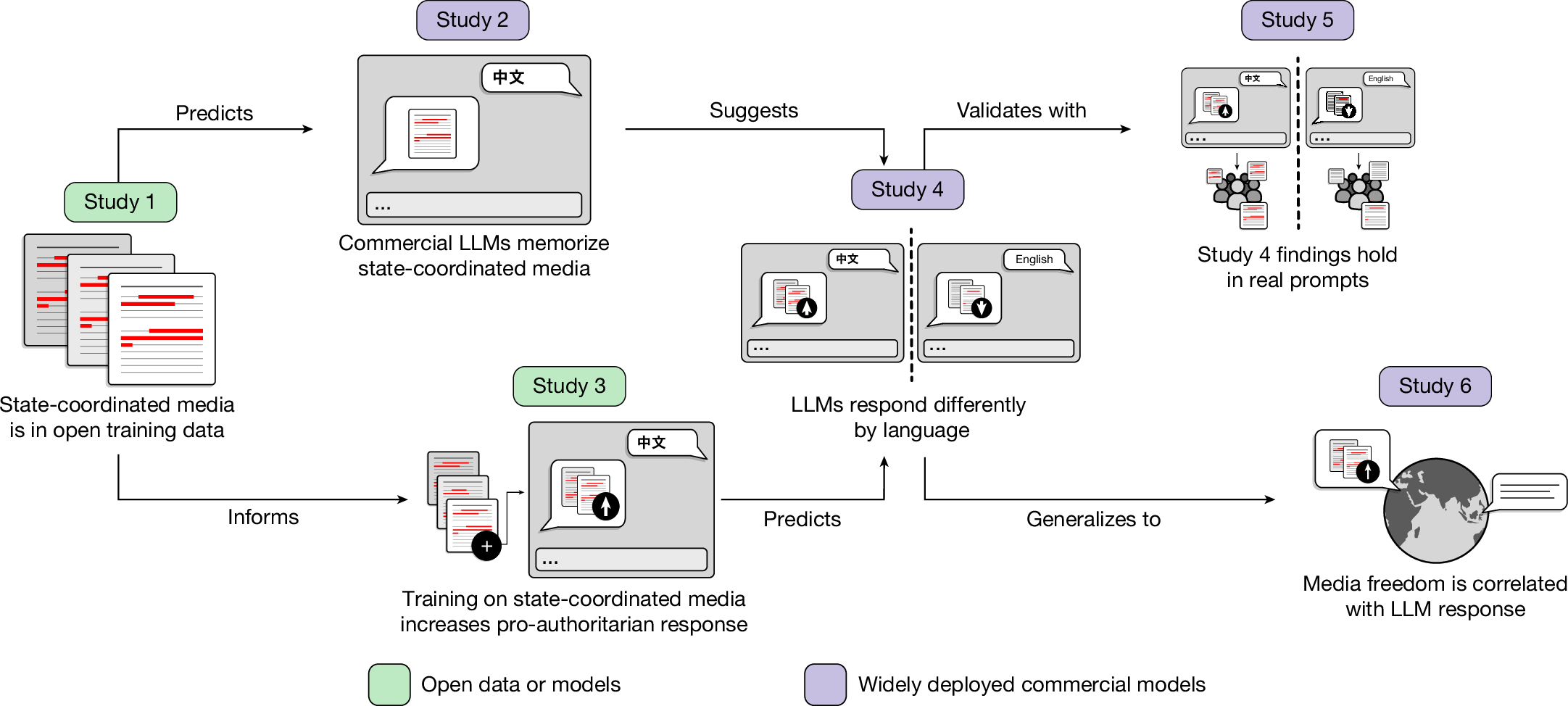
Replication dataset for "State Media Control Influences Large Language Models," forthcoming in Nature (https://doi.org/10.1038/s41586-026-10506-7). We show through six studies that government control of the media across the world influences the output of large language models (LLMs) via their training data.
Replication Data for "State Media Control Influences Large Language Models"
Replication dataset for "State Media Control Influences Large Language Models," forthcoming in Nature (https://doi.org/10.1038/s41586-026-10506-7). We show through six studies that government control of the media across the world influences the output of large language models (LLMs) via their training data.
State media control influences large language models
Millions of people around the world query large language models (LLMs) for information. Although several studies have compellingly documented the persuasive potential of these models1–10, there is limited evidence of who or what influences the models themselves, leading to a flurry of concerns about which companies and governments build and regulate the models. Here we show through six studies that government control of the media across the world already influences the output of LLMs via their training data. We use a cross-national audit to show that LLMs exhibit a stronger pro-government valence in the languages of countries with lower media freedom than in those with higher media freedom. This result is correlational, so to triangulate the specific mechanism of how state media control can influence LLMs, we develop a multi-part case study on China’s media. We demonstrate that media scripted and curated by the Chinese state appears in LLM training datasets. To evaluate the plausible effect of this inclusion, we use an open-weight model to show that additional pretraining on Chinese state-coordinated media generates more positive answers to prompts about Chinese political institutions and leaders. We link this phenomenon to commercial models through two audit studies demonstrating that prompting models in Chinese generates more positive responses about China’s institutions and leaders than do the same queries in English. The combination of influence and persuasive potential across languages suggests the troubling conclusion that states and powerful institutions have increased strategic incentives to leverage media control in the hopes of shaping LLM output.
State media control influences large language models
Millions of people around the world query large language models (LLMs) for information. Although several studies have compellingly documented the persuasive potential of these models1–10, there is limited evidence of who or what influences the models themselves, leading to a flurry of concerns about which companies and governments build and regulate the models. Here we show through six studies that government control of the media across the world already influences the output of LLMs via their training data. We use a cross-national audit to show that LLMs exhibit a stronger pro-government valence in the languages of countries with lower media freedom than in those with higher media freedom. This result is correlational, so to triangulate the specific mechanism of how state media control can influence LLMs, we develop a multi-part case study on China’s media. We demonstrate that media scripted and curated by the Chinese state appears in LLM training datasets. To evaluate the plausible effect of this inclusion, we use an open-weight model to show that additional pretraining on Chinese state-coordinated media generates more positive answers to prompts about Chinese political institutions and leaders. We link this phenomenon to commercial models through two audit studies demonstrating that prompting models in Chinese generates more positive responses about China’s institutions and leaders than do the same queries in English. The combination of influence and persuasive potential across languages suggests the troubling conclusion that states and powerful institutions have increased strategic incentives to leverage media control in the hopes of shaping LLM output.
Large language models are cultural technologies. What might that mean?
Four different perspectives

Language Models Trained on State Media Sources Launder Propaganda
Tech Policy Press is a nonprofit media and community venture intended to provoke new ideas, debate and discussion at the intersection of technology and democracy. We publish opinion and analysis.

State Media Monitor Global Dataset 2025
This dataset provides comprehensive information on the governance, funding, and editorial independence of state and public media outlets worldwide. In 2025, the State Media Monitor covers 170 countries, tracking changes in media governance models, funding mechanisms, and degrees of political control. The dataset underpins the annual State Media Monitor Global Study and supports comparative research in journalism, media policy, and governance. Access the full dataset here: https://www.statemediamonitor.com
LLMs and World Models, Part 1
How do Large Language Models Make Sense of Their “Worlds”?

How Large Language Models Actually Work
Are LLMs Stifling Political Speech? An Assessment of How AI Models Protect Free Expression | Oversight Board
The Oversight Board’s first evaluation of large language models (LLMs) shows that some of the world’s most-used models from Anthropic, DeepSeek, Google, Meta
AI Large Language Model Training: The Potential Risks of Ideological Skewing — PSG Consulting
LLMs (AI Large Language Models) have become part of everyday life. Systems such as ChatGPT, Claude, Gemini, Meta AI (Llama) and X.ai's Grok handle billions of interactions daily. They increasingly shape what information people encounter and in what order, subtly deciding what's important and even what is true, sometimes without users realizing it. Because LLMs wield growing power over information exposure, it is vital to recognize the political and ideological structures at multiple stages of their design, and to identify manipulation risks.

We Have Always Been Action TheoristsToward a Critical Theory of Language for the Era of “Large Language Models”
Scholars of literature and culture understandably place themselves among the world’s premiere experts on matters of language. But they also know that fields like linguistics and communication have their own ways of studying how people express themselves through speech and written media. A key difference concerns the theories and methodologies...
The diffusion of large language models in published academic articles
Large language models (LLMs) are rapidly changing academic research, raising questions of who is adopting these tools and under what conditions. This article analyzes full texts of 7.3 million journal articles published from 2020–2025 by four major publishers (Elsevier, Frontiers, MDPI, and PLoS) to track the prevalence of LLM-associated language and identify social and institutional correlates of adoption. A corpus of 228 focal words exhibiting sharp post-2022 frequency increases consistent with LLM output was developed; articles were scored on their rate of focal word usage. By 2025, an estimated 57% of published articles exhibited evidence of LLM influence, up from 12% in 2023. Among articles exhibiting LLM-influenced text, there is substantial heterogeneity, ranging from subtle linguistic influence to articles mostly or entirely LLM-generated. Difference-in-differences models reveal that LLM-associated language varies markedly across regions, institutional ranks, publishers, disciplines, and journal tiers. Economic development and proximity to English as a primary language are key predictors of regional variation. Lower-ranked institutions exhibit higher rates than elite universities, young for-profit publishers show elevated rates vis-à-vis competitors, and academic fields differ widely in adoption. LLM adoption in academic writing is pervasive but socially stratified. As models grow more powerful and their use becomes further entrenched in academic research, understanding social dynamics of adoption will be essential for governing the evolving relationship between AI and academic knowledge production.

Brandon Stewart on Twitter / X
1/ New @Nature! We study how powerful institutions shape the information environment for LLMs. Commercial LLM training is opaque, so we trace a path from state-coordinated media -> training data -> model responses. pic.twitter.com/5LdFvzbFaf— Brandon Stewart (@b_m_stewart) May 13, 2026
The LLMentalist Effect: how chat-based Large Language Models rep…
The new era of tech seems to be built on superstitious behaviour
Disentangling Models from Personas in Heterogeneous LLM Simulations
Multi-agent simulations with large language models (LLMs) often operate networks of agents with a single base model. This overlooks the inter-model effects which may dominate engagement dynamics in real-world deployments. To show this, we simulate a heterogeneous social network powered by several different base models and show that the amount of engagement an agent receives depends more on its base model than on its assigned persona. The attraction or repulsion effects of a base model strengthen dramatically when more models are added in the mix, suggesting that networks dynamics may converge to base model effects at scale. To help explain this effect, we conduct a series of content-mediating analyses, showing the predictability of base models across contexts as well as the relationship between a model's lexical patterns and an engagement-maximizing style. In light of recent developments in mass multi-agent interaction, this work underscores the relevance of *heterogeneous* compositions in driving the outcomes of those networks.