

In December 2025, I was grading final projects for my course on data visualization with R. On one of my screens, I had a browser open to my university’s learning management system and came across a now-familiar phenomenon: a student had used verbatim ChatGPT output for their assignment. The code they included was flawless, but used function arguments and code syntax that we never covered in class and that weren’t actually necessary. More concerning, the original chat prompt was inadvertently still included, along with fill-in-the-blank sections that the large language model (LLM) had included to help tailor the response to the course (e.g. “[insert an example from your professor’s class here]”). Following my course’s AI policy, I gave a sizable point reduction, sighed heavily, and moved on to the next assignment.
ChatGPT Is a Gimmick
AI offers a tempting illusion to students—and evidently to some teachers.
ChatGPT talks too much and it’s ruining learning
How the UX of AI chat can hijack our brains to compromise learning in schools and beyond

no slop grenade
Stop throwing AI-generated walls of text into conversations. If they wanted an AI essay, they would have asked ChatGPT themselves.
Teachers Are Not OK
AI, ChatGPT, and LLMs "have absolutely blown up what I try to accomplish with my teaching."

From Chalkboards to Chatbots : Evaluating the Impact of Generative AI on Learning Outcomes in Nigeria
This study evaluates the impact of a program leveraging large language models for virtual tutoring in secondary education in Nigeria. Using a randomized controlled trial, .

Jay Van Bavel, PhD on Twitter / X
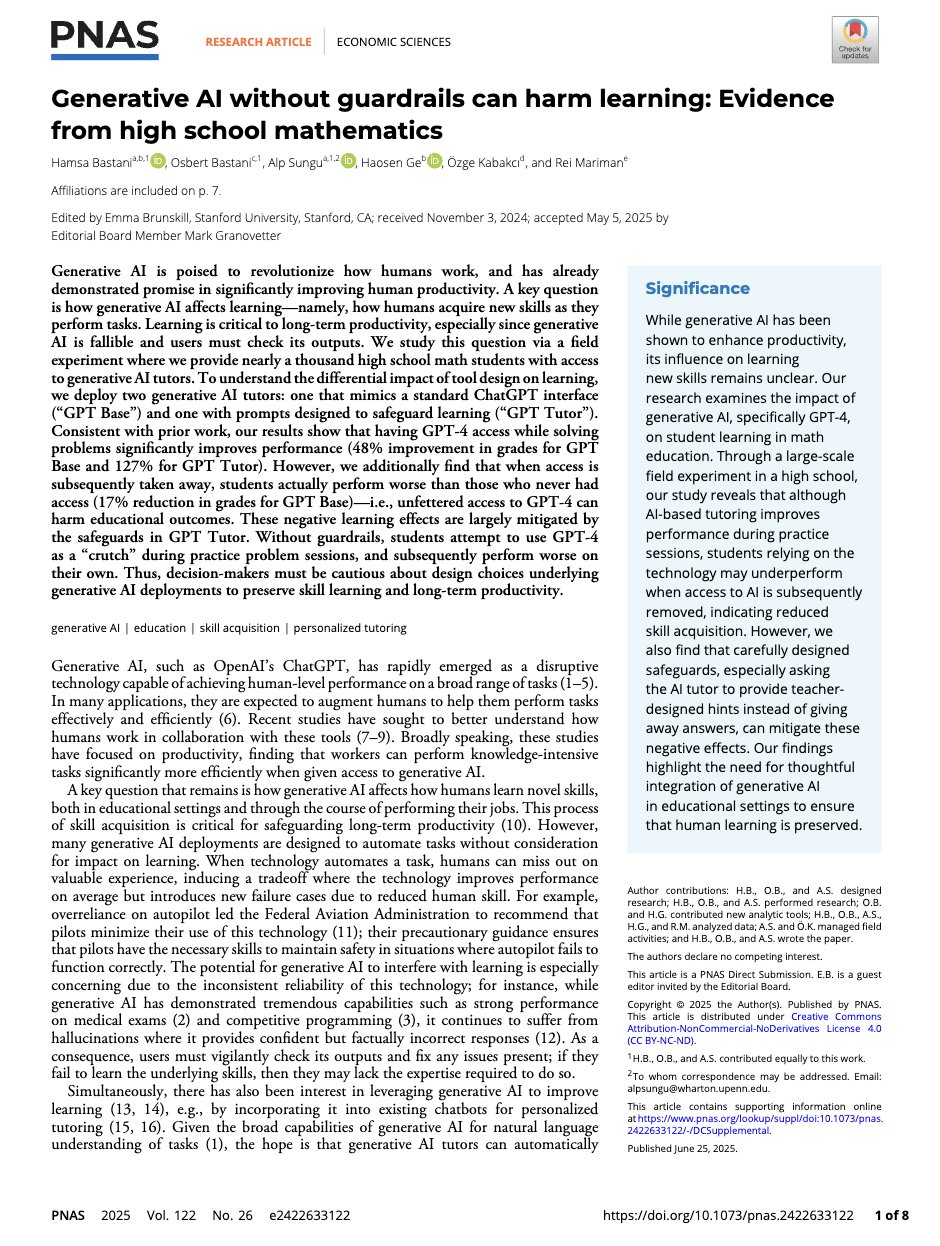
Giving students unfettered access to chatbots can harm educational outcomesHaving AI access while solving problems significantly improves performance (48% improvement in grades for GPT Base and 127% for GPT Tutor).However, when access to AI was taken away, students actually… pic.twitter.com/2g8GJcoRya— Jay Van Bavel, PhD (@jayvanbavel) July 18, 2026
Your Brain on ChatGPT: Accumulation of Cognitive Debt when Using an AI Assistant for Essay Writing Task – MIT Media Lab
This study explores the neural and behavioral consequences of LLM-assisted essay writing. Participants were divided into three groups: LLM, Search Engine, and …
ChatGPT acts as a "cognitive crutch" that weakens memory, new research suggests
A recent experiment provides evidence that relying on artificial intelligence to study tends to reduce how much information students remember weeks later.

Inside ChatGPT: How AI chatbots work
Large language models like ChatGPT use a complicated series of equations to understand and respond to your prompts. Here’s a look inside the system.
Methodologies for Improving the Quality of AI Tutoring in K-12 Education
Many AI tutors leverage large language models (LLMs) today. Given that LLMs are opaque black boxes, robust evaluation and live experimentation to measure the impact of every change are essential. We pioneered AI-powered tutoring for K-12 with the launch of Khanmigo (Khan Academy 2023). We describe the metrics we use to measure AI tutoring quality and student engagement as well as various experiments we have run. We highlight the changes that have moved our metrics, including models, prompting, personalization and agents.
Experimental Evidence on the Learning Impact of Generative AI
We study whether access to off-the-shelf generative AI changes how much students learn in a timed assignment. In a proctored, in-person randomized experiment, undergraduates study an unfamiliar topic and write an essay with or without AI, then complete unaided assessments immediately and one week later. AI access raises test scores, and a smaller gain persists a week later. Gains remain for students who use AI as a tutor ("augmentation") and fade for students who have AI write for them ("automation"). We document two mechanisms: students shift time from writing toward reading and searching for information, and report greater learning enjoyment.

On-screen and now IRL: FSU researchers find evidence of ChatGPT buzzwords turning up in everyday speech
Within five days of ChatGPT’s release in 2022, the artificial intelligence chatbot gained more than a million users. Today, more than half of all adults

ChatGPT as a cognitive crutch: Evidence from a randomized controlled trial on knowledge retention
The rapid integration of generative artificial intelligence into higher education has outpaced empirical understanding of its effects on fundamental learning processes. To address this gap, this randomized controlled trial (n = 120) tested ChatGPT's impact on long-term knowledge retention in undergraduates learning AI. Participants were randomly assigned either to use ChatGPT as a study aid (AI-Assisted Group) or to use only traditional, non-AI study methods (traditional learning group). Knowledge retention was assessed with a surprise test 45 days after learning. Students who used ChatGPT scored significantly lower on the retention test (57.5 % correct) compared to those who studied traditionally (68.5 % correct), t (83) = −3.19, p = .002, Cohen's d = 0.68. This suggests that unrestricted ChatGPT use impaired long-term retention, likely by reducing the cognitive effort that supports durable memory. The findings align with cognitive offloading theory and the ‘desirable difficulties’ principle: while AI assistance may ease initial learning, it appears to undermine the effortful processes needed for robust learning. These results have important implications for how generative AI tools should be integrated into higher education.
AI is Creating a Generation of Illiterate Programmers
A couple of days ago, Cursor went down during the ChatGPT outage. I stared at my terminal facing those red error messages that I hate to see. An AWS error glared back at me. I didn’t want to figure it out without AI’s help. After 12 years of coding, I’d somehow become worse at my own craft. And this isn’t hyperbole—this is the new reality for software developers.

Children of the Magenta Line
Why minimally guided AI does not work. Chatbots, novices, the automation of learning and the case for Alpha School
Building a better AI tutor

Research Question: can AI aid better user training past the chatbot support interface?
aclanthology.org
intextbooks.science.uu.nl

The ICAP Framework: Linking Cognitive Engagement to Active Learning Outcomes
Methodologies for Improving the Quality of AI Tutoring in K-12 Education
How Khan Academy Is Building a Better AI Tutor: Our Most Recent Learnings