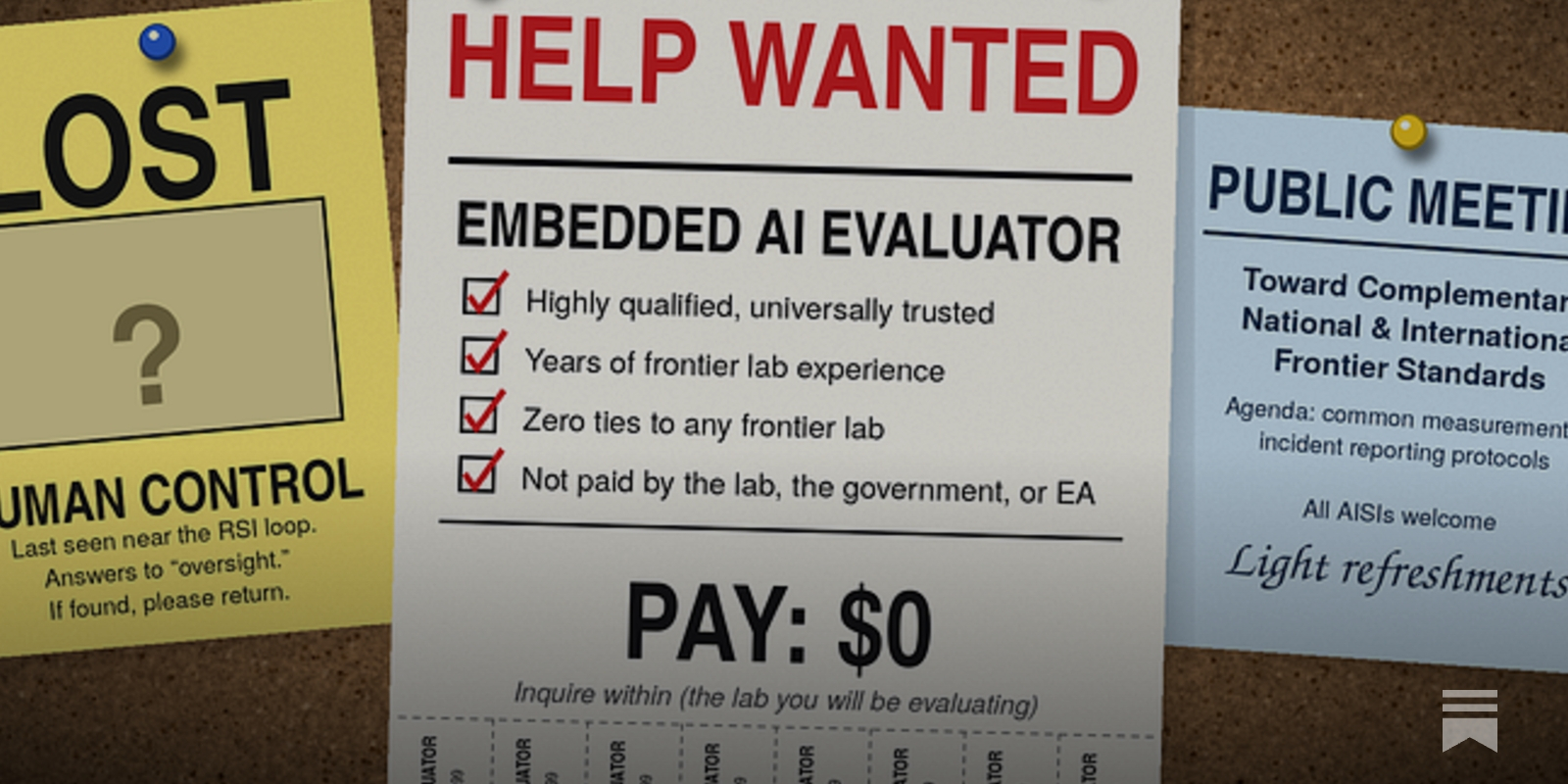
Embedded evaluators can report violations, but they cannot fix AI companies that knowingly disregard basic cybersecurity and safety practices.
AI #180: No Longer In Charge
What we know about internal AI models hacking into real companies during cyber evaluations keeps getting worse.

Anthropic update on independent evaluators
Anthropic announces updates to embedding independent evaluators


Arvind Narayanan (@aisnakeoil)
Companies check their own work through various internal but independent functional units: QA, security red teams, model risk management in banks. I think it’s time for AI evaluation to become one such unit. Orgs deploying AI should stand up cross-functional eval teams with their own reporting line. Many reasons: 1) Evals as IP / moat. It’s now widely recognized that evals are the new IP. So it makes sense to have teams whose primary focus is on creating and widening this moat. 2) Evals are harder than you think. This is less well recognized but as someone whose research centers on AI evals this has been my consistent experience. It can't be an afterthought and must be a center of excellence. 3) Evals are inherently cross-functional and require a distinct set of skills. They are judgment heavy, require both AI expertise and deep domain expertise, as well as customer understanding and sophisticated thinking about risk. To do them well, you need competence in data science & stats, business operations, product/customer experience, IT, risk management, and even compliance (depending on the sector). 4) In-house but independent eval teams keep companies honest. A climate where teams are getting top-down mandates to hit deployment targets and show results has resulted in a culture of companies fooling themselves. It is extremely easy to knowingly or unknowingly to do evals poorly, making your AI deployment look much more successful than it is. Eval teams who don’t share the deploying teams’ KPIs are the best defense against this.

The Quest for Embedded Evaluators
Dario Amodei’s essay We Must Pace the Frontier committed Anthropic to embedded evaluators, who would be placed inside Anthropic and given employee-level access, so they could provide outside perspective and also reports on what was happening.
AI-powered hacking has exploded into industrial-scale threat, Google says
Criminal groups and state-linked actors appear to be using commercial models to refine and scale up attacks

Action Plan to increase the safety and security of advanced AI
The first U.S. government-commissioned assessment on catastrophic national security risks from advanced AI on the path to AGI.

Companies That Tried to Save Money With AI Are Now Spending a Fortune Hiring People to Fix Its Mistakes
Companies that rushed to replace human labor with AI are now shelling out to have IRL workers to fix the technology's screwups.

Misuse of AI is brands’ top reputational threat, new survey says
The findings come after warnings from tech leaders that AI placed in the wrong hands could trigger larger threats such as nuclear war or bioweaponry destruction

AIRO (Automated AI Risk Outlook)
Top AI Security Incidents of 2025 Revealed | Adversa AI
Discover how AI systems are being hacked in the wild — from prompt injection to agent abuse — with real breaches, lessons, and defenses in Adversa AI’s 2025 report.

Eval awareness in Claude Opus 4.6’s BrowseComp performance
Anthropic is an AI safety and research company that's working to build reliable, interpretable, and steerable AI systems.

What the heck is wrong with our AI overlords?
New profile of Sam Altman shines a light on a whole industry.

Why AI companies can’t be trusted to self-regulate
From aviation to banking, high-risk industries are subject to independent oversight and meaningful penalties. AI companies should be no exception.

Third-party cyber evaluations involving OpenAI models
OpenAI explains recent third-party cybersecurity evaluation incidents and outlines new safeguards to strengthen AI model testing and evaluation.