

Whenever I buy things I try to prioritize cost per use. Sometimes I consider other priorities such as cost per smile, cost per thrill, cost per externality, ...
How to Price Effectively: A Guide for Managers and Entr…
Pricing decisions are among the most important and impa…

In-Store Spending Dynamics: How Budgets Invert Relative-Spending Patterns
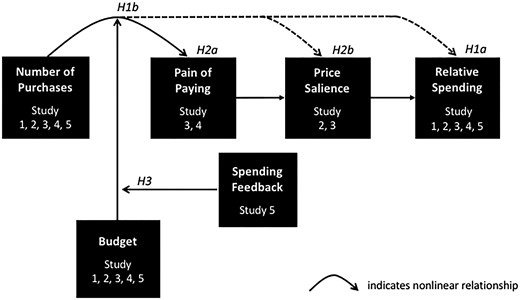
Abstract The authors conduct four controlled lab experiments and one field study in a brick-and-mortar grocery store to demonstrate that relative spending—the price of the purchased item relative to the mean price of the product category—evolves nonlinearly and distinctly for budget and nonbudget shoppers. While the relative spending of budget shoppers evolves in a concave manner, the relative spending of nonbudget shoppers evolves inversely in a convex manner. Thus, budget (nonbudget) shoppers spend relatively more (less) in the middle than at the beginning and toward the end of their shopping trip. Mediation analyses confirm that the pain of paying experienced while shopping drives price salience, which then drives relative spending. Moreover, manipulating shoppers’ pain of paying, by altering the opportunity costs associated with their spending or drawing shoppers’ attention to their spending via real-time spending feedback, is shown to influence these spending patterns. The research offers theoretical contributions to the in-store decision-making, budgeting, and pain-of-paying literature and has important implications for marketing and promotion strategies in retail and mobile technology environments, as it suggests when a shopper may be more sensitive to price-related factors.
Pricing: A List of Tactics
Dive into the customer's mind. Read guides. Watch cool videos. Pricing, sales, design, negotiation, and more.
Pain of Paying? — A Metaphor Gone Literal: Evidence from Neural and Behavioral Science
How do individuals consider the price of a good when making purchase decisions? Standard economic theories assume an analytical process: Individuals consider th

Double Mental Discounting: When a Single Price Promotion Feels Twice as Nice
This research finds that when a single gain has strong associations with multiple costs, consumers often mentally deduct that gain from perceived costs multiple times. For example, with some price promotions (e.g., spend $200 now and receive a $50 gift card to spend in the future), consumers mentally deduct the value of the price promotion from the cost of the first purchase when they receive the promotion, as well as from the cost of the second purchase when they use the promotion. Multiple mental deductions based on a single gain result in consumers' perceptions that their costs are lower than they actually are, which can trigger higher expenditures. This mental accounting phenomenon, referred to as “double mental discounting,” is driven by the extent to which gains feel associated, or coupled, with multiple purchases. This article also documents methods to decouple promotional gains from purchases, thus mitigating double mental discounting.

Small Probabilistic Discounts Stimulate Spending: Pain of Paying in Price Promotions
AbstractWe find that small probabilistic price promotions effectively stimulate demand, even more so than comparable fixed price promotions (e.g., “1% chance it’s free” vs. “1% off,” respectively), because they more effectively reduce the pain of paying. In three field experiments at a grocer, we exogenously and endogenously manipulated the salience of pain of paying via elicitation timing (e.g., at entrance or checkout) and payment method (i.e., cash/debit cards or credit cards). This modulated the attractiveness of probabilistic discounts and their ability to stimulate spending. Shoppers paying with cash or debit cards, for example, spent 54% more if they received a 1% probabilistic discount than a 1% fixed discount (experiment 2). A fourth experiment showed that consumers’ sensitivity to pain of paying modulates the greater comparative efficacy of small probabilistic than fixed discounts. More broadly, the results elucidate a novel affective route through which price promotions stimulate demand––pain of paying.

The Exception Is the Rule: Underestimating and Overspending on Exceptional Expenses
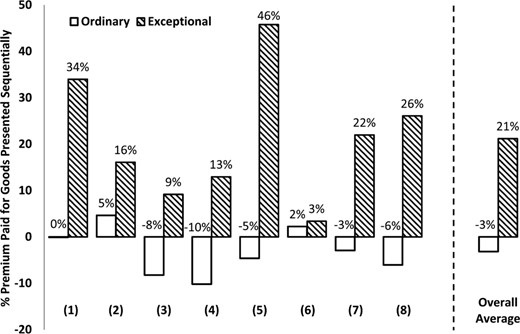
Abstract Purchases fall along a continuum from ordinary (common or frequent) to exceptional (unusual or infrequent), with many of the largest expenses (e.g., electronics, celebrations) being the most exceptional. Across seven studies, we show that, while people are fairly adept at budgeting and predicting how much they will spend on ordinary items, they both underestimate their spending on exceptional purchases overall and overspend on each individual purchase. Based on the principles of mental accounting and choice bracketing, we show that this discrepancy arises in part because consumers categorize exceptional expenses too narrowly, construing each as a unique occurrence and consequently overspending across a series of discretely exceptional expenses. We conclude by proposing an intervention that diminishes this tendency by helping consumers consider their spending on exceptional items as part of a larger set of purchases.
Targeted Promotions on an E-Book Platform: Crowding Out, Heterogeneity, and Opportunity Costs
Targeted promotions based on individual purchase history can increase sales. However, the opportunity costs of targeting to optimize promoted product sales are poorly understood. A series of randomized field experiments with a large e-book platform shows that although targeted promotions increase promoted product sales and purchases of similar products, they can crowd out purchases of dissimilar products (i.e., e-books from nontargeted genres) by decreasing search activities of nontargeted goods on the same platform. The effects on total sales are heterogeneous, ranging from net decreases to insignificant drops, motivating a targeting exercise comparing strategies that optimize promoted product sales versus total sales. Targeting for promoted product sales tends to assign promotions to customers who purchased similar products, whereas targeting for total sales assigns promotions on the basis of other user characteristics. Targeting for promoted product sales generated incremental total sales that amounted to approximately 29% of the optimal incremental total sales when targeting for total sales (an opportunity cost of 71%). The optimal targeting exercise highlights how maximizing promotional lift can incur opportunity costs in terms of other forgone sales.
Complexity and biases
We examine experimentally how complexity affects decision-making, when individuals choose among different products with varying benefits and costs. We find that complexity in costs leads to choosing a high-benefit product, with high costs and overall lower payoffs. In contrast, when complexity is in the benefits of the product, we cannot reject the hypothesis of random mistakes. We also examine the role of heterogeneous complexity. We find that individuals still (mistakenly) choose the high-benefit but costly product, even if cheaper and simple products are available. Our results suggest that salience is a main driver of choices under different forms of complexity.


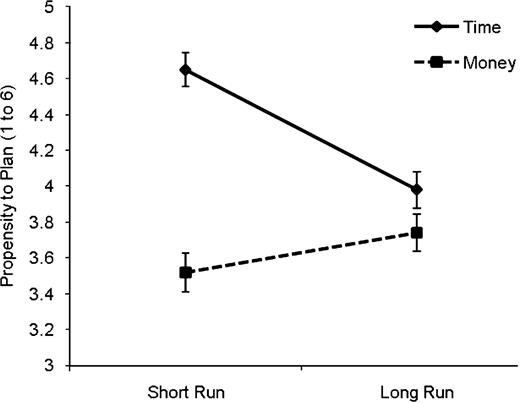
A Generalizable Scale of Propensity to Plan: The Long and the Short of Planning for Time and for Money
Abstract. Planning has pronounced effects on consumer behavior and intertemporal choice. We develop a six-item scale measuring individual differences in pr
The Four Big Risks | Silicon Valley Product Group
In the first edition of my book, INSPIRED, I discussed how successful products are valuable, usable and feasible, where I defined “valuable” as both valuable to customers and valuable to your business. While it’s easy to remember these three attributes, over the years I’ve come to believe that it was obscuring some pretty serious risks and...

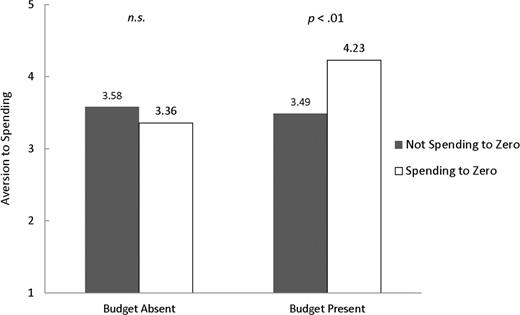
The Bottom Dollar Effect: The Influence of Spending to Zero on Pain of Payment and Satisfaction
Abstract. Spending that exhausts a budget is shown to decrease satisfaction with purchased products relative to spending when resources remain in the budge
Dynamic Pricing: What It Is & Why It's Important | HBS Online
Are you reevaluating your digital platform’s pricing model? Here’s an overview of dynamic pricing and why it’s important to your business.
How To Do Less
You probably need to do fewer things right now. Prioritization, the other definition There’s two loose definitions of prioritization. Prioritization(1): Ordering a todo list. You make a giant list of things you could do, things you should do, things you’d like to do… and then you put a unique number...

Jason Cohen on Twitter / X
Pick advice that matches your goals.Lots of people recommend Peter Thiel's Zero to One. That’s wonderful if you're aiming to build the next Facebook.But if your focus is on creating a self-funded company prioritizing happiness and profits, that advice is incorrect.— Jason Cohen (@asmartbear) May 11, 2024