

Brian Merchant argues that "AI populism" is not a new political force but 21st-century populism responding to unrestrained capitalism. The term, coined by Jasmine Sun and amplified by David Wallace-We
AI as the new avatar of American capitalism
Why "AI populism" is just "populism"

A Thesis on the History of the 21st Century: Technocracy, AI, and the End of the World
Reviewing a trio of books by a sextet of ruling-class ideologues, Mathias Fuelling finds an ambient anxiety hanging over a perceived crisis in American capitalism, with visions of bolstering a Silicon Valley-led technocracy fueled by AI investment reflecting American fears over the dawn of a "Chinese Century."


Capitalism Without Humans
As new technologies (not immigrants) replace human labor, "machine breaking" as a tactic of rebellion is taking on a renewed vitality.

Palantir's social media manifesto is a blueprint for technofascism
The surveillance firm’s viral X post calls for hard power, conscription and the end of pluralism. AI expert and academic Mark Coeckelbergh on what happens when technology becomes the gateway to authoritarianism
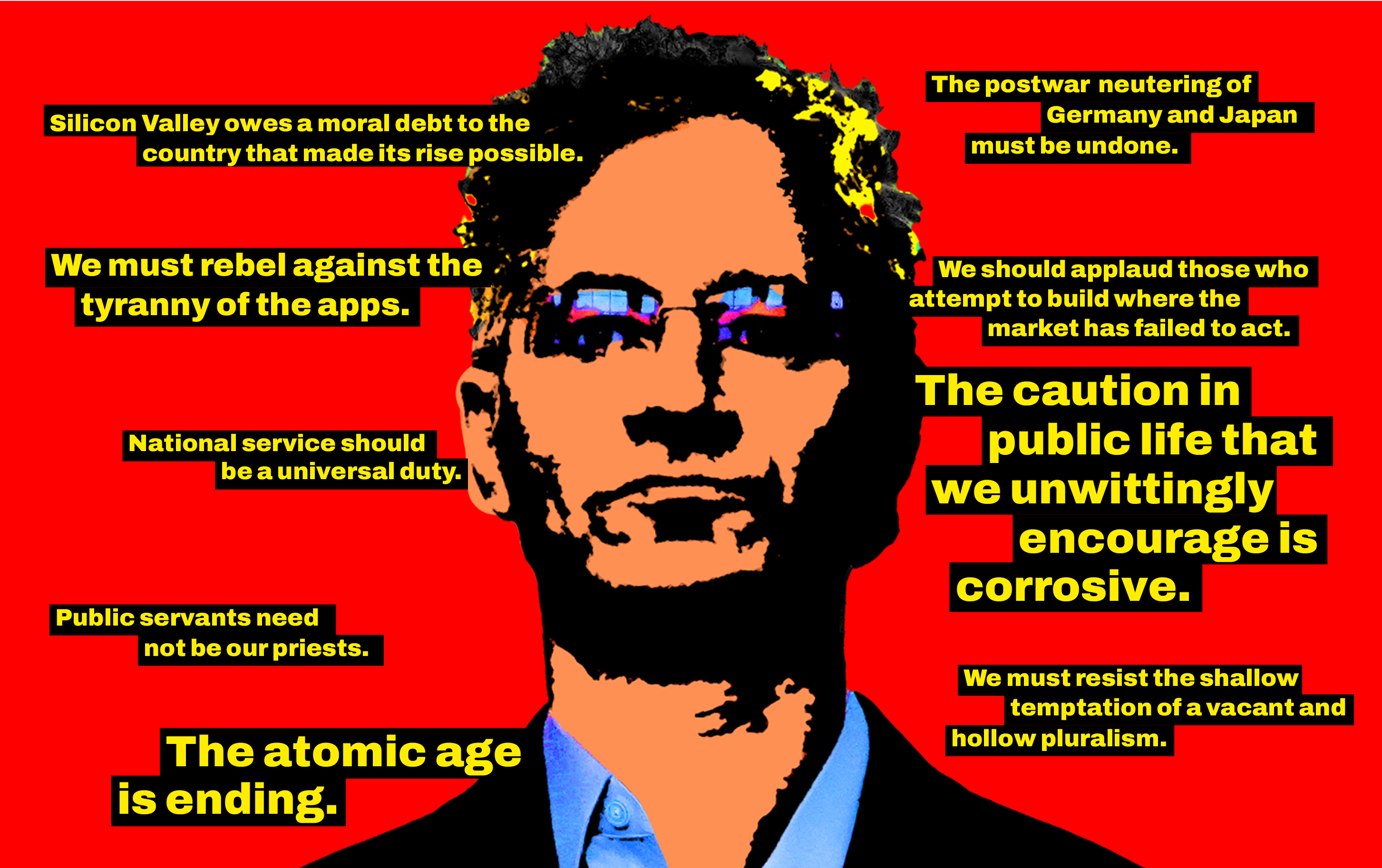
The AI bubble isn’t new — Karl Marx explained the mechanisms behind it nearly 150 years ago
OpenAI CEO Sam Altman’s warning of an AI bubble highlights a deeper economic problem: capitalism is producing more capital than it can profitably invest.

Myopic memory: Capitalism's new continuity in the age of AI
This article is a commentary on the relationship between artificial intelligence (AI), capitalism, and memory. The political policies of neoliberalism have reduced the capacity of individuals and groups to reflect on and change the social world, meanwhile applications of AI and algorithmic technologies, rooted in the profit-seeking objectives of global capitalism, deepen this deficit. In these conditions, memory in individuals and across society is at risk of becoming myopic. In this article, I develop the concept of myopic memory with two core claims. Firstly, I argue that AI is a technological development that cannot be divorced from the capitalist conditions from which it comes from and is implemented in service of. To this end, I reveal capitalism and colonialism's historical and contemporary use of surveillance as a way to control the populations it oppresses, imagining their pasts to determine their futures, disempowering them in the process. My second core claim emphasises that this process of disempowerment is undergoing an acute realisation four decades into the period of neoliberalism. Neoliberal policies have restructured society on the basis of being an individual consumer, leaving little time, space, and institutional capacity for citizens to reflect on their impact or challenge their dominance. As a result, with the growing role of AI and algorithmic technologies in shaping our engagement with society along similar lines of individualism, it is my conclusion that the scope of memory is being reduced and constrained within the prism of capitalism, reducing its potential, and rendering it myopic.

From the Platform Society to the AI Society: Towards Critical Studies of Generative AI
The era of AI has begun. Generative AI is rapidly reshaping knowledge production, culture, and political authority, giving rise to an emerging AI society. Yet this transformation did not emerge ex nihilo. This paper argues that the AI society can only be understood in relation to the platform society from which it arises. Tracing the transition from platforms to AI, we identify interlinked economic, epistemic, and political shifts. Economically, AI emerges within platform-based rentier capitalism but reconfigures the monopoly mechanisms on which its accumulation depends. Epistemically, LLMs mark a shift from predictive to generative epistemics, entangling theory formation and knowledge production with private research-as-a-service infrastructures. Politically, governance shifts from data politics to alignment politics: from shaping visibility to shaping what can be said, thought, and imagined. Together, these transformations signal a qualitative shift in mediation—from governing interaction to governing cognition itself—and call for a Critical AI Studies.
‘Think Everybody Dead’: How the Threat of AI Is Fueling a New Political Alliance
A billionaire-backed movement from Silicon Valley and populists like Bernie Sanders are eager to stop an AI disaster — but can they overcome their mutual distrust and work together?
Amazon Created The Socialist Dream
Apocalypse Now and Then • EQUATOR
Artificial intelligence is capitalism’s final destination

A Real Political Economy of Technology - The Ideas Letter
Two technological futures are competing for political and material priority: generative AI and the green transition. Benanav argues that while AI is marketed as a world-reordering breakthrough, its productivity gains…

AI, Decomputing and the Interregnum
This paper treats AI as diagnostic for the deeper changes taking place in the existing order of things. It uses AI's alignment with both the political economy and with the dualisms that underpin it, including race, gender and anthropocentrism, to highlight the nihilistic character of the current restructuring. AI's scaling and accelerationism are taken as examples of the wider tactics being invoked by hegemonic power to maintain control under changing conditions. From this perspective, the massive build-out of data centres isn't simply a seizure of energy resources but a manifestation of an aggressive and misogynist technopolitics. The paper argues that a liberal push for digital sovereignty doesn't interrupt these dynamics but plays into the hands of emerging technofascism. It proposes instead the prefigurative tactic of 'decomputing', which draws on degrowth, deautomatisation and a convivial approach to technology. It explores decomputing as a means to mitigate both material and relational harms and as a decisive turn towards infrastructuring the common good. The paper concludes that AI is the contradiction that reveals many others, not least the gap between claims to legitimacy and the actuality of destructive violence, and proposes an alternative technopolitics of reciprocity that prioritises care and sustainability.
AI, Decomputing and the Interregnum
This paper treats AI as diagnostic for the deeper changes taking place in the existing order of things. It uses AI's alignment with both the political economy and with the dualisms that underpin it, including race, gender and anthropocentrism, to highlight the nihilistic character of the current restructuring. AI's scaling and accelerationism are taken as examples of the wider tactics being invoked by hegemonic power to maintain control under changing conditions. From this perspective, the massive build-out of data centres isn't simply a seizure of energy resources but a manifestation of an aggressive and misogynist technopolitics. The paper argues that a liberal push for digital sovereignty doesn't interrupt these dynamics but plays into the hands of emerging technofascism. It proposes instead the prefigurative tactic of 'decomputing', which draws on degrowth, deautomatisation and a convivial approach to technology. It explores decomputing as a means to mitigate both material and relational harms and as a decisive turn towards infrastructuring the common good. The paper concludes that AI is the contradiction that reveals many others, not least the gap between claims to legitimacy and the actuality of destructive violence, and proposes an alternative technopolitics of reciprocity that prioritises care and sustainability.
> the central promise of “ai” is that nothing is worth doing and that community doesn’t exist. It’s individual entitlement as software. It’s Thatcherism. post.lurk.org/@emenel/117441848350524047
emenel (@emenel@post.lurk.org)
post.lurk.org"The forces that are now shaping AI are the same forces that turned the open internet into monopolistic platforms, converted peer-to-peer participation into precarious labor, and enclosed the digital commons. They are now threatening to capture and enclose thought itself." osf.io/preprints/socarxiv/qahd3_v1/

