


The Internet ends gatekeepers and increases transparency, which has world-altering effects — both good and bad.
The Dark Forest Theory of the Internet
Why the dark forests of the internet — podcasts, newsletters, and other private channels — are growing, and why might that pose a problem
Please Let the Internet Die
Online spaces are captured by oligarchs and saturated with slop—and they’re exacerbating humanity’s worst impulses. It’s time to start over.

The future of the open internet — and our way of life — is in your hands
There are a lot of scary things happening these days, but here’s what keeps me up late at night. A handful of corporations are turning our open internet into this: These corporations want to lock down the internet and give us access to nothing more ...

Beware online "filter bubbles" | Eli Pariser
The Side Effects of an Unfinished Internet
A rambling opinion piece on the internet’s negative side-effects. Why hasn’t it lived up to what we’d expected?
What happened to the fight for the Internet? -- Dustycloud Brainstorms
At the moment I am writing this, bad internet bills are being proposed across the US, Canada, Europe, and the UK. They're using the usual tactics: they claim they're fighting for kids or fighting security risks, but in general, that's what surveillance and censorship bills have always claimed.
The Internet Transition
The Internet is allowing us to build a richer, more complex society but the way in which we Internet today is failing to support the governance systems that a more complex world requires. I take a look at why these issues are related, try to develop an intuition for a way forward, and point at the emerging field that is coming together to build that future.

The Internet Transition
The Internet is allowing us to build a richer, more complex society but the way in which we Internet today is failing to support the governance systems that a more complex world requires. I take a look at why these issues are related, try to develop an intuition for a way forward, and point at the emerging field that is coming together to build that future.
Lisa Nakamura: The internet is a trash fire. Here's how to fix it.
Life on the internet is real life, and we need to stop pretending that what happens online doesn't matter, says digital media researcher Lisa Nakamura. In this timely talk, she explains the steps we can take to correct the toxic behaviors that have become common online -- and help make the internet a place where we all feel safe.

The Internet is a Series of Webs
The fate of the open web is inextricable from the other ways our world is in crisis. What can we do about it?

"The S is for surveillance": fighting KOSA and bad internet bills in the ATmosphere and the fediverses
Part 2 of The Time Is Right: shifting from theory to practice.
Internet for the People: The Fight for Our Digital Future
"For all the informational convenience the internet offers, it is deeply flawed. How can it be improved? Writer Ben Tarnoff proposes one possibility in this intriguing book, which urges the development of 'a public lane on the information superhighway.' It's worth checking out for yourself." – Seth MacFarlane Why is the internet so broken, and what could ever possibly fix it? In Internet for the People, leading tech writer Ben Tarnoff offers an answer. The internet is broken, he argues, because it is owned by private firms and run for profit. Google annihilates your privacy and Facebook amplifies right-wing propaganda because it is profitable to do so. But the internet wasn't always like this—it had to be remade for the purposes of profit maximization, through a years-long process of privatization that turned a small research network into a powerhouse of global capitalism. Tarnoff tells the story of the privatization that made the modern internet, and which set in motion the crises that consume it today. The solution to those crises is straightforward: deprivatize the internet. Deprivatization aims at creating an internet where people, and not profit, rule. It calls for shrinking the space of the market and diminishing the power of the profit motive. It calls for abolishing the walled gardens of Google, Facebook, and the other giants that dominate our digital lives and developing publicly and cooperatively owned alternatives that encode real democratic control. To build a better internet, we need to change how it is owned and organized. Not with an eye towards making markets work better, but towards making them less dominant. Not in order to create a more competitive or more rule-bound version of privatization, but to overturn it. Otherwise, a small number of executives and investors will continue to make choices on everyone’s behalf, and these choices will remain tightly bound by the demands of the market. It's time to demand an internet by, and for, the people now.
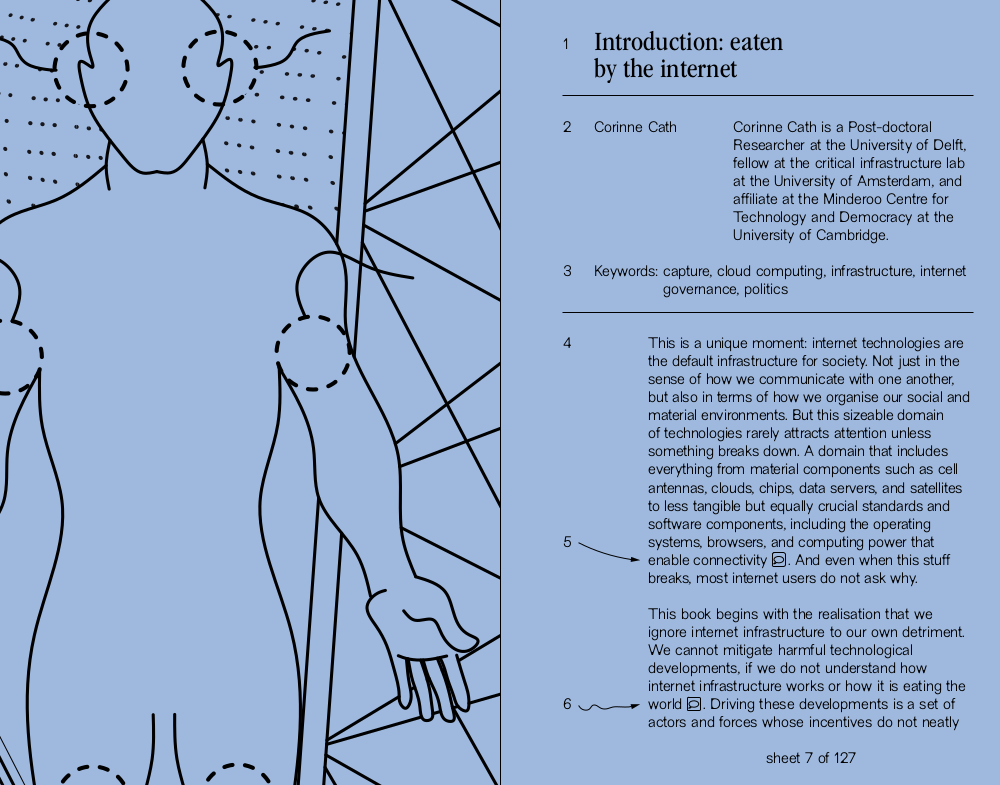
Eaten by the Internet
This book makes internet infrastructure visible as a force of political power, which is transforming the social world, from the bottom up—through fifteen chapters contributed by a global set of researchers, activists, and techies. We are living a unique moment: internet technologies are the default infrastructure for society, not just how we communicate but also how we organise our social life, politics, and economy, all the way down to our material environments, like cities. Our world is eaten by the internet. This means that those who control the internet control the bounds of public speech, economic production, social cohesion, and politics, making its infrastructure a core political terrain in the networked age. The book’s chapters cover a wide set of topics, spanning from the global politics of content moderation by internet infrastructure to the colonialism inherent in the race to plug the moon, from the harms wrought by blockchain companies in rural America to the particularities of online censorship across Asia. The chapters take on thorny topics, discussing power consolidation in the advertisement and cloud industry, the role of internet infrastructure in the war in Ukraine, and tech’s environmental impact—amongst others. In doing so, this book roots contemporary technology debates in the politics of internet infrastructure and urges us to ask how can we ensure our infrastructures sustain us, rather than consume us?
EFFecting Change: How to Build a Decentralized Web That Truly Works for All
The Internet, and how we've developed with it

Not "doomscrolling has killed our lives". But how, looking back, our enjoyment of the internet has shaped our experience of life.
We can have a different web

My journey to the heart of the forgotten internet

VC&G | » My memories of what life was like before the Internet

Habbo Hotel Memories - Sneer Campaign
blogs.loc.gov

My old SoundCloud page is a time capsule