


A thought experiment! Let's reimagine the web with r-selected thinking.
Redecentralization
A thought experiment! Let's reimagine the web with r-selected thinking.
Philosophy Experiments — Interactive Thought Experiments
Explore 27 interactive philosophy experiments that challenge your moral intuitions, test your logical reasoning, and probe the boundaries of belief.

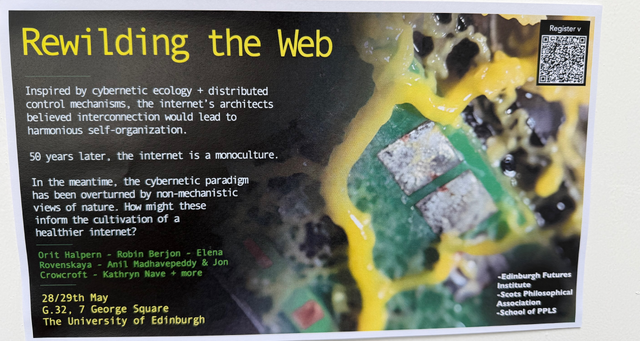
Rewilding the Web: my workshop report from Edinburgh
Notes from a wonderfully interdisciplinary Edinburgh workshop on 'Rewilding the Web', ranging coopetition and biological variety through the philosophy of self-organisation, polycrisis governance, protopian science fiction, and moderation seen through the lens of artisanal cheese.
Anthropic on Twitter / X
New Anthropic research: A global workspace in language models.Of everything happening in your brain right now, only a tiny fraction is consciously accessible—thoughts you can describe, hold in mind, and reason with.We found a strikingly similar divide inside Claude. pic.twitter.com/aLUPBifxth— Anthropic (@AnthropicAI) July 6, 2026

Field Notes: The Architecture of Rationalization - Aaron Ross Powell
Marginalia on the internet turning bad, platform extraction, and existential restlessness.
Alienation, Idealization, and Modeling
Models allow us to expose, explore, and excavate our assumptions. This is especially true for the sorts of assumptions that concern scholars of marginalization and resistance, who aim to show how ...

Experiments — ux-phi
Playable versions of canonical experiments in philosophy: the Socratic-questionnaire thought experiments — the trolley problem, Gettier cases, the side-effect effect, Mary the colour scientist.

The Mind-Expanding Ideas of Andy Clark
The tools we use to help us think—from language to smartphones—may be part of thought itself.

howard rheingold's | tools for thought
The Missing Building Blocks of the Web
At a time when millions are losing trust in the the web’s biggest sites, it’s worth revisiting the idea that the web was supposed to be…

Sense of abundance
Expansive, curious, open, unfearful, unhurried. The opposite of Scarcity mindset .NoteLink.Active { background-color: rgba(10, 132, 255, 0.15); } .
Resource-rational belief revision can mitigate as well as amplify polarization
People's beliefs sometimes diverge after observing the same information, which has been interpreted as evidence of irrationality. This behaviour has been proposed to result from people's limited cognitive resources and motivated reasoning, but how belief revision differs across these explanations has not been formalized or compared to a rational norm. Further, while people may be biased relative to a normative ideal, they may still make optimal choices given their limited cognitive resources, or rationally balance the utility of holding accurate beliefs with the belief's intrinsic utility. Across two studies, we develop and test a unified computational account of belief polarization under these proposed mechanisms, showing that people's performance on a belief updating task best fits a limited-resource Bayesian model; external motivations may contribute to divergence (or convergence) by determining what pre-existing information people consider relevant to a situation, rather than by changing how people evaluate new information in isolation.
Opinion | Think Less, Think Better (Published 2016)
A wandering mind has less innovative thoughts.

Watch and Link Disparate Ideas — Think Jar Collective
An important skill to develop to enhance thinking creatively is to be able to link disparate ideas. This article lays out some provocations to spark creative collisions for innovation

I’ve been hearing about this project for years from @fernpizza.bsky.social and I’m stoked to see it out. It’s wildly elegant mixture of theory and empirics, with novel methods that manages to ask and answer deep questions about selection. Paper of the year. science.org/doi/10.1126/science.adx0665

Intracellular competition shapes plasmid population dynamics
www.science.org