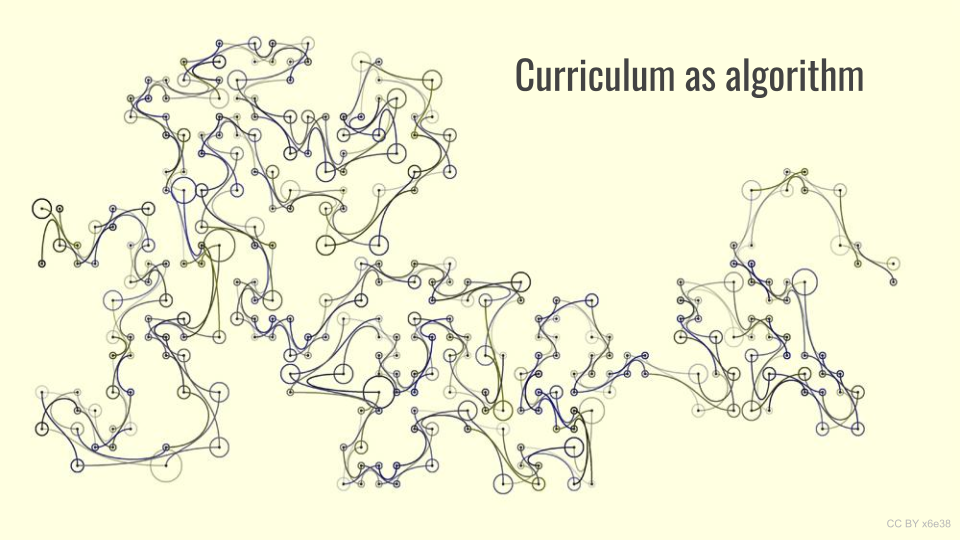
If you've ever seen me present on digital literacies or digital credentials, you've probably seen me use the above slide in passing. I use it to explain that ev…
Curriculum | AI Safety — ARENA
Explore the ARENA curriculum for AI safety education, covering fundamentals, transformers, reinforcement learning, and evaluations, with resources for educators and learners.
Model of educational reconstruction
A key feature of theEducational Reconstructionapproach is that in planning instruction – by teachers or curriculum developers – the science content to be learnedandstudents’ cognitive and affective variables, including their learning processes, should be given equal attention. In addition, the science content is not viewed as “given” but has to undergo certainreconstructionprocesses. Thescience content structure(e.g., for the concept of evolution) has to be transformed into acontent structure for instruction. The two structures are fundamentally different. The first step in this reconstruction, called “elementarization” (in German, Elementarisierung), is to identify the elementary ideas that relate to the aims of instruction, taking into account student perspectives (e.g., their pre-instructional conceptions). Then the content structure for instruction has to be developed. Finally, teaching and learning settings have to be designed. [This is an excerpt from the content].
Transitioning to a Living Curriculum
The Principles and Practices to building a new way of Learning

visualising data structures and algorithms through animation - VisuAlgo
VisuAlgo was conceptualised in 2011 by Associate Professor Steven Halim (NUS School of Computing) as a tool to help his students better understand data structures and algorithms, by allowing them to learn the basics on their own and at their own pace. Together with his students from the National University of Singapore, a series of visualizations were developed and consolidated, from simple sorting algorithms to complex graph data structures. Though specifically designed for the use of NUS students taking various data structure and algorithm classes (CS1010/equivalent, CS2040/equivalent (inclusive of IT5003)), CS3230, CS3233, and CS4234), as advocators of online learning, we hope that curious minds around the world will find these visualizations useful as well.
AI Literacy Across the Curriculum
As you have no doubt seen, AI is becoming ubiquitous in our lives and in the technologies we use every day. Generative AI is no longer an experimental tool, but a deployed technology in many of the…

Integrated Data Science for Secondary Schools: Design and Assessment of a Curriculum
This summary was generated using automated tools and was not authored or reviewed by the article's author(s). It is provided to support discovery, help readers assess relevance, and assist readers from adjacent research areas in understanding the work. It is intended to complement the author-supplied abstract, which remains the primary summary of the paper. The full article remains the authoritative version of record. Click here to learn more.

The Program
AI-powered curriculum focused on engagement, personalized mastery learning, and life skills workshops
The Digital Productivity Pyramid - Forte Labs
Imagine if we had a learning curriculum for modern knowledge work. This curriculum would reliably produce elite performers, training them in the

The education of a computer
Curriculum Guide
Riot Games’ Game Design Curriculum is an entry-level course that teaches high school students the fundamental elements of game design using a framework and interactive workshops created by our own game designers. Students will ultimately utilize their newfound knowledge of core game design concepts like goals, types of fun, opposition, rules, interaction, and balance to create a paper prototype of a multiplayer game.

Bloom’s Taxonomy – Agile Learning
Adopting Foundational Data Science Curriculum with Diverse Institutional Contexts
This summary was generated using automated tools and was not authored or reviewed by the article's author(s). It is provided to support discovery, help readers assess relevance, and assist readers from adjacent research areas in understanding the work. It is intended to complement the author-supplied abstract, which remains the primary summary of the paper. The full article remains the authoritative version of record. Click here to learn more.

Restructuring Education in the Age of Artificial Intelligence from the Perspective of Humanistic Scientific Methodology
The development of the education market, academic credentials, digital data, and artificial intelligence is widening the gap between knowledge and actual competence, as well as between technical efficiency and human development. This study aims to clarify the humanistic foundation of education, analyze the mechanism of the instrumentalization of knowledge, and establish principles for restructuring education in the context of digital technology. Humanistic scientific methodology is employed in conjunction with the operations of analysis and synthesis, logic and history, abstraction and concretization, criticism and construction. The conceptual material of this study comprises the concepts of life, needs, capabilities, creativity, scientific knowledge, norms, power, the market, qualifications, actual competence, and artificial intelligence. The analysis reveals that education loses its humanistic function when norms, profit, academic credentials, or algorithms occupy the position of the end. Education attains legitimacy when it develops cognitive, creative, self-learning, reflective, and responsible capacities. The study concludes that human beings must retain their position as subjects, while science, the market, and technology must remain means serving life.

Social OMNI-EPIC: Learning-Progress-Driven Curriculum Generation for Social Interaction
To address the rapid saturation of fixed social benchmarks by increasingly capable models, we introduce Social OMNI-EPIC, an open-ended curriculum generation framework that adapts learning-progress-driven environment design to LLM-based social simulation. Starting from a seed archive, it continuously generates scenarios targeting a learner's evolving capability frontier using intrinsic signals of learning progress and interestingness. Across 90 generated scenarios, Social OMNI-EPIC shifts the distribution from predominantly easy scenarios toward frontier-level challenges and becomes increasingly calibrated over time.
Eval awareness in Claude Opus 4.6’s BrowseComp performance
Anthropic is an AI safety and research company that's working to build reliable, interpretable, and steerable AI systems.