

You’ve almost certainly encountered Conventional Commits before. It may have reared its ugly head in the changelog of an open source project you’ve used. It may have been the enforced commit format for an open source project you contributed to. A lot of people swear by it. I swear at it. Even though it is used by a large number of popular open source projects, Conventional Commits is an actively bad standard which encourages focus on the wrong things and fails to deliver on its promises.
The Perfect Commit
For the last few years I’ve been trying to center my work around creating what I consider to be the Perfect Commit. This is a single commit that contains all …
Why Funding Open Source is Hard
tl;dr: Either developers need to change, or GitHub needs to change

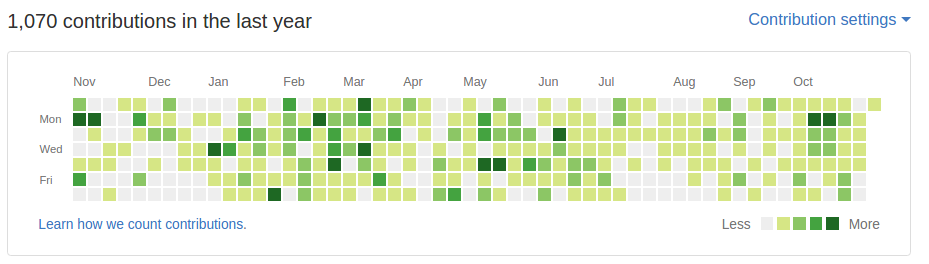
GitHub’s one-dimensional view of open source contributions – Wes McKinney
TL;DR One of the most harmful parts of the GitHub platform is the code contribution calendar. This “hacker score card” overemphasizes the value of commits over the other kinds of important contributions to open source projects, like doing code reviews and discussing bugs and new features on the issue tracker.
Why your Open Source Project might lack (my?) contribution (1)
"In this article I describe some things to consider when maintaining

A method for giving credit to organizations that contribute code to Open Source
By tracking organizational contributions in Git commits, we can give organizations more tangible reasons to fund open source and help sustain it over time.
Degrees of Open Source
I realized that I never captured what I learned about the nature of open source projects anywhere, so here’s one attempt to rectify this omission. The way I understand the concept of “open source” …

I hate the term “open source”
It doesn’t accurately reflect how people are building today anymore.

The Asymmetry of Open Source - Matt Holt
A comprehensive guide to funding open source software projects

"Open source" is not broken
FOSS is not broken and the log4j2 fiasco is not FOSS' fault. The system is broken.

Dear Matt Mullenweg: an open letter from Wix.com's CEO
Dear Matt,We were all very surprised by your post, as you have so many claims against us.Wow, dude I did not even know we were fighting.First, you say we have been taking from the open source community without giving back, well, of course, that isn’t true. Here is a list of 224 projects on our public GitHub page, and as you can see they are all dated before your post. We have not checked if WordPress is using them, but you are more than welcome to do so, some of them are pretty good.We always sh


A Replication Study on Measuring the Growth of Open Source
Context: Over the last decades, open-source software has pervaded the software industry and has become one of the key pillars in software engineering. The incomparable growth of open source reflected that pervasion: Prior work described open source as a whole to be growing linearly, polynomially, or even exponentially. Objective: In this study, we explore the long-term growth of open source and corroborating previous findings by replicating previous studies on measuring the growth of open source projects. Method: We replicate four existing measurements on the growth of open source on a sample of 172,833 open-source projects using Open Hub as the measurement system: We analyzed lines of code, commits, new projects, and the number of open-source contributors over the last 30 years in the known open-source universe. Results: We found growth of open source to be exhausted: After an initial exponential growth, all measurements show a monotonic downwards trend since its peak in 2013. None of the existing growth models could stand the test of time. Conclusion: Our results raise more questions on the growth of open source and the representativeness of Open Hub as a proxy for describing open source. We discuss multiple interpretations for our observations and encourage further research using alternative data sets.

I Don’t Want to Know What “Open Source” Means
I am he as you are he as you are me and we are all on GitHub.

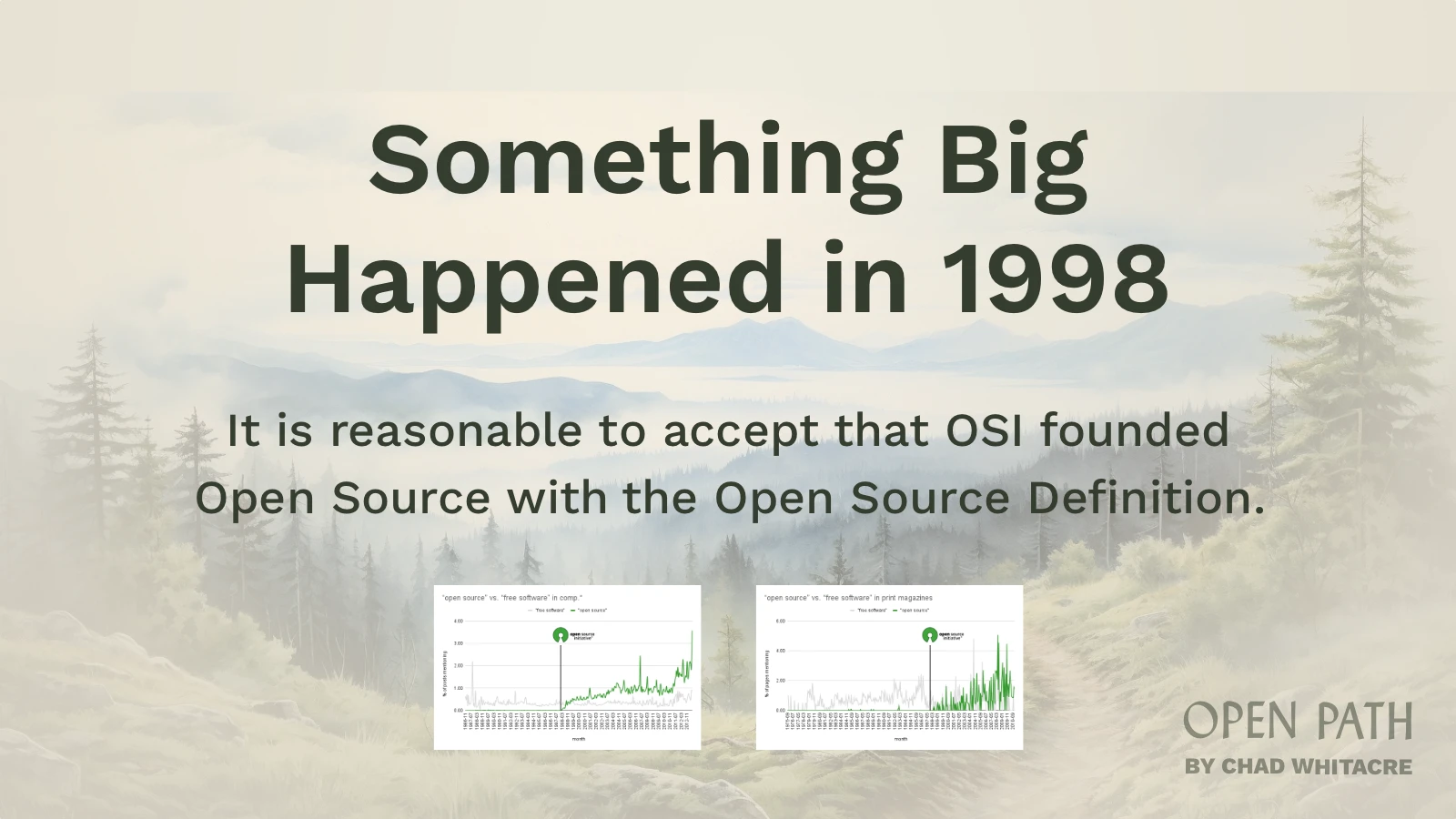
Something Big Happened in 1998
It is reasonable to accept that OSI founded Open Source with the Open Source Definition.
Nibble Stew: The Nine Phases of an Open Source Project Maintainer
There is more to running an open source project than writing code. In fact most of all work has to do with something else. This places addit...