

How do you know that a product respects your privacy – other than by wading through the fine print? We’ve created a framework to measure the way people actually experience privacy in tech products.
Privacy and human behavior in the age of information
This Review summarizes and draws connections between diverse streams of empirical research on privacy behavior. We use three themes to connect insights from social and behavioral sciences: people's uncertainty about the consequences of privacy-related behaviors and their own preferences over those consequences; the context-dependence of people's concern, or lack thereof, about privacy; and the degree to which privacy concerns are malleable—manipulable by commercial and governmental interests. Organizing our discussion by these themes, we offer observations concerning the role of public policy in the protection of privacy in the information age.
Privacy Principles
Privacy is an essential part of the web. This document provides definitions for privacy and related concepts that are applicable worldwide as well as a set of privacy principles that should guide the development of the web as a trustworthy platform. People using the web would benefit from a stronger relationship between technology and policy, and this document is written to work with both.
Privacy Principles
Privacy is an essential part of the web. This document provides definitions for privacy and related concepts that are applicable worldwide as well as a set of privacy principles that should guide the development of the web as a trustworthy platform. People using the web would benefit from a stronger relationship between technology and policy, and this document is written to work with both.
Privacy by Design
In view of rapid and dramatic technological change, it is important to take the special requirements of privacy protection into account early on, because new technological systems often contain hidden dangers which are very difficult to overcome after the basic design has been worked out. So it makes all the more sense to identify and examine possible data protection problems when designing new technology and to incorporate privacy protection into the overall design, instead of having to come up with laborious and time-consuming “patches” later on. This approach is known as “Privacy by Design” (PbD).

A Cypherpunk's Manifesto
Privacy is necessary for an open society in the electronic age. Privacy is not secrecy. A private matter is something one doesn't want the whole world to know, but a secret matter is something one doesn't want anybody to know. Privacy is the power to selectively reveal oneself to the world.

How GDPR Will Change The Way You Develop — Smashing Magazine
GDPR requires you to be more thoughtful about the sites and services you build, more transparent about the ways you collect and use data, more considerate of your users, and more thorough in your development and documentation processes. In this article, Heather Burns will explore what you, as a developer, need to know about the new data protection regime. At the end, you’ll understand how the challenges posed by the privacy overhaul will ultimately help to make you a better developer.


Unwillingness to pay for privacy: A field experiment
We measure willingness to pay for privacy in a field experiment. Participants bought at most one DVD from one of two competing online stores. One store consistently required more sensitive personal data than the other, but otherwise the stores were identical. In one treatment, DVDs were one Euro cheaper at the store requesting more personal information, and almost all buyers chose the cheaper store. Surprisingly, in the second treatment when prices were identical, participants bought from both shops equally often.
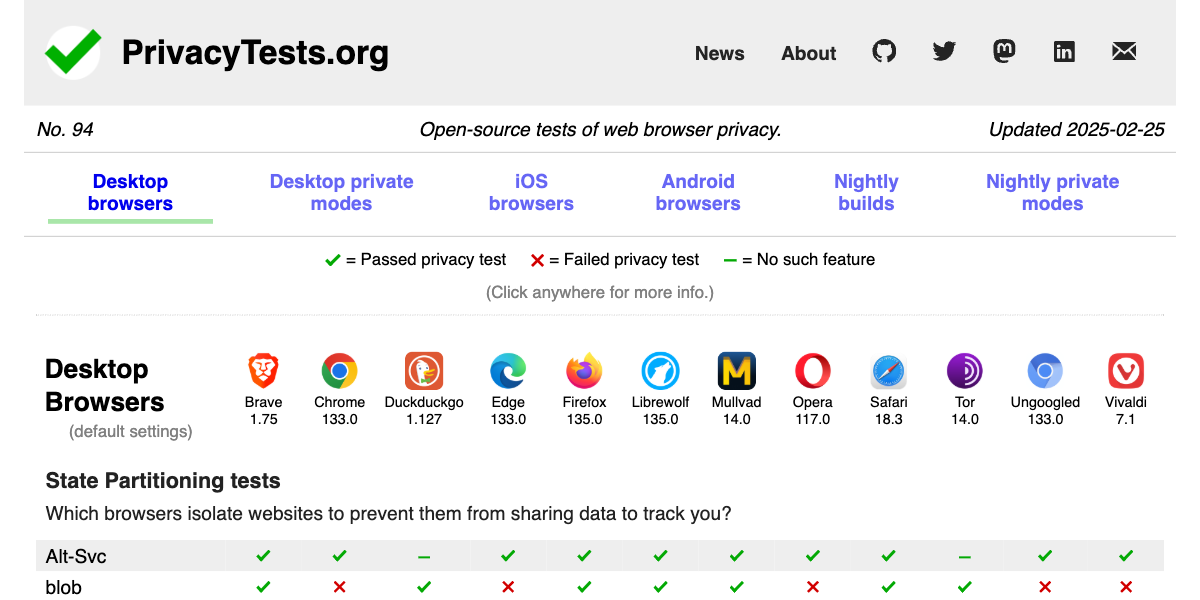
Which browsers are best for privacy?
An open-source privacy audit of popular web browsers.
User Privacy and Large Language Models: An Analysis of Frontier Developers' Privacy Policies
Hundreds of millions of people now regularly interact with large language models via chatbots. Model developers are eager to acquire new sources of high-quality training data as they race to improve model capabilities and win market share. This paper analyzes the privacy policies of six U.S. frontier AI developers to understand how they use their users' chats to train models. Drawing primarily on the California Consumer Privacy Act, we develop a novel qualitative coding schema that we apply to each developer's relevant privacy policies to compare data collection and use practices across the six companies. We find that all six developers appear to employ their users' chat data to train and improve their models by default, and that some retain this data indefinitely. Developers may collect and train on personal information disclosed in chats, including sensitive information such as biometric and health data, as well as files uploaded by users. Four of the six companies we examined appear to include children's chat data for model training, as well as customer data from other products. On the whole, developers' privacy policies often lack essential information about their practices, highlighting the need for greater transparency and accountability. We address the implications of users' lack of consent for the use of their chat data for model training, data security issues arising from indefinite chat data retention, and training on children's chat data. We conclude by providing recommendations to policymakers and developers to address the data privacy challenges posed by LLM-powered chatbots.

User Privacy and Large Language Models: An Analysis of Frontier Developers' Privacy Policies
Hundreds of millions of people now regularly interact with large language models via chatbots. Model developers are eager to acquire new sources of high-quality training data as they race to improve model capabilities and win market share. This paper analyzes the privacy policies of six U.S. frontier AI developers to understand how they use their users' chats to train models. Drawing primarily on the California Consumer Privacy Act, we develop a novel qualitative coding schema that we apply to each developer's relevant privacy policies to compare data collection and use practices across the six companies. We find that all six developers appear to employ their users' chat data to train and improve their models by default, and that some retain this data indefinitely. Developers may collect and train on personal information disclosed in chats, including sensitive information such as biometric and health data, as well as files uploaded by users. Four of the six companies we examined appear to include children's chat data for model training, as well as customer data from other products. On the whole, developers' privacy policies often lack essential information about their practices, highlighting the need for greater transparency and accountability. We address the implications of users' lack of consent for the use of their chat data for model training, data security issues arising from indefinite chat data retention, and training on children's chat data. We conclude by providing recommendations to policymakers and developers to address the data privacy challenges posed by LLM-powered chatbots.
PrivacySIM: Evaluating LLM Simulation of User Privacy Behavior
Large language models (LLMs) are increasingly used to simulate human behavior, but their ability to simulate individual privacy decisions is not well understood. In this paper, we address the problem of evaluating whether a core set of user persona attributes can drive LLMs to simulate individual-level privacy behavior. We introduce PrivacySIM, an evaluation suite that benchmarks LLM simulation of user privacy behavior against the ground-truth responses of $1{,}000$ users. These users are drawn from five published user studies on privacy spanning LLM healthcare consultations, conversational agents, and chatbots. Drawing on these user studies, we hypothesize three persona facets as plausible predictors of privacy decision-making: demographics, previous experiences, and stated privacy attitudes. We condition nine frontier LLMs on subsets of these three facets and measure how often each model's response to a data-sharing scenario matches the user's actual response. Our findings show that (1) privacy persona conditioning consistently improves simulation quality over no-persona conditioning, but even the strongest model (40.4% accuracy) remains far from faithfully simulating individual privacy decisions. (2) A user's stated privacy attitudes alone may not be the best predictor because they often diverge from the user's actual privacy behavior. (3) Users with high AI/chatbot experience but low stated privacy attitudes are the most challenging to simulate. PrivacySIM is a first step toward understanding and improving the capabilities of LLMs to simulate user privacy decisions. We release PrivacySIM to enable further evaluation of LLM privacy simulation.
Why Big Tech's Privacy Promises Are Lies