


Visit the post for more.
Nebula – Indie Streaming
Nebula is smart, thoughtful videos, podcasts, and classes from your favorite creators.

The Astrosky Ecosystem: An independent online home for astronomy - ATmosphereConf 2026
Starlight 🌟 Build documentation sites with Astro
Starlight helps you build beautiful, high-performance documentation websites with Astro.
Observational Evidence from Supernovae for an Accelerating Universe and a Cosmological Constant
We present observations of 10 type Ia supernovae (SNe Ia) between 0.16 < z < 0.62. With previous data from our High-Z Supernova Search Team, this expanded set of 16 high-redshift supernovae and 34 nearby supernovae are used to place constraints on the Hubble constant (H_0), the mass density (Omega_M), the cosmological constant (Omega_Lambda), the deceleration parameter (q_0), and the dynamical age of the Universe (t_0). The distances of the high-redshift SNe Ia are, on average, 10% to 15% farther than expected in a low mass density (Omega_M=0.2) Universe without a cosmological constant. Different light curve fitting methods, SN Ia subsamples, and prior constraints unanimously favor eternally expanding models with positive cosmological constant (i.e., Omega_Lambda > 0) and a current acceleration of the expansion (i.e., q_0 < 0). With no prior constraint on mass density other than Omega_M > 0, the spectroscopically confirmed SNe Ia are consistent with q_0 0 at the 3.0 sigma and 4.0 sigma confidence levels, for two fitting methods respectively. Fixing a ``minimal'' mass density, Omega_M=0.2, results in the weakest detection, Omega_Lambda>0 at the 3.0 sigma confidence level. For a flat-Universe prior (Omega_M+Omega_Lambda=1), the spectroscopically confirmed SNe Ia require Omega_Lambda >0 at 7 sigma and 9 sigma level for the two fitting methods. A Universe closed by ordinary matter (i.e., Omega_M=1) is ruled out at the 7 sigma to 8 sigma level. We estimate the size of systematic errors, including evolution, extinction, sample selection bias, local flows, gravitational lensing, and sample contamination. Presently, none of these effects reconciles the data with Omega_Lambda=0 and q_0 > 0.

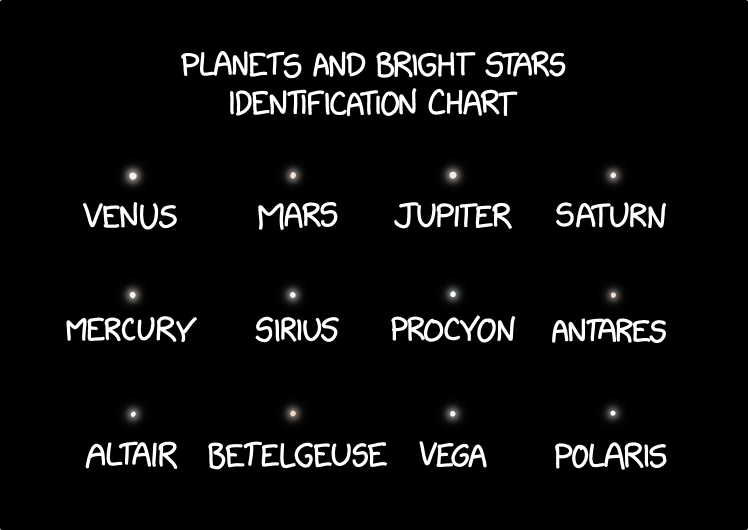
Planets and Bright Stars
This work is licensed under a Creative Commons Attribution-NonCommercial 2.5 License.
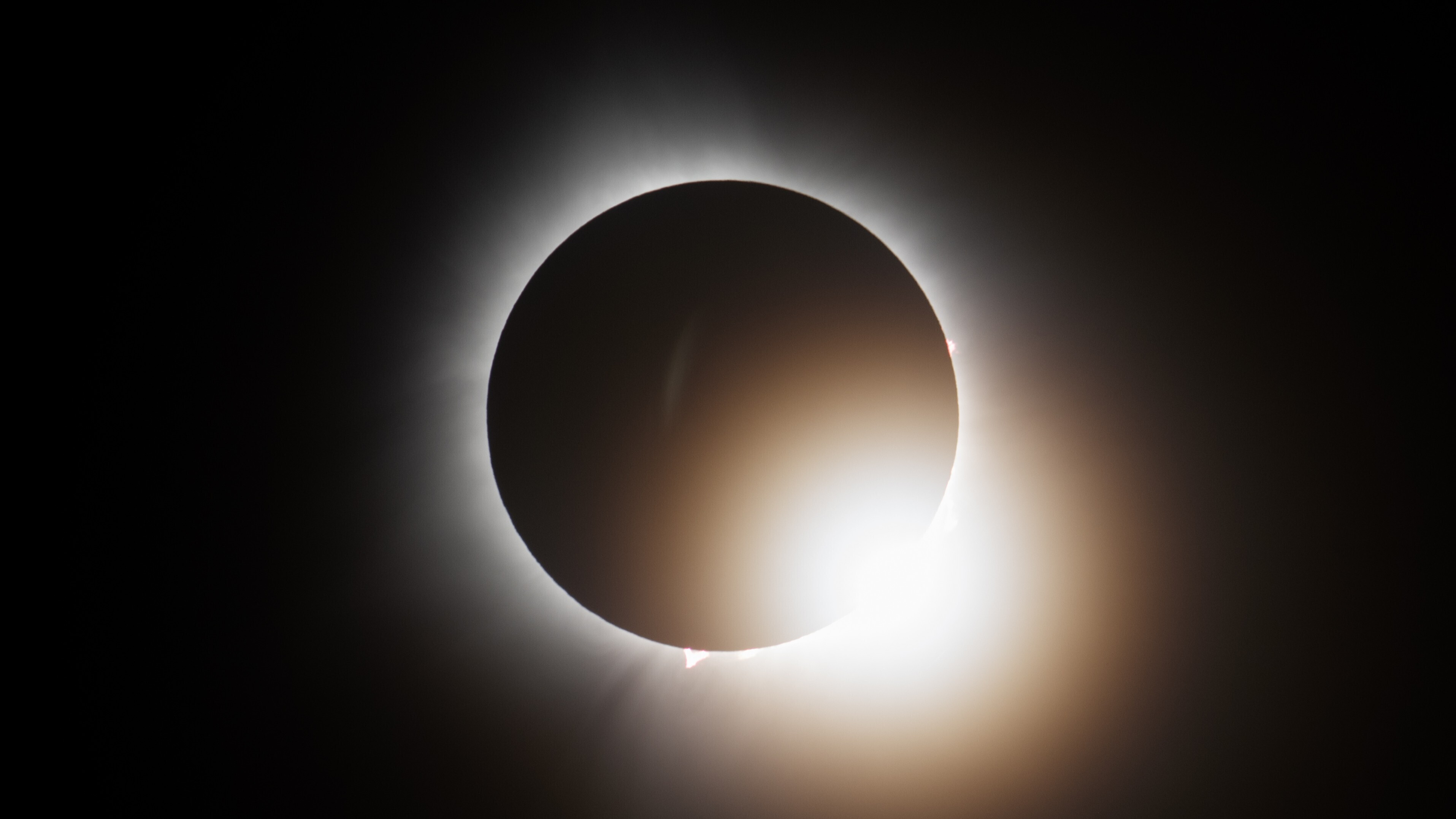
Everything to know about this week's solar eclipse : Short Wave
During a total solar eclipse the world around you is very different. The sun gets totally blotted out and suddenly, it feels like night time. The temperature drops. Birds stop singing. These surreal celestial events happen every year or so around the globe – including tomorrow. To get you prepped, we’re talking to eclipse chasers about what makes these few minutes of darkness worthwhile and break down how to view an eclipse. That includes using special specs, so we’re linking the American Astronomical Society’s list of trustworthy eclipse glasses. To nerd out even more, check out NASA’s eclipse website.Interested in more space news? Email us your question at shortwave@npr.org and we may cover it in an upcoming segment.Support public media with NPR+ and enjoy perks for over 25 podcasts like this one. This show’s perks include sponsor-free listening. Learn more at plus.npr.org.
HOME | Unlock Astrology
Unlock Astrology with Sam Reynolds, professional astrologer making astrology practical, insightful, and easy to understand.

Keynote: Towards Modular Open Science with @row1.ca and @matsulab.com - ATmosphereConf 2026
The Astrosky Ecosystem
We're building social media tools for the astronomy & space science communities. From feeds to hosting, we're billionaire-proofing scientific discussion for good.
The Astrosky Ecosystem: An independent online platform for science communication and social networking
While almost everything that astronomers study occurs in the vacuum of space, astronomy itself does not `happen in a vacuum'. Interactions between scientists, as well as outreach to members of the public, improve extensively from access to good communication tools. Social media has become a key tool for communication in astronomy, being widely used by individuals and organizations alike for networking, outreach, and more. However, traditional social media is reliant on benevolent corporations providing a free service without compromising on quality, and the recent takeover and decline of Twitter has shown how vulnerable these platforms can be. In this proceeding, we present The Astrosky Ecosystem, which is an initiative to develop open-source tools and integrations for social media, principally the Bluesky social network. We explain how our project enables the astronomy community to operate its own social media infrastructure, independent of for-profit corporations. We also discuss some of the project's technical aspects, including its use of the AT Protocol for social networking, before concluding with ideas for the future.
Sunsetting Atom
We are archiving Atom and all projects under the Atom organization for an official sunset on December 15, 2022.
Sunsetting Atom
We are archiving Atom and all projects under the Atom organization for an official sunset on December 15, 2022.
Pages now have support for showing links to @semble.so, @bookhive.buzz, @teal.fm (via a 3rd party frontend) and @rocksky.app. Looking into adding support for standard calendar lexicons soon.
Just released the first alpha of Stargraph featuring the frontend that brings your Atmosphere profiles together. Share your presence in one link or QR code. stargraph.link

