


Anthropic has signed the EU AI Act's Article 50(2) Code of Practice on Transparency of AI-Generated Content, as a provider of both generative AI models and generative AI systems. This article describes how we’re planning to put those commitments into practice, how marking works, and what its limitations are. We’ll update this article and publish more detailed technical guidance as it becomes available.
Code of Practice on Transparency of AI-generated Content
This code of practice supports compliance with the AI Act transparency obligations related to marking and labelling of AI-generated content.
EU Icons for labelling AI-generated content
Deployers of generative AI systems can use the EU set of icons to label certain AI-generated content, in accordance with the AI Act transparency rules.
How Claude's text watermarking works
Future Claude models will generate text that contains a watermark. This is a way of determining the likelihood that Claude was involved in writing the text, and we, along with several other major AI providers, are implementing this change to comply with the EU AI Act. In this article, we share answers to some of the questions we’ve received about how our chosen watermarking method works, whether it affects Claude’s outputs, and why we’re making this change.
The Omg Lol Times · We have to talk about AI “art”
Note: In this post I’m going to use the term “AI” as a lazy shorthand for “generative content creation via large-scale pre-trained models” because time is tight and I’ve got arthritis. I know it’s not really “AI”, but please, let me give my typing fingers a break here.
EU Artificial Intelligence Act | Up-to-date developments and analyses of the EU AI Act
Browse the full AI Act text online. Search within the Act for parts which are relevant to you.
Google Search's guidance about AI-generated content | Google Search Central Blog | Google for Developers
In this post, we'll share more about how AI-generated content fits into our long-standing approach to show helpful content to people on Search.

My AI Content Journey
I apologize ahead of time, what follows has no tooling applied to it. No grammar checks, no AI, and...

Is there something it is like to be an AI?
Posted on Wednesday 2 Jul 2025. 1,593 words, 6 links. By Matt Webb.

The Myth of the Instant Cake Mix
How to think about creative tooling in the new world of generative AI

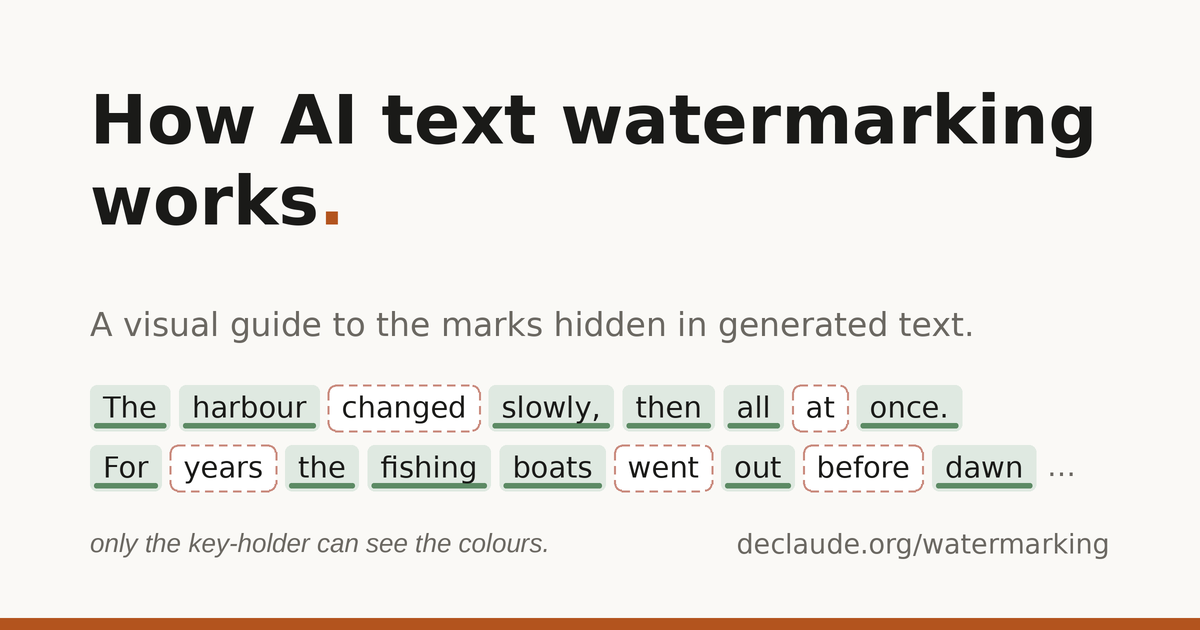
How AI text watermarking works
A gentle visual guide to how a statistical mark hides inside generated text, and what erases it.
Really, you made this without AI? Prove it
The quest to find the ‘Fair Trade’ logo for human-made content.

Ars Technica's policy on generative AI
How Ars Technica uses, and doesn't use, generative AI.
Content Signals
An up-to-date guide to the IETF's proposed new AI Preferences (aipref): a new way for website publishers to control how automated systems use their content.
Generative artificial intelligence: The Times and Sunday Times editorial guidelines
As we explore the potential of generative artificial intelligence our commitment is to uphold our high editorial standards.