


Explore how we’re demonstrating support for fundamental human rights and the dignity of workers
Google and Amazon: Acknowledged Risks, and Ignored Responsibilities
In late 2024, we urged Google and Amazon to honor their human rights commitments. Since then, a stream of additional reporting has reinforced that our concerns were well-founded. Yet despite mounting

principles
Contemporary permaculture is founded on three core ethics: Earth Care, People Care, and Fair Share. These ethics serve as a guiding compass for its design principles, co-creating a holistic framework for regenerative living. Similarly, permacomputing is built upon 10 principles that encourage and raise awareness about more sustainable digital practices.
AI and the Dangerous Fiction of ‘All Lawful Use’
Dunstan Allison-Hope and Iain Levine argue that human rights commitments are essential for all companies selling their products to governments worldwide.

From Territorial to Functional Sovereignty: The Case of Amazon
Economists tend to characterize the scope of regulation as a simple matter of expanding or contracting state power. But a political economy perspective emphasizes that social relations abhor a power…

Steward Ownership, Sustainability, and Capitalism: Part 1
Human Rights | Bridge EU
Bridge EU aims to provide strategic support to bridge the gap between recent social and human rights challenges and policies across Europe.
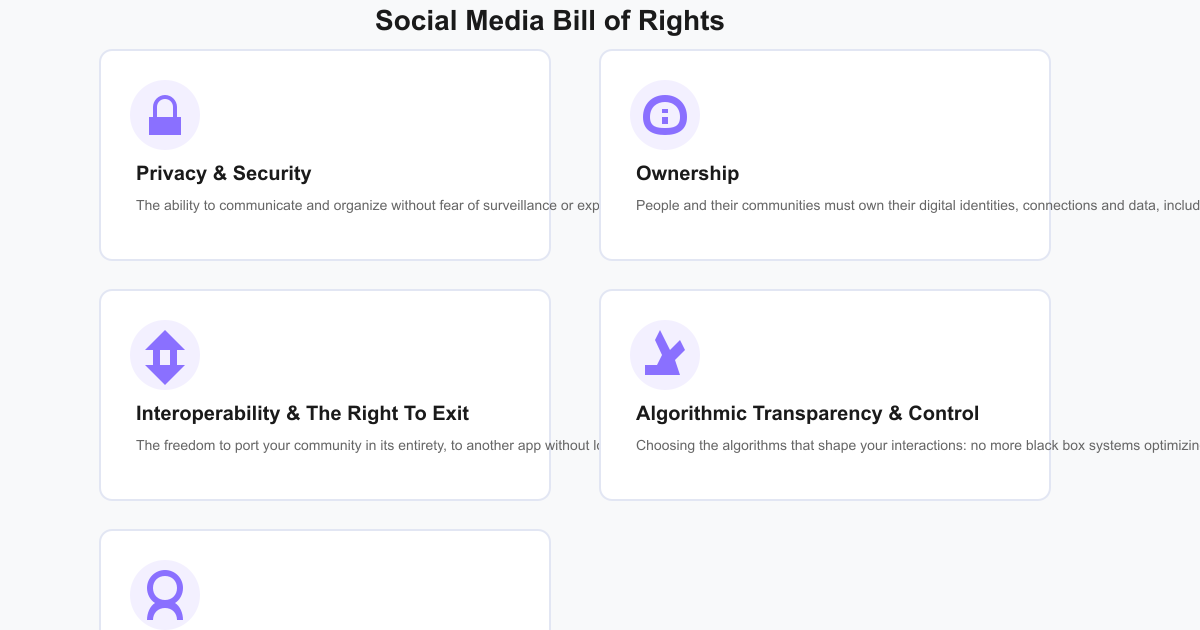
Declaration of Social Media Rights
Five fundamental rights we need for a free, open, and humane social media ecosystem
'Technology Freedom Cooperative' To Build Infrastructure for Human Rights and Justice Groups
A conversation with Maheen Khan, director of technology at the Invisible Institute, and Patrick Ball, director of research at HRDAG.

Why Amazon Has No Profits (And Why It Works) | Andreessen Horowitz
Amazon has a tendency to polarize people. On one hand, there is the ruthless, relentless, ferociously efficient company that’s building the Sears Roebuck of the 21st Century. But on the other, there is the fact that almost 20 years after it was launched, it has yet to report a meaningful profit. This chart captures the...

Deep Response: An Emergency Education in Post-Consumer Praxis
You see the climate destabilization, biodiversity loss, resource scarcity, toxic bioaccumulation, and climate injustice happening all around us. You aren't the type to bury your head in the sand or shrug it off and so you roll up your sleeves. But where to start? How to ensure your work doesn't...

Calling for Ethical AI that Empowers Women and Protects Human Dignity
30 October 2024: Women4Ethical AI platform

Social Influence and Action — Jen Christiansen
I’m wary of climate solutions that are hyper focused on the action of individuals as opposed to systems and corporations. Do you experience carbon footprint guilt every time you board a plane to visit family too? Well, that whole schema was a product of the PR firm Ogilvy & Mather for British Petroleum. It was an effort to shift focus away from oil companies and onto individual responsibility to lower greenhouse gas emissions. For more, read “The carbon footprint sham” by Mark Kaufman for Mashable in 2021, and “Big oil coined ‘carbon footprints’ to blame us for their greed. Keep them on the hook” by Rebecca Solnit for The Guardian.

Reflections on Anthropic and EA
Personal reflections I've been sitting on lately.

Culturalizing sustainability
Policy-makers and scientists dominate high-level sustainability debates but any decision that follows has consequences for ordinary people in their local communities and environments. We asked experts to reflect on the importance of embracing a culturally informed, bottom-up approach to the sustainability discourse and action.

HRW warns right to protest ’under attack’ in UK
Human Rights Watch says the UK has “severely restricted the right to protest” and is expanding repressive measures against peaceful demonstrators.
