

You can’t write serious applications in vanilla JavaScript without hitting a complexity wall. But a compiler can do it for you.
Do Frameworks Matter Anymore?
I'm not trying to be facetious. I want to really want consider whether or not, in 2026, in the age of vibe coding, agentic programming, loop or graph or whatever diagrammatic metaphor-based engineering is most popular, does it matters what web framework you use? More importantly (to me and my particular interests), and at the risk of Betteridge-ing myself: should we make new frameworks?
How it feels to learn JavaScript in 2016 | HackerNoon
<em>No </em><a href="https://hackernoon.com/tagged/javascript" target="_blank"><em>JavaScript</em></a><em> frameworks were created during the writing of this article.</em>
JavaScript Frameworks - Heading into 2026
I suppose after three years, we can consider my review of JavaScript Frameworks an annual event now....

Stop learning frameworks
We are developers. We need to stay up to date with technology. Every day, we learn programming languages, frameworks, and libraries. The more modern tools we know — the better. Keeping up to date with Angular, React, Vue, Riot, Ember, Knockout is fun. But we are wasting our time.
Fresh - The simple, approachable, productive web framework.
Fresh features just-in-time edge rendering, island based interactivity, and zero-configuration TypeScript support. Fast to write; fast to run.
Everything you need to know about: Svelte
Everything you need to know about the world’s most loved JS framework

The many, many, many JavaScript runtimes of the last decade
This last decade has seen an inundation of new JavaScript runtimes (and engines in equal measure), enabling us to run JavaScript in all manner of contexts...

Introducing Bare: Actually run Javascript Everywhere - Pears
The Holepunch team has introduced Bare, a groundbreaking minimal JavaScript runtime designed for both desktop and mobile. Built to be fast, modular, and efficient, Bare revisits the original vision of Node.js by embracing modularity and universal compatibility.

A brief history of JavaScript | Deno
In 30 years, JavaScript went from being a little scripting language to one of the world's most popular. Here are key moments to show how it has evolved and where it is headed.
I Built the Same App 10 Times: Evaluating Frameworks for Mobile Performance | Loren Stewart
I needed to choose a framework for a mobile-first app at work. I started comparing Next.js, SolidStart, and SvelteKit, then expanded to 10 frameworks. The measurements revealed dramatic differences in bundle sizes, performance, and the real cost of framework choices.
The Cost of Frameworks
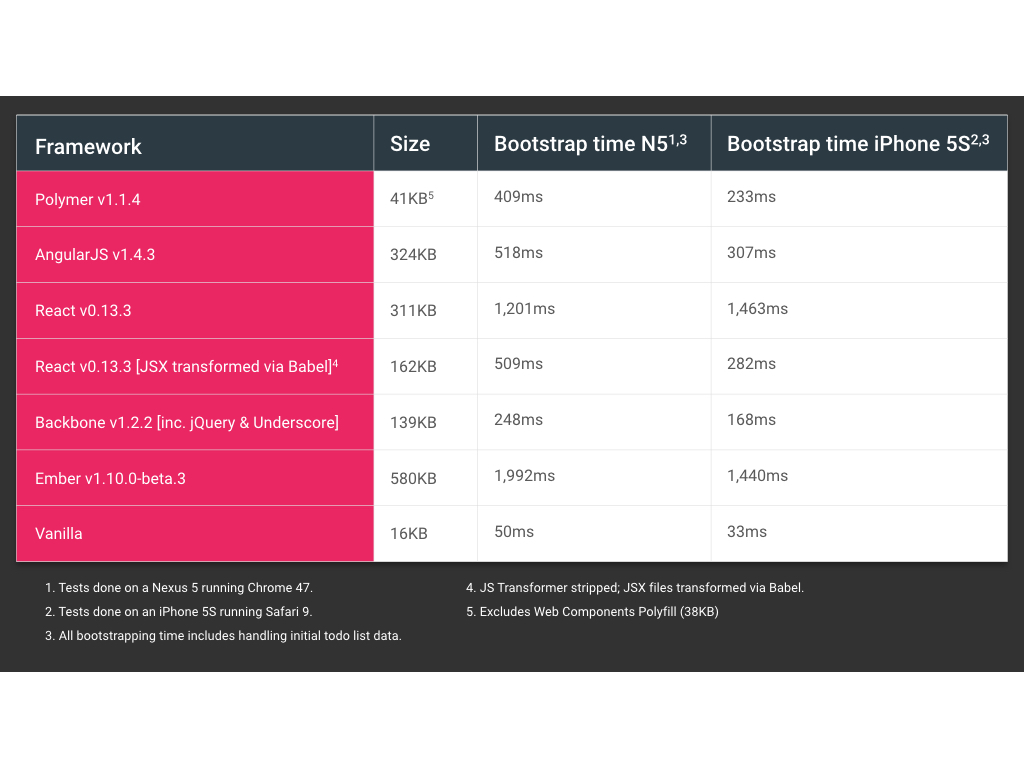
I recently delivered a talk at FFConf in Brighton, called "You should use <insert library / framework here>, it's the bestestest!". I wanted to do a write-up of the presentation's content here, hopefully so it can start a broader conversation that I think we need to have, mainly around the cost of modern frameworks on mobile devices.

Component Party
Compare JavaScript frameworks side-by-side: React, Vue, Angular, Svelte, Solid.js, and more. See syntax differences, features, and code examples for web development frameworks.

JavaScript With Syntax For Types.
TypeScript extends JavaScript by adding types to the language. TypeScript speeds up your development experience by catching errors and providing fixes before you even run your code.
Writing a Web-based Editor from Scratch
At some point a while back I decided that I was going to write the front end of Weaver in Rust. I'd looked through the various 'fullstack' web application frameworks kicking around, and while they still had a ways to go, they seemed complete enough. Plus I wanted to write a semi-custom Markdown parser and renderer, to support features I wanted to exist in Weaver, like atproto record embeds, dual-column mode, and resizable images, and since I also wanted it to be fast, that meant that at least a portion of the front-end codebase would be in Rust, and Javascript-Rust FFI wasn't something I had dealt with a lot yet.
Frontend Minimalism in Action: Do More With Less JavaScript | Peter Kröner | webinale Berlin 2026