

The left chart tiers authors by actual follower count (at analysis time). The right chart tiers authors by median likes per post — a proxy for effective reach. Interesting divergence: under the follower definition, medium-size accounts show no 4-img penalty; under median-engagement, the pattern is different.
sweetbeex/bsky-photo-number-analyses
Statistical analysis of Bluesky posts, before app changed multi-photo presentation from grids to carousels. Looking specifically at image count vs post engagement on posts with images of people.
Bluesky Analytics
Engagement analytics for Bluesky accounts. See which posts resonated most.
Bluesky Counter (Free Bluesky Analytics) – Marc Köhlbrugge
Marc Köhlbrugge's Bluesky profile stats and follower analytics
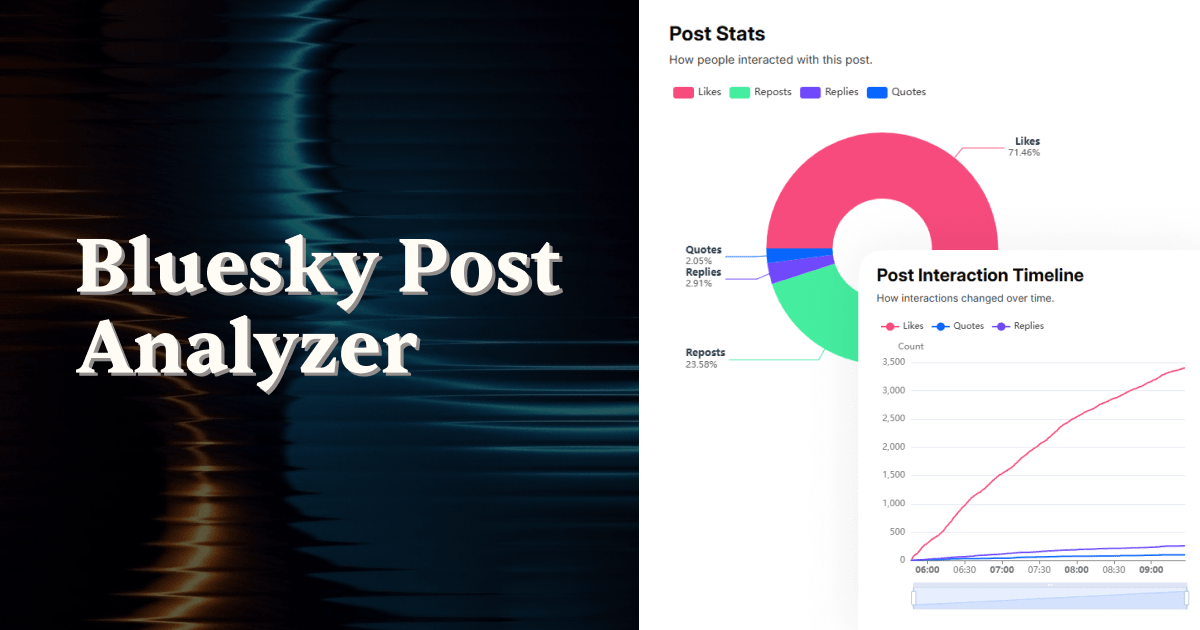
Bluesky Post Analyzer
Analyze Bluesky posts with detailed stats - track likes, reposts, replies, and quotes. View engagement timelines, user interactions, and performance metrics.
Bluesky Analytics — Track Any Account, Free | GraphTracks
Bluesky analytics for creators and brands. Track followers, likes, reposts, replies, quotes, mentions and unfollows, see who engages with you, and compare any two accounts. Public stats for any Bluesky profile, no signup.

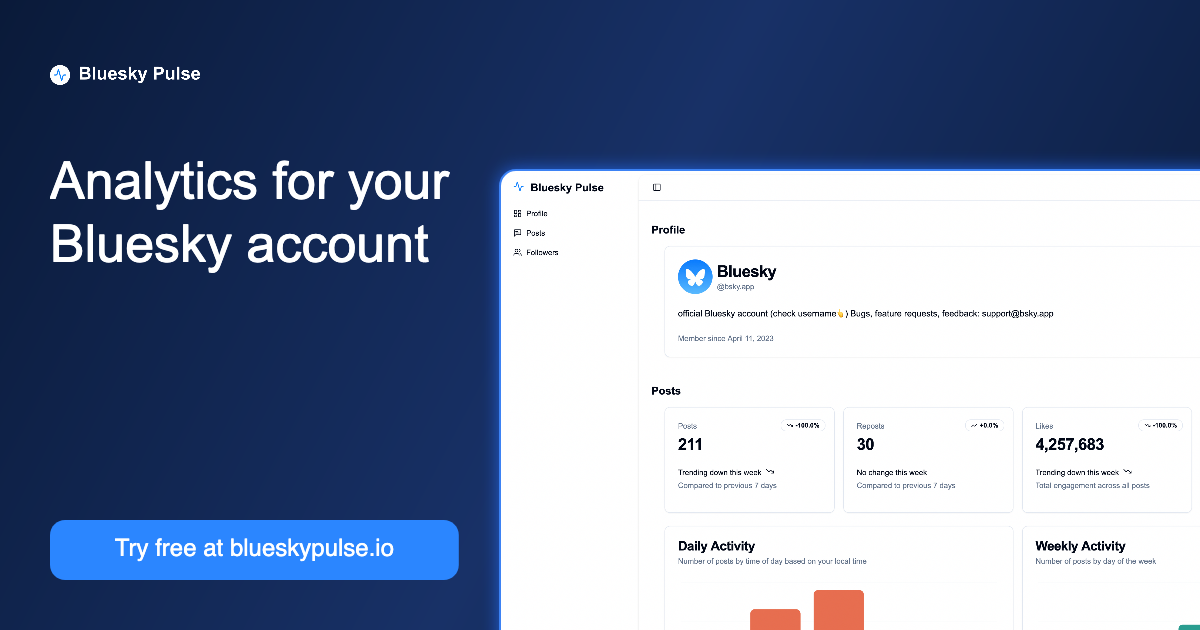
Bluesky Pulse - Analytics for Your Bluesky Account
Get detailed insights about your Bluesky posts, followers, and engagement. Analyze your presence with comprehensive analytics.
Value misalignment in X’s feed algorithm is a reflection of value tensions in engagement
Social media feed algorithms rank content that is purported to be preferred by users, but the engagement behaviors that drive these algorithms are (at best) indirect proxies for users’ explicitly self-stated values. Are the resulting feeds value aligned, and if not, why? We investigate this question by annotating the basic human values expressed in participants’ X (Twitter) feeds (N = 715 US users), analyzing the relationship between the posts’ value expressions and the posts’ amplification in the ranked “For You” Page feed, and then comparing the amplified values to users’ own values. We observe that the inventory of posts from followed accounts reflects users’ self-stated values—but that there is an overall negative correlation (misalignment) between users’ explicit values and the value expressions the algorithm is more likely to amplify. We turn to engagement behavior to understand this misalignment and observe that users’ engagement behaviors can be misaligned with their stated values—likely causing the algorithm to learn and reflect these misaligned values. We also detect partisan differences consistent with this theory: While the algorithm amplifies values negatively correlated with both Democrats’ and Republicans’ self-stated values, they are more misaligned for Democrats. And in fact replying, a heavily weighted form of engagement, is associated with values that are less aligned for both Democrats’ and Republicans’ self-stated values, and is even more misaligned for Democrats. Taken together, these findings offer a glimpse into the tensions between the values that people hold and those that provoke reactions, and how these value tensions can produce misaligned outcomes.

Value misalignment in X’s feed algorithm is a reflection of value tensions in engagement
Social media feed algorithms rank content that is purported to be preferred by users, but the engagement behaviors that drive these algorithms are (at best) indirect proxies for users’ explicitly self-stated values. Are the resulting feeds value aligned, and if not, why? We investigate this question by annotating the basic human values expressed in participants’ X (Twitter) feeds (N = 715 US users), analyzing the relationship between the posts’ value expressions and the posts’ amplification in the ranked “For You” Page feed, and then comparing the amplified values to users’ own values. We observe that the inventory of posts from followed accounts reflects users’ self-stated values—but that there is an overall negative correlation (misalignment) between users’ explicit values and the value expressions the algorithm is more likely to amplify. We turn to engagement behavior to understand this misalignment and observe that users’ engagement behaviors can be misaligned with their stated values—likely causing the algorithm to learn and reflect these misaligned values. We also detect partisan differences consistent with this theory: While the algorithm amplifies values negatively correlated with both Democrats’ and Republicans’ self-stated values, they are more misaligned for Democrats. And in fact replying, a heavily weighted form of engagement, is associated with values that are less aligned for both Democrats’ and Republicans’ self-stated values, and is even more misaligned for Democrats. Taken together, these findings offer a glimpse into the tensions between the values that people hold and those that provoke reactions, and how these value tensions can produce misaligned outcomes.
Social Media Feed Ranking Algorithms: Guide to Field Experiments
IC2S2'26 Tutorial | Social Media Feed Ranking Algorithms: Guide to Field Experiments
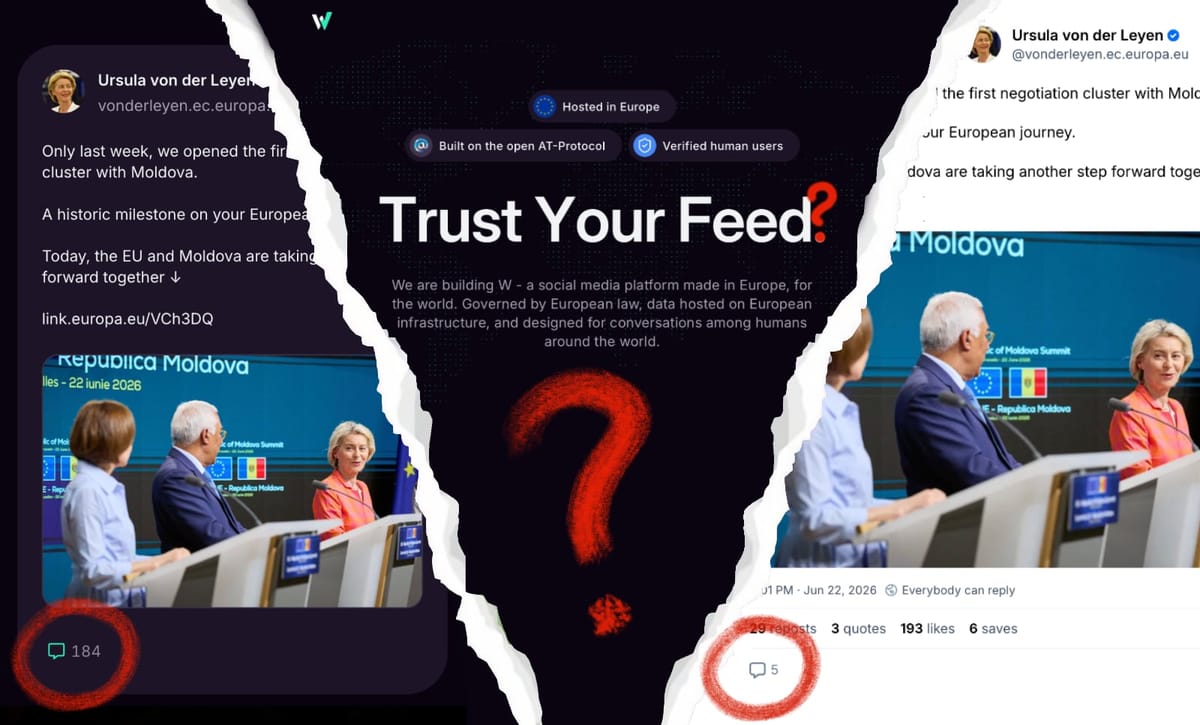
W Social, Fictional Metrics and the Beauty of Open Data
W Social's tagline is "Trust Your Feed" but the company's landing page displays inflated engagement metrics - a misrepresentation that contradicts its own promise.
BlueSky Score
Build credibility with shareable milestone images that highlight your activity and trustworthiness on BlueSky.
Atlas - Engagement-Based Social Graph for Bluesky by Jaz (jaz.bsky.social)
Atlas - Engagement-Based Social Graph for Bluesky by Jaz (jaz.bsky.social)
I analyzed 22k photo posts from 1014 @realnsfw.social creators to determine if the old grid layout was "broken" After controlling for account size, caption length, alt-text use, and time of day, 4-image posts still got ~39% fewer likes than 1-image posts #atdev sweetbeex.github.io/bsky-photo-number-analyses/

♍ Bee 🐝
mmm data
people love the For You feed, and it shows in the numbers. it generates around 4% of post views inside feeds on Bluesky. that's amazing especially because it's operated by one dev, @spacecowboy17.bsky.social given its popularity, we've decided to give it a bump in visibility on the feeds page.
